★★★★★
“job well done good communication throughout the job very clean and tiddy when the job is finish flat roof replacement many thanks.”
Sumit Bal
In Widnes the first thing a gale moves is often the concrete cap on top of the chimney stack. A cap that has shifted is a falling weight above a path, so it is treated as urgent.
Most storm calls from Widnes that involve a chimney are about the very top of the stack rather than the roof beneath it. Across the estate housing of Hough Green, Upton Rocks, Farnworth, Ditton and Halton View, the brick stacks finish only a few courses above the slope, and a good many of them are capped not with mortar but with a precast concrete slab. A gale tests that slab in a way nobody had in mind when it was cast flat in a yard and carried up to the roof.
Widnes sits on the north bank of the Mersey with very little between the town and the estuary, and the prevailing wind comes from the south-west. A cap on a stack in that position is the highest and most exposed thing on the house. Wind alone rarely lifts a heavy slab that is properly bedded. What it does is find a cap whose bed joint has already washed out, so that the slab rocks, creeps towards the edge of the stack, or cracks along a line that was waiting to open.
What follows is about that one component: what a moved or broken cap looks like from the ground, why it cannot be left to see what the weather does next, and how we deal with it. Start at the storm damage roof repairs page for the general picture; the stack itself is covered on our chimney repairs in Widnes page for the town.
The components a gale usually finds first, and the repairs that follow them.
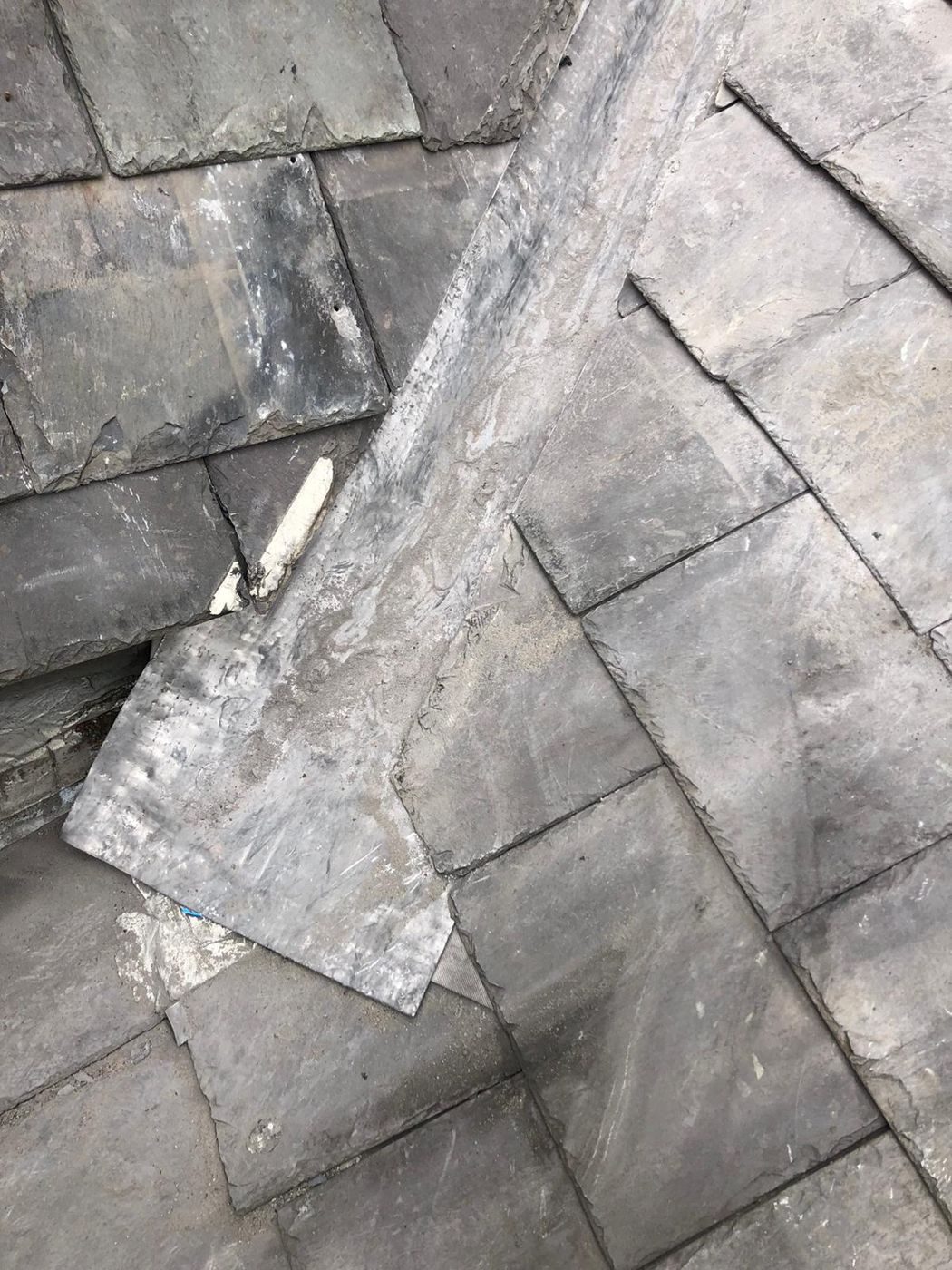
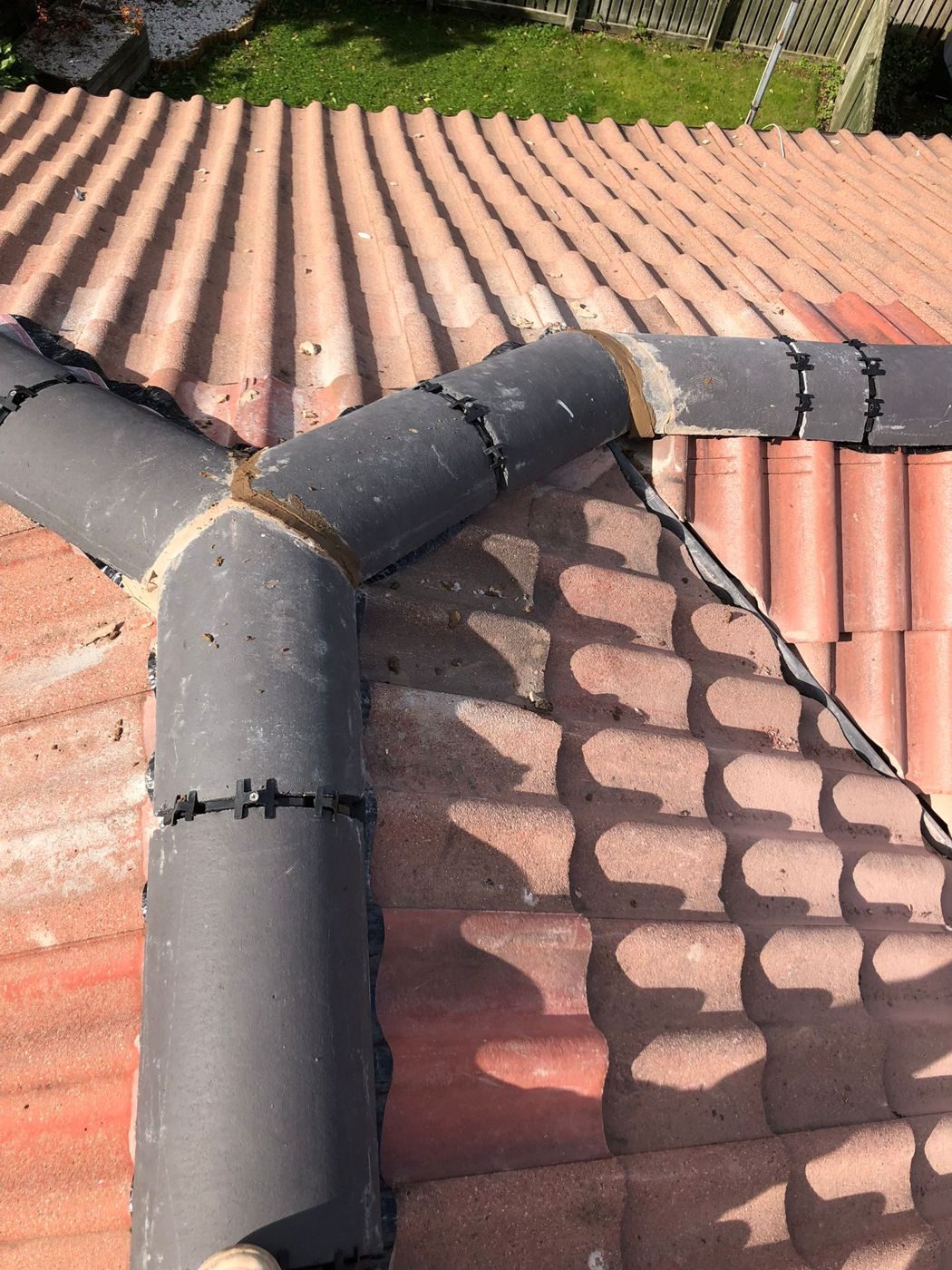
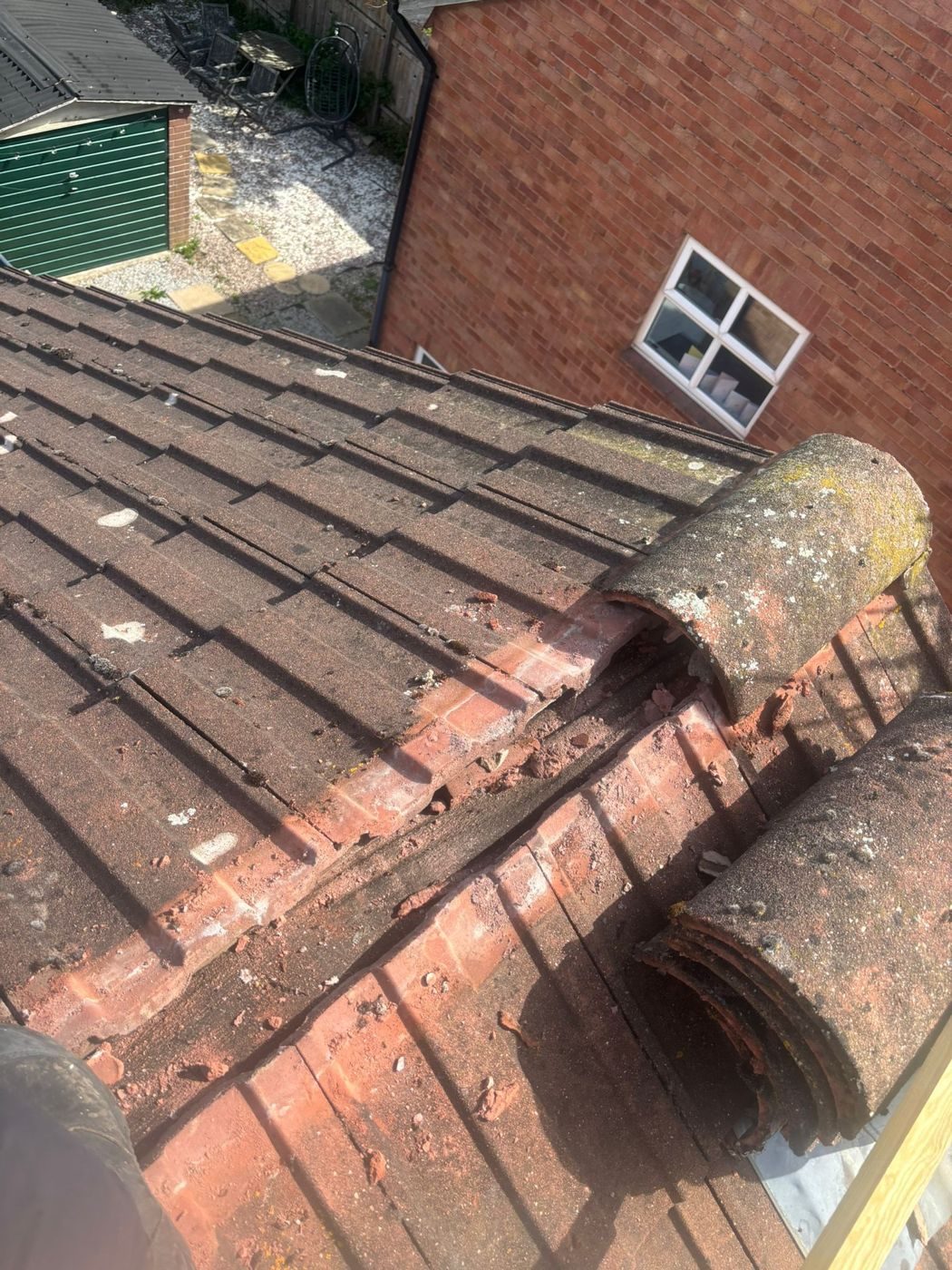
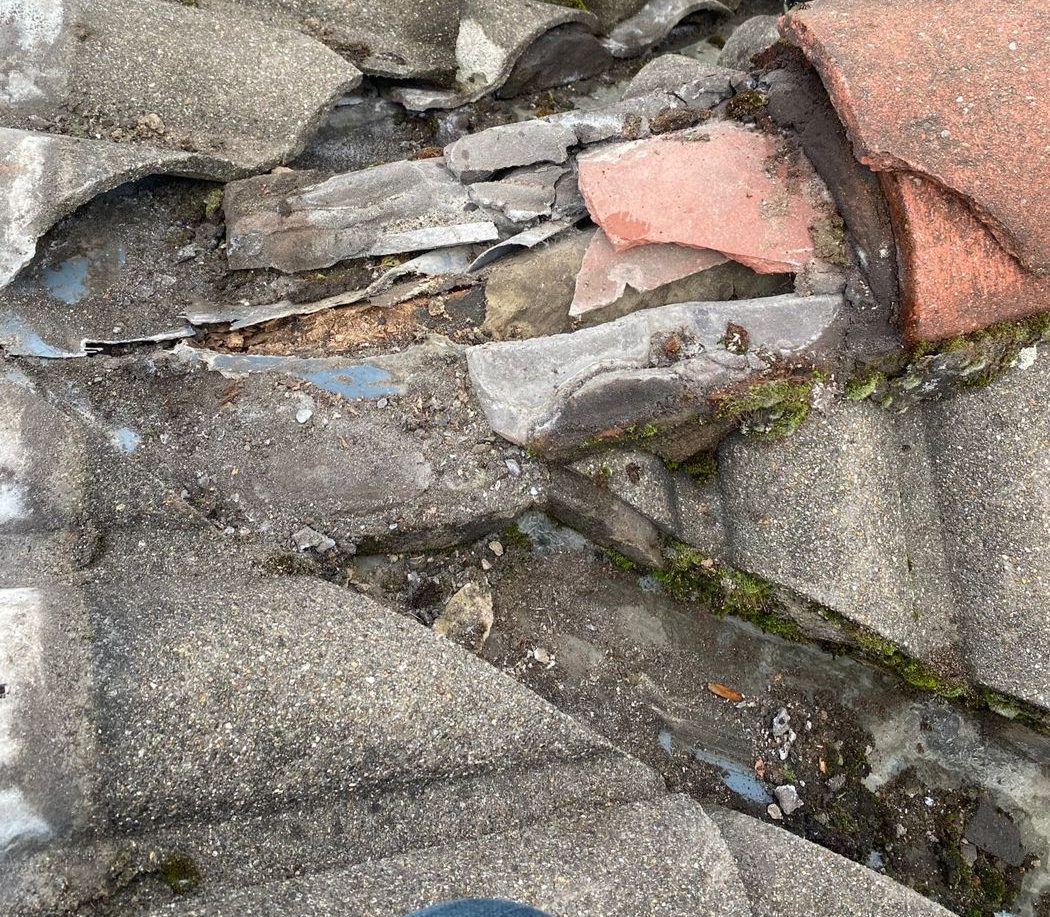
Photographs of our own work. None of them is a storm job — they show the parts that fail and how they are put right. More on the storm damage hub.
Think about what a precast cap is. It is a single rigid plate of concrete, resting on a bed of mortar, at the top of a brick column, above a roof, above a path or a drive. Everything else that fails in a storm is a leak waiting to happen. A cap that has lifted at one edge, slid, or split in two is different, because the first thing it does wrong is fall. It is the weight above the roof that makes it urgent, not the water it lets in.
The failure usually starts quietly. The slab and the brickwork under it expand and contract at different rates, the bed joint opens, and any steel cast into the concrete rusts and swells until the slab cracks from inside. None of that is dramatic. Then a gale arrives and finds a plate that is no longer bonded to the stack, only resting on it. A corner can come away and drop onto the tiles, or the whole cap can tip, and a slab that goes through concrete interlocking tiles does not stop at the first layer.
That is why we treat a shifted cap differently from a cracked ridge tile. A lifted ridge can usually wait for a dry day once the roof is dry inside. A cap that has moved is a hazard to anyone in the garden, the drive or the next-door yard, and a second gust can finish what the first one began. Our first visit is about taking that weight out of play, with the temporary part of the job done before the permanent repair is even priced.
Start from the ground and do not go looking from above. After a gale, look at the top of the stack against the sky and compare it with how it normally sits. A cap that has moved often shows as a change in the line: one edge overhanging further than the other, a visible gap beneath it, or a corner that is simply no longer there. Look at the tiles, the drive and the lawn below for grey fragments, because pieces of concrete tell you the slab has shed something even if you cannot see where from.
Pots, cowls and terminals matter too, because on these estates the flue often ends in a squat terminal set in the cap. If the cap has shifted, the terminal usually has too. A dark gap round the opening that was not there before, or a rust-coloured stain running down the brickwork below, suggests the slab was already failing and the storm has made it worse. Take photographs from the ground before anything is touched, because that record is what a report is built on.
A precast cap is heavy and awkward, with nothing on it to grip, so it cannot be slid down a slope or dropped down a chute. On the estate roofs around Hough Green, Upton Rocks and Halton View there is normally a drive or side gate and room in the garden to stand a scaffold, which means the work can be planned properly. The platform goes up boarded on all sides, set a course or two beneath the head, so that a slab can be lowered on a line or broken up in place with the debris contained.
The older terraces nearer the centre and towards West Bank are less forgiving, with the front wall on the footway. A scaffold there needs a licence from Halton Borough Council and the bay beneath suspended, and we would rather tell you that on the first call than discover it on the day. Scaffolding is quoted separately and in writing. Concrete tiles are brittle at the nibs and do not forgive being walked on, so the stack is reached from the scaffold, never across the slope.
The make-safe comes first and is deliberately modest. If the cap has shifted, we take the loose weight off the stack before it can come down, containing the pieces and lowering them rather than letting them fall. If the roof covering beneath has been struck, we deal with it so that water stays out until the dry weather. We then write the report: photographs from the scaffold, what failed, the state of the bed joint and the top course, and what the permanent repair needs. That is the document your insurer will ask for, and we do not deal with them for you.
The permanent repair depends on what is found underneath. Often the bed joint has washed out and the cap was the only thing holding the top course together, so a replacement means rebuilding that course first. A new cap goes on bedded properly, with the overhang and drip matched and the collar formed in mortar rather than mastic. Where the top courses need attention anyway, we may suggest forming a traditional mortar head instead. Either way, the lead apron and back gutter below are checked before we leave, because a cap and its flashings fail together more often than either fails alone. See also our roof repairs in Widnes page for the roof beneath, and the guide on The Parts of a Roof That Fail in Wind — and Why the Edges Decide a Claim. Why the edges of a roof decide so many claims is set out in The Parts of a Roof That Fail in Wind — and Why the Edges Decide a Claim.
If water is coming in now, ring rather than fill in a form. Weekday emergency call-outs are answered around the clock; weekend cover runs from eight in the morning until seven in the evening. Please do not go up to look: describe what you can see from the ground.
Photograph everything before anybody tidies or moves anything, because that is the evidence. The steps for the hours after a storm are set out in what to do after storm damage to your roof, and the general picture is on our storm damage hub.
What an insurer means by a storm, why wear and tear turns claims down, what belongs in a roofer's report, who pays for the make-safe, and who is who in a claim. The aftermath itself — what to do first, what to check — is covered in detail on our roof repairs section and linked throughout rather than repeated here.
“job well done good communication throughout the job very clean and tiddy when the job is finish flat roof replacement many thanks.”
Sumit Bal“Excellent service from Buddy and the team in installing a new garage roof in a really professional manner. Was kept updated at all stages and given good advice as to our options. Would highly recommend”
Peter Aspinall“Very professional efficient team great communication
Would definitely recommend made the process quick and easy will definitely look to keep for any future need
Thankyou”
Every town has its own page, written around the roofs that are actually there. Start with the main storm damage page.
Describe the roof and roughly where you are, and we will come back to you — usually the same day. If water is coming in now, please call instead.
Prefer to talk? Call 07464 259566 · WhatsApp 0044 7464 259566 · Email Evensbuddy@yahoo.com
We work across Chester, Cheshire and the Wirral from our base at Elton, just north of Chester.
2 Manley View
Elton
Chester
CH2 4QF
Almost all of our work happens at your property rather than here, so please call before travelling.
Monday – Friday — 24hrs — Emergency Call-Outs
Saturday — 8:00 – 19:00
Sunday — 8:00 – 19:00
Weekday emergency call-outs are answered around the clock. Weekend cover is 8:00 to 19:00.