★★★★★
“I had a leak in my vally had a number of roofers to come and take a look couldn’t find the problem Roofline’s solutions fixed the problem first time. Very happy with these guys thank you for the brilliant service”
Michael PriceThe order matters. Make people safe, stop the water where you can from inside, record everything, and stay off the roof — in that order.
A ceiling holding trapped water is heavier than it looks and gives way without warning. If a ceiling is bulging, sagging or dripping from a single point, keep everybody out of that room and shut the door.
Water and electricity together is the other immediate risk. If water is anywhere near a light fitting, a ceiling rose or a consumer unit, turn the power off at the consumer unit for that circuit and leave it off until someone competent has looked.
Outside, look up before you walk out of the front door. A dislodged tile or a cracked chimney pot that has not yet come down is a hazard to anyone underneath it. If something is visibly loose above a path, a drive or a pavement, keep people away from it and say so when you call.
Move what you can out of the way and get something under the drip — a bin rather than a bowl, because you will not be emptying it as often as you think.
If a ceiling is bulging with water and you are confident it is safe to approach from a doorway, piercing it deliberately with a screwdriver, over a bucket, at the lowest point of the bulge, releases the water in a controlled way rather than letting the whole ceiling come down at once. It feels wrong and it is usually the right call. If you are not confident, do not.
Lift carpets and underlay if water is spreading across a floor. Underlay holds water against floorboards for weeks.
Before anything is moved, tidied or repaired, photograph it. Wide shots showing the room and the damage, close-ups of the ceiling, and pictures of anything that has been damaged by the water.
From the ground outside, photograph the roof. Do not go up for a better angle.
Note the date and, if you can, what the weather actually did — a named storm, or the day the wind was at its worst. Insurers ask.
Keep anything that came off the roof. A broken tile, a length of ridge, a piece of lead. It is evidence and it is also useful to us for matching.
Storm damage is normally covered by buildings insurance, and buildings insurance is the freeholder's or the owner's policy rather than a tenant's. If you rent, report it to your landlord or agent and let them deal with the claim.
Two things are worth knowing before you call. Insurers generally cover sudden damage caused by a storm, and generally do not cover gradual deterioration, wear and tear or lack of maintenance — so a roof that was already failing and finally let go in a gale can be argued either way. And most policies expect you to take reasonable steps to prevent further damage, which is what a make-safe is. Emergency work to stop water entering is normally acceptable before an assessor has been; a full permanent repair usually is not, so ask before authorising one.
We are happy to provide a written assessment naming the defect, which is what an insurer actually wants and is more useful than a bare invoice. We are not loss assessors and we will not tell you what your policy covers — that is a conversation with your insurer.
A make-safe comes first: sheeting, temporary fixing, getting the roof closed so it stops doing damage every hour. That is not the repair and it should not be sold to you as one.
The permanent repair follows once the weather has settled and a proper inspection is possible. It is also worth asking, once the immediate work is done, whether the storm caused the damage or found it. Those are different situations. A tile broken by something striking it is bad luck. Three tiles gone on a roof whose fixings have been going for a decade is a covering telling you where it is up to.
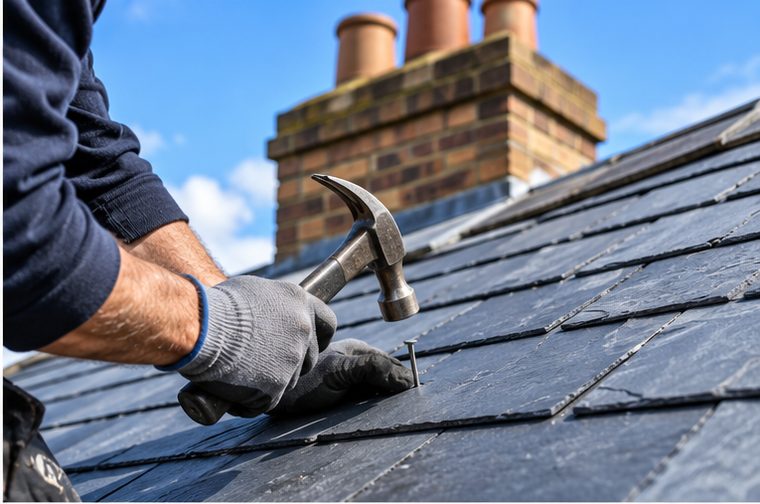
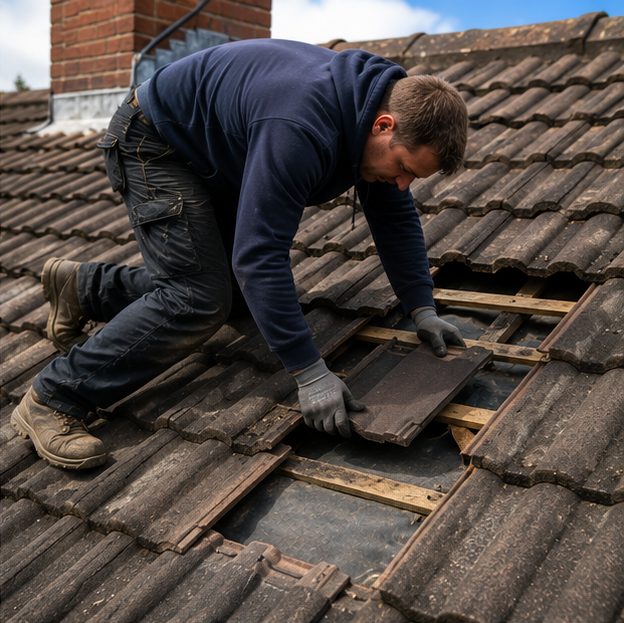
Do not go up on the roof. Not to look, not to put a tarpaulin on, not to take a better photograph. Roof work in the aftermath of a storm involves wet surfaces, loose material and often more wind coming, and it is the single most dangerous thing a homeowner is tempted to do all year.
Do not accept a knock at the door. Storm chasing is a real and well-documented problem: a van appears in a damaged street, someone tells you your roof is dangerous, and there is pressure to agree to work on the spot. Take a name and a business address, get it in writing, and phone a firm you have looked up rather than one that found you.
The rest of the series, on the questions people ask most.
Every town has its own page, written around what the roofs there are actually like. Start with the main roof repairs page.
“I had a leak in my vally had a number of roofers to come and take a look couldn’t find the problem Roofline’s solutions fixed the problem first time. Very happy with these guys thank you for the brilliant service”
Michael Price“Excellent work replacing ridge tiles, repointing chimney and repairing flashing. Also fixed other broken tiles. Clean and tidy job. Would definitely recommend.”
Neil“Highly recommend. Very quick and efficient. Great communication. Went above and beyond to work the weekend to complete the work that needed to be done. Very happy with the results.”
Karen JonesDescribe what is happening and roughly where you are, and we will come back to you — usually the same day. If water is coming in now, please call instead.
Prefer to talk? Call 07464 259566 · WhatsApp 0044 7464 259566 · Email Evensbuddy@yahoo.com
We cover Chester, Cheshire, the Wirral and Flintshire from Elton, just north of Chester.
2 Manley View
Elton
Chester
CH2 4QF
Almost all of our work happens at your property rather than here, so please call before travelling.
Monday – Friday — 24hrs — Emergency Call-Outs
Saturday — 8:00 – 19:00
Sunday — 8:00 – 19:00
Weekday emergency call-outs are answered around the clock. Weekend cover is 8:00 to 19:00.