★★★★★
“job well done good communication throughout the job very clean and tiddy when the job is finish flat roof replacement many thanks.”
Sumit Bal
Newer Warrington roofs fail differently from old ones: a clip lets go, an end cap goes, a moulded stack shifts. Here is what wind does to modern roofing, and how we make it safe and put it right.
A gale does not need mortar to cause trouble. Across the estates at Birchwood, Westbrook, Chapelford and Great Sankey, the ridge, the verge and the chimney are mostly held on by plastic clips, screws, straps and sealant, and those are the things that give way when the wind gets underneath. The failure looks different from the crumbling mortar on an old terrace, but the cause is the one described on our storm damage roof repairs page: air lifts at an edge and works inward.
That difference changes what you should expect to find. There are rarely lumps of mortar on the path. Instead you may see a pale plastic cap on the lawn, a length of ridge section hanging off its fixings, or a gap in the line of the verge where a unit has unclipped and the rest of the run is loose behind it. A stack that looks like brick may have shifted slightly on its base without a single brick moving, because it was never brick.
Older Warrington streets at Latchford, Bewsey and the village centres have their own storm story, and it is covered on our roof repairs in Warrington page. This page is about the newer stock, where roofs are young enough that people assume nothing can have gone wrong. A modern roof is not weaker than an old one. It simply fails at its fixings, and a fixing that has let go is quiet, hard to see from the road and easy to dismiss.
The components a gale usually finds first, and the repairs that follow them.
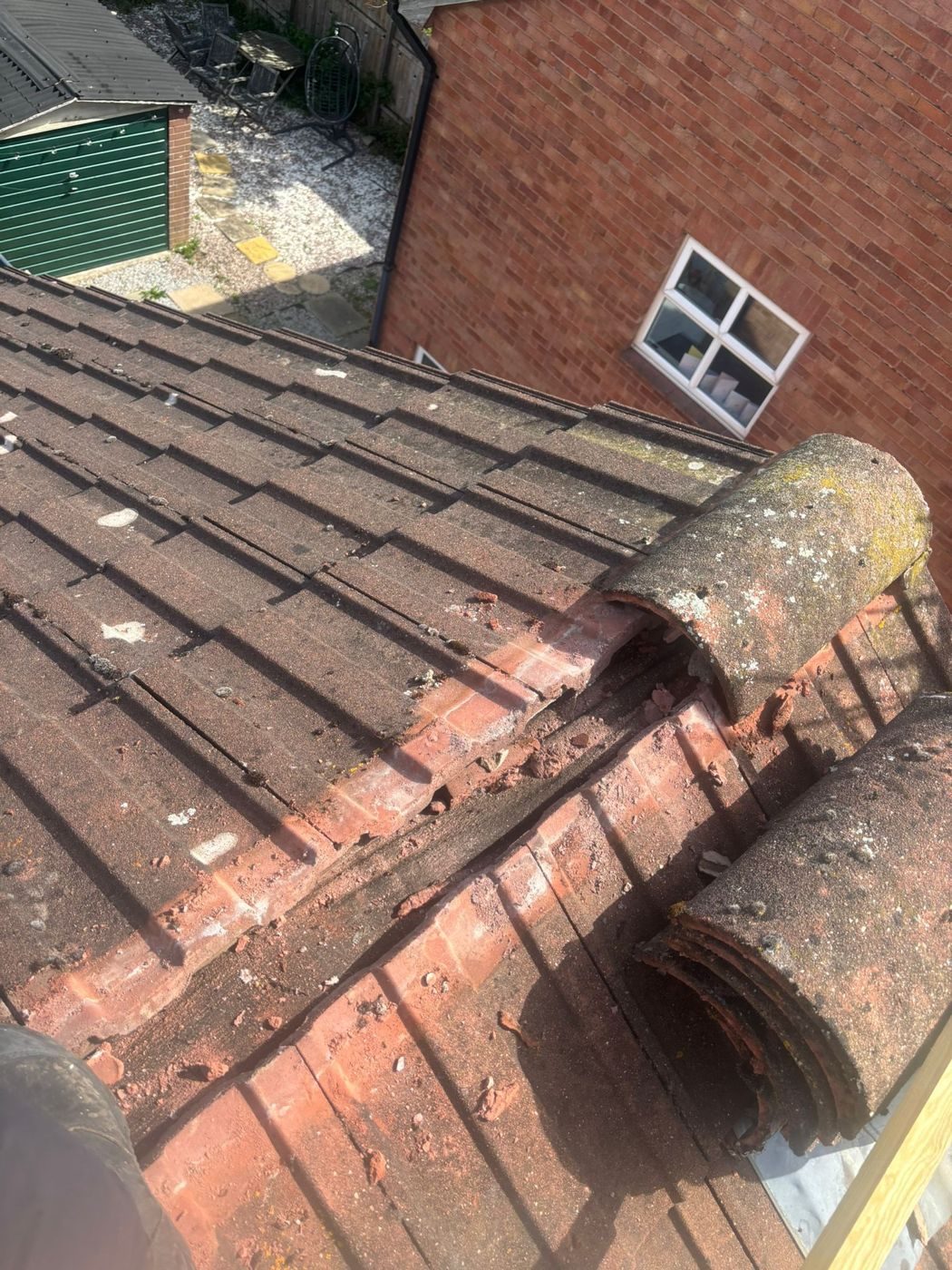
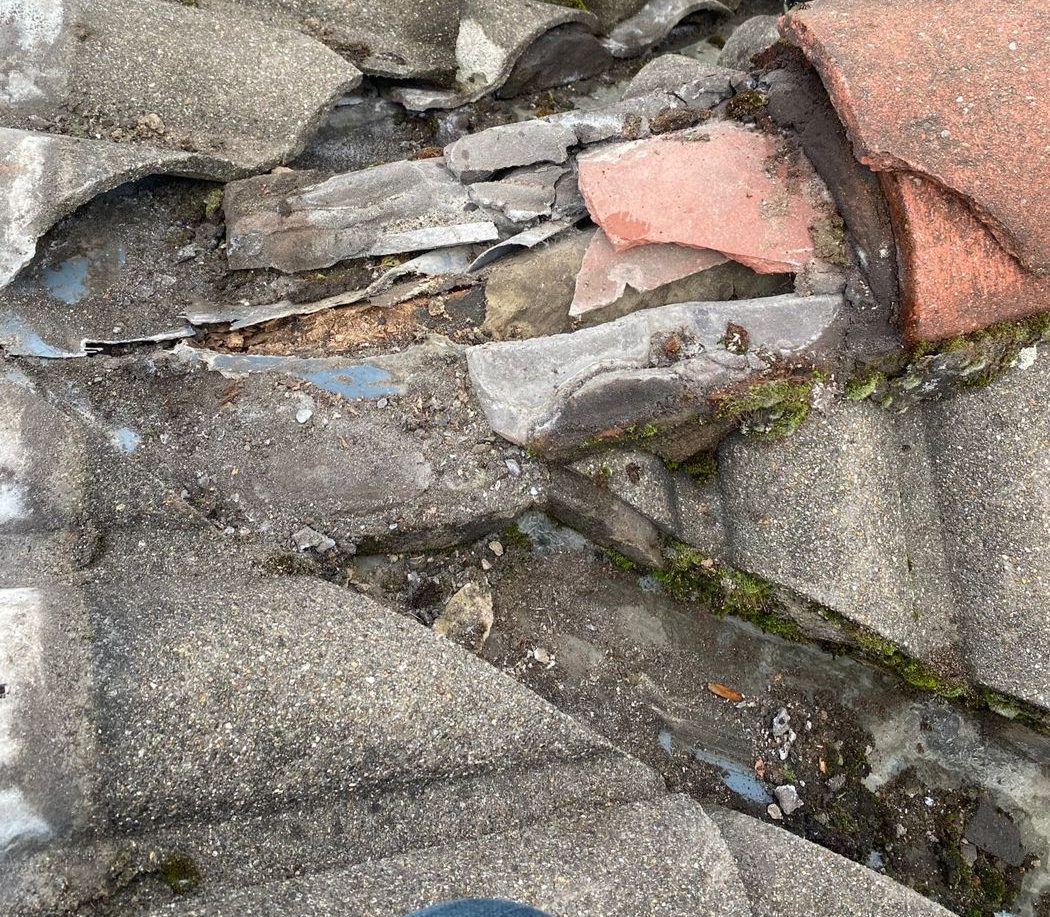
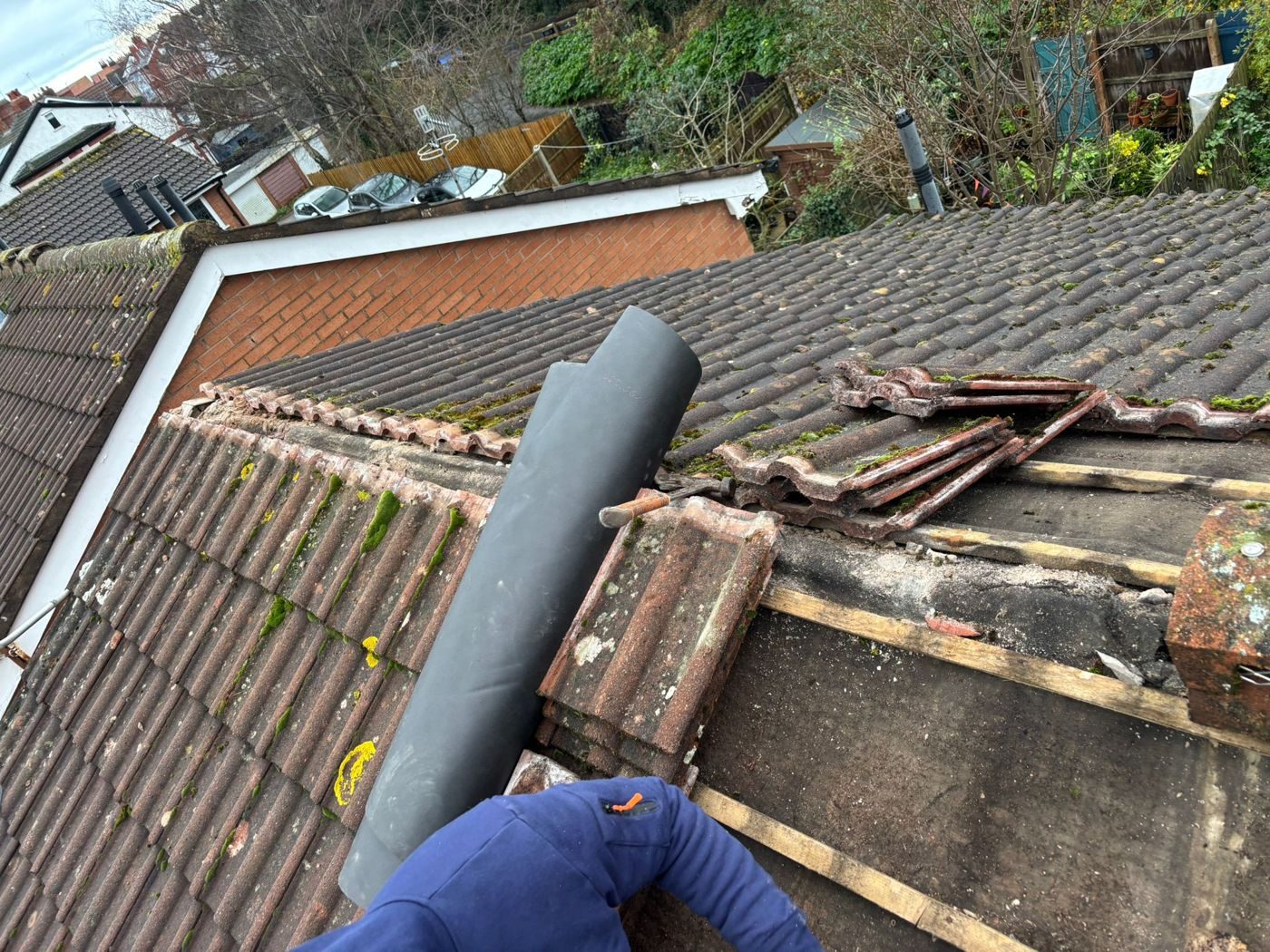
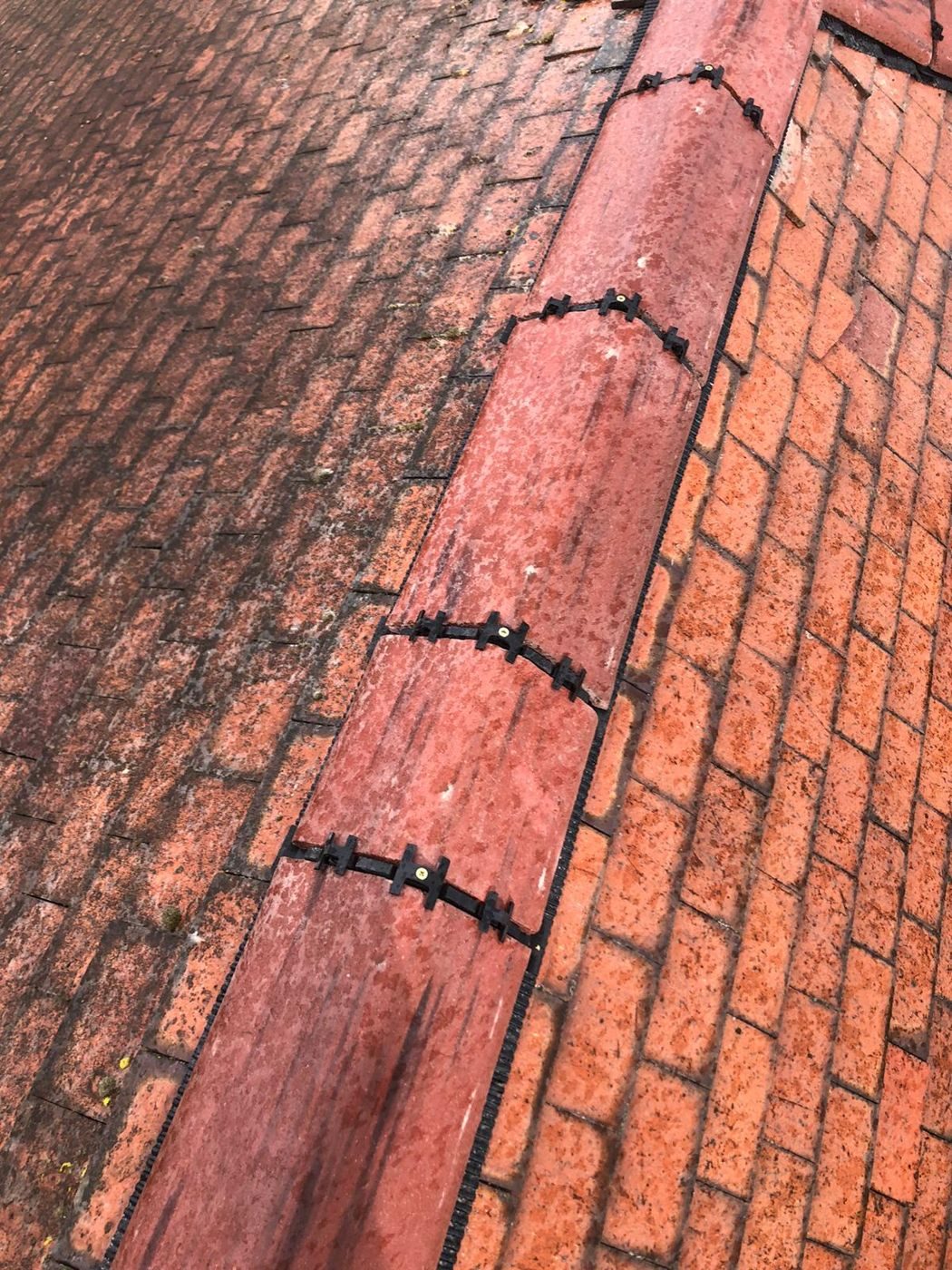
Photographs of our own work. None of them is a storm job — they show the parts that fail and how they are put right. More on the storm damage hub.
Dry-fix systems are a sound way to finish a roof. A dry ridge is a batten-mounted rail with a mechanical fixing under each tile, and a dry verge is a run of plastic or aluminium units clipped to the edge of the gable tiles and screwed through. Wind has nothing to crack. What it does is find the one weak link, which is nearly always an end cap, a joint between two sections, or a clip that was never fully seated. Once a single unit has lifted, the pressure goes into the next one along, and a gale can strip a run in sequence.
Fixings that are only just holding give little warning. Screws in a thin batten can pull out without the head ever moving. Clips go brittle in sunlight and snap when they are flexed, and a cap that was pushed on rather than fixed will blow off whole and land in a neighbour’s garden. Those are the pieces that tend to turn up on the lawn the morning after, and they are worth photographing where they fell before anyone tidies them away, because they show what type of system you have and how it let go.
The same thinking applies to the roof edge generally. A dry verge that has lost a cap leaves the end of every batten exposed to rain, and the repair grows from a handful of clips into a strip of rotten battens if it is left through a wet winter. Our guide to The Parts of a Roof That Fail in Wind — and Why the Edges Decide a Claim explains the order in which wind finds these parts, and on a modern Warrington roof the answer is almost always the dry-fix components first.
Many newer houses have a chimney that is not a chimney. It is a moulded glass-fibre shell strapped to a timber kerb, with an insulated flue pipe running up the inside. From the garden it reads as brick, so owners often report a leaning or loose stack without knowing what they are looking at. The tells are a brick pattern that repeats exactly, joints that are moulded rather than recessed, and a skirt at the base instead of stepped lead let into the courses. Our chimney repairs in Warrington page covers this in more detail.
This matters after a storm because the damage is not the same. A real stack loses pointing, pots and flaunching. A dummy stack loses its straps, its screws or the sealant at its base, and it can shift or be lifted slightly on its kerb. Water then runs down the inside of the moulding rather than into brickwork, and appears at a bedroom ceiling well away from where it came in. Do not lean a ladder on one, and do not treat it as a handhold. It is a light moulding over fresh air.
The newer estates are easy to reach and awkward to stand on. Roads are narrow with cars on both sides, plots are tight and the gap at a gable may be barely wide enough for a scaffold base, so where the platform goes is settled at the survey rather than on the morning. Block paving and resin drives need boarding and sole plates to spread the load, and a platform on a footway or verge needs a licence from Warrington Borough Council.
Tying a scaffold in takes a little more thought on this kind of house, because some modern stock is timber-framed behind a brick skin and ties go where the structure can take them. Scaffolding is quoted separately, and on a low roof or a small edge repair it is often not needed at all, in which case we say so. Please do not go up to look yourself. Call us, describe what you can see from the garden, or send a photograph on WhatsApp.
The make-safe on a dry-fix roof is usually simple and quick. Loose caps and sections are removed or refixed so nothing can come down on a path or a car, an exposed batten end is covered, and a lifted unit that cannot be secured safely is taken off. Then we write the report with photographs from the roof, showing which clips, caps or fixings failed and how, which is the document your insurer asks for. We are roofers, not loss assessors, and we do not deal with insurers.
The permanent repair follows in dry weather. Dry verge and ridge runs are refixed with new clips and screws into sound battens, damaged units are replaced, and the whole run is checked rather than just the section that fell. On a GRP stack the work is fresh fixings, a proper lead or flashing seal at the base instead of another bead of mastic, and a repair or replacement of a cracked section. Free written quotations, and we are fully insured. Whose responsibility a newer roof is can be worth checking first, and Whose Insurance Is It? Flats, Leaseholds and Shared Roofs sets out how shared roofs work.
If water is coming in now, ring rather than fill in a form. Weekday emergency call-outs are answered around the clock; weekend cover runs from eight in the morning until seven in the evening. Please do not go up to look: describe what you can see from the ground.
Photograph everything before anybody tidies or moves anything, because that is the evidence. The steps for the hours after a storm are set out in what to do after storm damage to your roof, and the general picture is on our storm damage hub.
What an insurer means by a storm, why wear and tear turns claims down, what belongs in a roofer's report, who pays for the make-safe, and who is who in a claim. The aftermath itself — what to do first, what to check — is covered in detail on our roof repairs section and linked throughout rather than repeated here.
“job well done good communication throughout the job very clean and tiddy when the job is finish flat roof replacement many thanks.”
Sumit Bal“Excellent service from Buddy and the team in installing a new garage roof in a really professional manner. Was kept updated at all stages and given good advice as to our options. Would highly recommend”
Peter Aspinall“Very professional efficient team great communication
Would definitely recommend made the process quick and easy will definitely look to keep for any future need
Thankyou”
Every town has its own page, written around the roofs that are actually there. Start with the main storm damage page.
Describe the roof and roughly where you are, and we will come back to you — usually the same day. If water is coming in now, please call instead.
Prefer to talk? Call 07464 259566 · WhatsApp 0044 7464 259566 · Email Evensbuddy@yahoo.com
We work across Chester, Cheshire and the Wirral from our base at Elton, just north of Chester.
2 Manley View
Elton
Chester
CH2 4QF
Almost all of our work happens at your property rather than here, so please call before travelling.
Monday – Friday — 24hrs — Emergency Call-Outs
Saturday — 8:00 – 19:00
Sunday — 8:00 – 19:00
Weekday emergency call-outs are answered around the clock. Weekend cover is 8:00 to 19:00.