★★★★★
“I had a leak in my vally had a number of roofers to come and take a look couldn’t find the problem Roofline’s solutions fixed the problem first time. Very happy with these guys thank you for the brilliant service”
Michael PriceNo statute defines a storm, and no two policies define it quite the same way. Here is what an insurer actually tests, in what order, and why proving the weather was bad has never been enough on its own to settle a roof claim.
Most people assume there is a fixed point at which weather becomes a storm — a wind speed, a warning colour, a name on the forecast. There is not. UK home insurance has no legal definition of a storm, no regulator has imposed one, and the courts have not settled on a single test either. Each insurer writes its own definition into the policy booklet, and those definitions are not the same from one company to the next.
What most of them have in common is a combination rather than a single number. Wind is usually the first element, described either in words or as a stated speed. Many definitions then add torrential rain, large hail or heavy snow as alternatives, so that a downpour or a weight of snow can qualify without a gale at all. Some wordings talk instead about weather that is violent or unusual for the area and the time of year, which is vaguer and, in practice, more arguable.
Because they differ, no single gust figure is the threshold, and a number quoted confidently on a forum or in an article may belong to somebody else’s policy rather than yours. The definition that governs your claim is the one printed in your own wording, in the buildings section of the booklet or on the insurer’s portal. It is a five minute job to find it, and it is worth doing before you ring rather than after a letter arrives.
Photograph of our own work.
The Financial Ombudsman Service looks at complaints where a policyholder and an insurer cannot agree, and it has published the approach it takes to storm claims. That approach is the clearest frame a homeowner has, because insurers know it is the one their decision will eventually be measured against. It reduces to three questions, and all three have to be answered yes.
First, were there storm conditions on or around the date claimed — was the weather genuinely extreme, rather than merely unpleasant? Second, is the damage of a type that storm conditions are capable of causing? Third, were those conditions the main cause of the damage? The third question is the one that does the work. Far more roof claims fail there than fail on whether the weather was bad enough.
That structure explains letters that otherwise read as pure obstruction. An insurer can accept the wind was exceptional, accept that ridge tiles do come off in exceptional wind, and still decline — because it believes the ridge came off for a reason that existed before the wind arrived, and the wind merely found it. Which is why a claim is very rarely won by evidence about the weather alone. That argument is the subject of its own page: storm damage or wear and tear.
Storm naming is a public warning convention. The Met Office names a storm when it expects disruption serious enough to be worth warning the country about, and the name exists so that broadcasters and emergency services can all refer to the same weather system. It is not a threshold written into the policy wordings we have read, none of which uses the word “named” in its definition of a storm at all. Your own wording is the one to check.
So the absence of a name proves very little. Weather that lifts a ridge in Chester can pass over the rest of the country without troubling anyone, and a named storm can cross Cheshire and leave nothing behind but a noisy night. Localised gusts, funnelling between buildings and down a valley, and a squall line that lasts ten minutes all do real damage without ever appearing in a headline.
What usually decides the weather question instead is the observed record for the nearest station — Met Office data, or figures an insurer buys from a weather service. Gust speeds, rainfall and snow depth for that postcode and that date get checked as a matter of routine. That cuts both ways. It is what supports a claim where the day really was severe, and it is what quietly undermines one where the date on the form turns out to have been calm.
Which is the practical reason for getting the date right. If the water first showed on a Tuesday but the wind that moved the tiles blew on the Friday before, the Friday is the date of loss and the Tuesday is when it was noticed. Say both, in that order, and say plainly that the roof was not visible from the ground until then.
The second question — is this the sort of damage storm conditions cause — is a technical one, and it is where a competent description of the roof earns its place. Wind damage has a signature. It begins at edges, because edges are where air gets underneath and lifts: the ridge, the verge along the gable, the eaves course, flashings and abutments. It throws debris, usually downwind and usually onto the lawn, the drive or a flat roof below. It takes whole components rather than making a neat hole in the middle of a slope.
Damage that does not fit that signature attracts questions. A leak in the centre of an otherwise undisturbed slope. A slipped slate on the sheltered elevation the wind never reached. A ceiling stain with old dried tide marks around the fresh wet patch. None of those is fatal on its own, but each moves the conversation from the second question to the third, where the argument is about cause rather than weather.
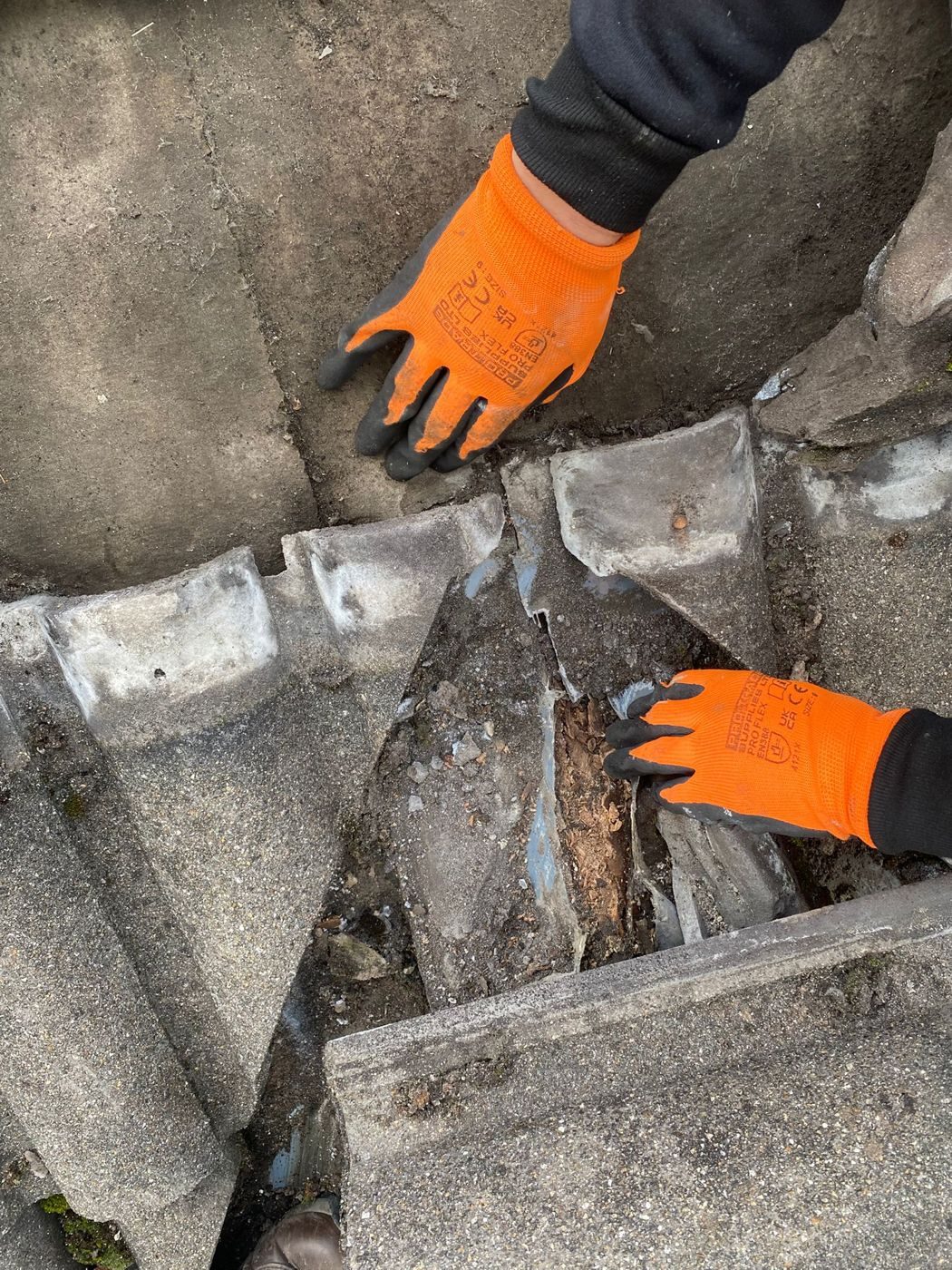
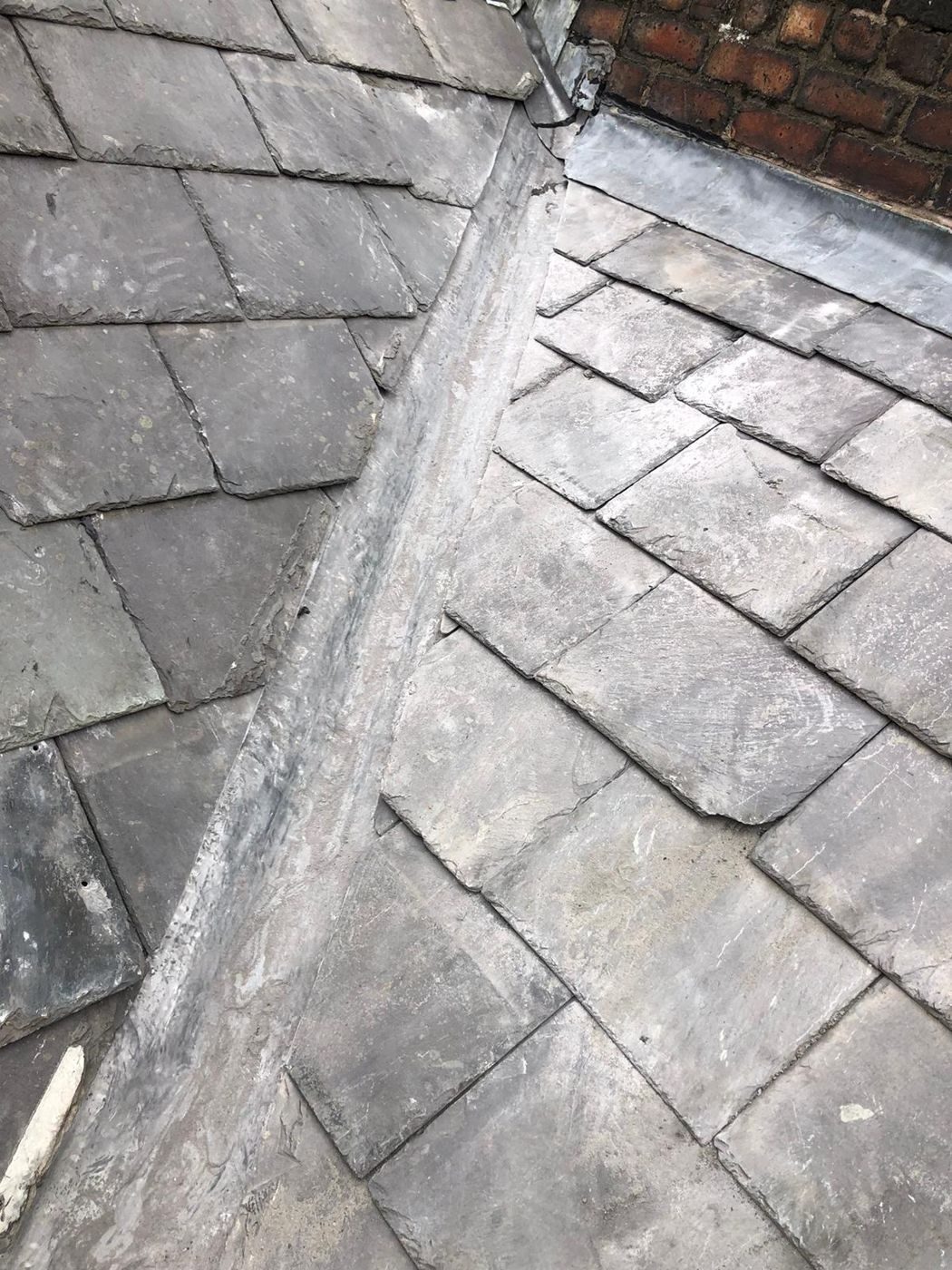
The valley is the clearest illustration, and it is what the photographs on this page show. A valley that has been taking water into the timber beneath it gives nothing away from the ground: the tiles either side sit where they always sat, and the first anybody knows is a wet patch on a bedroom ceiling after a long night of driving rain. Lift the tiles back and the account is written underneath — a lining split along its length, grit and moss packed into the channel, boarding gone soft at the edges. That is not the work of one night, and a claim form that says it was will not survive an inspection.
Leadwork is misjudged more often than anything else on a roof, because a flashing or a valley lining looks passive and inert until it is not. A chase that has opened, a clip that has dropped out, a length of lead lifted and laid back rather than fixed — each behaves in wind exactly like a loose ridge tile. For what the wind reaches first and what it does when it gets there, the roof repairs section covers the damage strong winds cause to a roof component by component.
Photograph of our own work.
Nearly everything useful is gathered in the first day or two, and almost none of it needs anybody to leave the ground. Note the date and roughly the time you first heard or saw something go — the bang, the slate on the patio, the draught in the loft. Write down what the weather was doing in your own words while you still remember it. Take a screenshot of the forecast and of any warning showing for your postcode, because those pages are overwritten within days and the conditions on the date of loss are the first thing anybody will go and check.
Two other things are worth a line here and no more, because they have a page of their own. Keep whatever came down off the roof instead of clearing it away, and make sure the roof is photographed before any temporary covering goes over it. What a record needs to contain to be worth anything, and why a sheeted roof shows an insurer nothing, is set out in what should be in a roofer’s report. Do not go up for a better angle — the ground and an upstairs window are where a homeowner’s photographs come from, and anything that can only be seen from the roof is for somebody with the access equipment to be there safely.
That is the part we provide: photographs taken on the roof and from inside, alongside a written description of which components failed and what condition they were found in. You receive it and you send it on, because we are roofers rather than assessors and will not tell you what your policy covers or how your insurer will read it. The storm damage page sets out how the make-safe and the report fit together, and the roof repairs section’s storm damage roof repairs: what to look for is the fuller list of what tends to show up afterwards.
The other guides in this set. What happens in the hours right after a storm is covered in detail on our roof repairs section, and linked throughout these pages rather than repeated.
Emergency call-outs across all of it, including Chester, Ellesmere Port, Neston, Runcorn, Frodsham, Helsby, Tarvin, Birkenhead, Wallasey, Heswall, Hoylake, West Kirby, Bebington, Deeside, Flint, Widnes, Warrington, Northwich, Winsford and Tarporley.
Start with the main storm damage page, or the town pages on roof repairs.
“I had a leak in my vally had a number of roofers to come and take a look couldn’t find the problem Roofline’s solutions fixed the problem first time. Very happy with these guys thank you for the brilliant service”
Michael Price“Highly recommend. Very quick and efficient. Great communication. Went above and beyond to work the weekend to complete the work that needed to be done. Very happy with the results.”
Karen Jones“Excellent work from the lads at roofline solutions. I had a leak in my valley, they came out and sorted it within a day.”
Chris HollewellDescribe the roof and roughly where you are, and we will come back to you — usually the same day. If water is coming in now, please call instead.
Prefer to talk? Call 07464 259566 · WhatsApp 0044 7464 259566 · Email Evensbuddy@yahoo.com
We cover Chester, Cheshire, the Wirral and Deeside from Elton, just north of Chester.
2 Manley View
Elton
Chester
CH2 4QF
Almost all of our work happens at your property rather than here, so please call before travelling.
Monday – Friday — 24hrs — Emergency Call-Outs
Saturday — 8:00 – 19:00
Sunday — 8:00 – 19:00
Weekday emergency call-outs are answered around the clock. Weekend cover is 8:00 to 19:00.