★★★★★
“I had a leak in my vally had a number of roofers to come and take a look couldn’t find the problem Roofline’s solutions fixed the problem first time. Very happy with these guys thank you for the brilliant service”
Michael PriceWind lifts a roof rather than pushing it, so it takes the ridge, the verge and the flashings. What decides a claim is not that those parts failed, but what condition they were in when the wind found them.
Wind lifts a roof rather than pushing it. Air accelerating over a building drops in pressure, and low pressure above a surface is a pull on it — fiercest at the ridge, the gable edges and the corners, and a fraction of that in the middle of a slope. So damage starts at a perimeter and works inward.
That mechanism is already set out on this site and there is nothing to gain from writing it twice. Our guide to what roof damage strong winds cause gives the running order in detail, and what damage wind can cause to a pitched roof covers the same ground generally. Read either if what you want is the physics.
This page starts where those two stop, because neither draws out the consequence. If wind damage is always the same short list of components, a roof claim is not really about a roof. It is about one edge detail — a run of ridge caps, a strip of verge mortar, an upstand of lead — and whether it was still doing its job on the night.
Photograph of our own work.
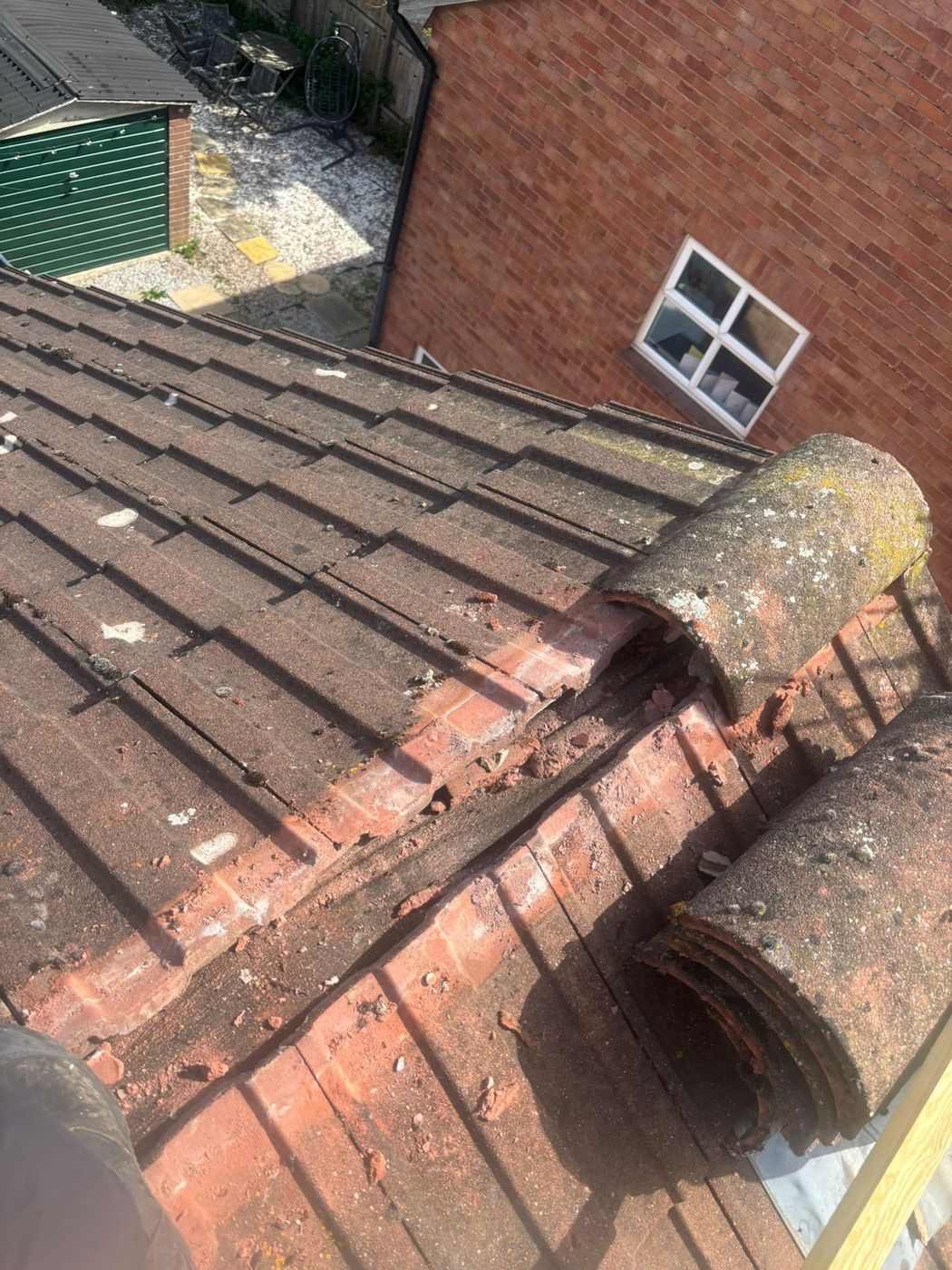
On a great many roofs the ridge caps are bedded in sand and cement and held by nothing else. Mortar is rigid and a roof is not, so the bond breaks, and once gone it does not come back. The cruel part is that nothing visible happens: the caps are heavy, they sit in a moulded trough of old bedding, and there is nothing to move them. They are no longer fixed to the roof. They are parked on it.
What puts it at the top of everyone’s list is not only that it fails most often. It is that the ridge is the one part of a domestic roof where the fixing method is legible in a single photograph. Everywhere else you are inferring from symptoms. Here there is either a bond or a clip and a screw, and the cap that came down carries the answer on its underside.
Be equally clear about what that does not settle. A dead bond shows the cap was unfixed. It does not show when it died, because mortar carries no date. The usual reason two people talk past each other here is that one is describing a condition and the other an event, and both are true. The exclusion that turns a condition into an outcome has a guide of its own in why roof claims get turned down; what belongs here is that it bites hardest at the edges, where the fixings are the oldest and most exposed on the building.
It is the sentence that comes back in a letter, and it lands badly, because it reads like an accusation of neglect. It is not one. It is a statement about sequence: a component had already stopped being fixed before the weather arrived, and the weather then did what weather does to an unfixed component. Whether that defeats a claim is a question about a policy wording, not about roofing.
In practice it describes a handful of things a roofer meets constantly. A verge strip parted from the tile behind it, sounding hollow when tapped, leaving the gable an open door into the batten spaces. A lead upstand whose pointing had weathered out of the chase, so the top edge was free to flap. A ridge on dead bedding. A bottom hip tile under a rusted-through hip iron. In each, the component had already stopped doing its job, and the gale did not have to be remarkable to finish it.
It also gets used loosely, and it is worth knowing when it does not fit. A verge strip that comes away with tile still bonded to its back was not loose. A slate that snapped across its nail holes was held until it broke. Torn underlay beneath tiles still clipped down is not a maintenance story. Clean fracture faces point at something that was performing until the weather overcame it — and those are exactly the surfaces that go into a skip during the clear-up.
Photograph of our own work.
Many policies expect the property to be kept in a reasonable state of repair, and that condition sits among the conditions rather than the exclusions, where nobody reads it. It is where the question comes from: when was the roof last looked at, and by whom. It is not a trap, but it is doing real work, because the answer is the only part of the conversation about the time before the weather.
A useful answer is specific and dull. Somebody came out, this is what they wrote down, this is what they recommended, this is the invoice for the part that was done. A weaker answer is that the roof has never given any trouble, because that describes the inside of the house rather than the condition of an edge — and the whole problem with a mortar bond is that it fails without anything appearing to happen.
Which is the argument for having the edges looked at while nothing is wrong. A written note of the ridge, the verges, the flashings and the valleys, with photographs, made on an ordinary afternoon, is the one document that cannot be produced after the event. It puts a condition and a date on the exact components a claim will turn on.
Our own part is narrow and worth stating plainly. We look, we make a roof safe when water is coming in, and we write down what we found: which component, in what condition, with photographs from the roof and from inside. The homeowner is the one who sends it on. We are not loss assessors, claims are not something this firm touches, and we will not tell anybody what their policy covers or how it is likely to go. Quotations are free and in writing, and the firm is fully insured. The storm damage section sets out how a make-safe, a report and a permanent repair fit together.
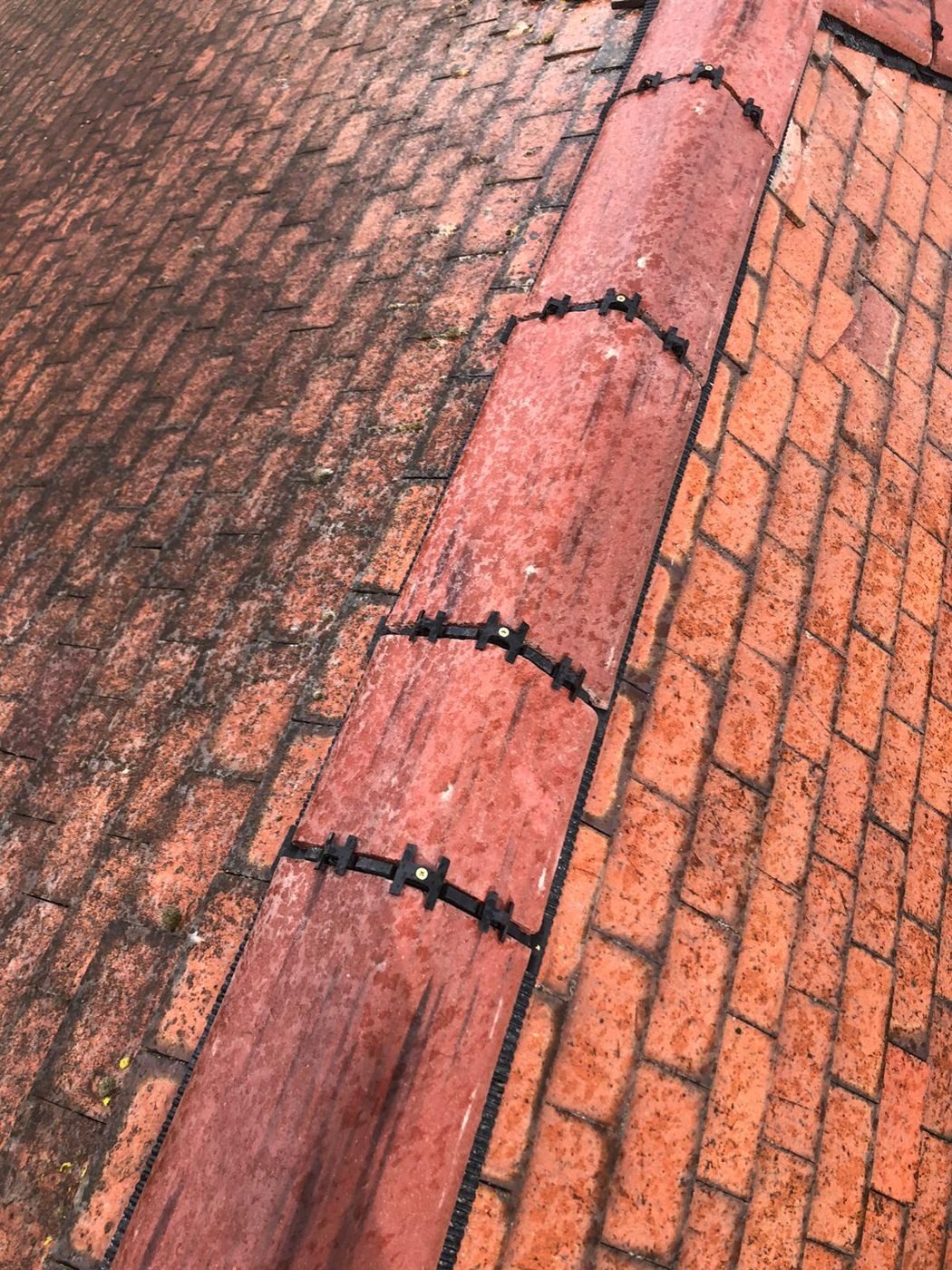
A dry ridge replaces the bed of mortar with a fixing you can point at: a ventilated roll along the apex, each cap screwed down through a clip, every joint held by metal rather than by a bond. A verge can go the same way. The second photograph on this page is the same component as the first, held in a completely different manner. BS 5534, the British Standard for slating and tiling, is what moved the trade: it took ridge and hip tiles off mortar-only bedding, called for a wind-uplift calculation for the actual site, and raised fixing density at the perimeter.
The part that belongs on this page is the part nobody mentions. A mechanical fixing can be inspected. A screw is either in the batten or it is not, and the difference photographs from a metre away; a bond can only be tested by lifting the tile, and lifting it is how you find out it had already gone. So converting an edge does two things at once: it takes the commonest failure off the table, and it swaps a condition nobody can date for one anybody can see.
None of it needs a whole new roof. A mortar ridge can be re-laid dry on the existing covering without disturbing the slopes, and a verge converted while it is open anyway. It is worth knowing what is under your own tiles, because on older roofs the field tiles are generally not each fixed: traditionally every third or fifth course was nailed, and on single-lap interlocking roofs the fixings were often confined to the perimeter, the hips and the ridge, the rest relying on the interlock and on weight. Fixing every tile is current practice rather than a description of the roofs this page is about — which is the whole reason the edges, where the fixings always were, are what it comes down to.
Photograph of our own work.
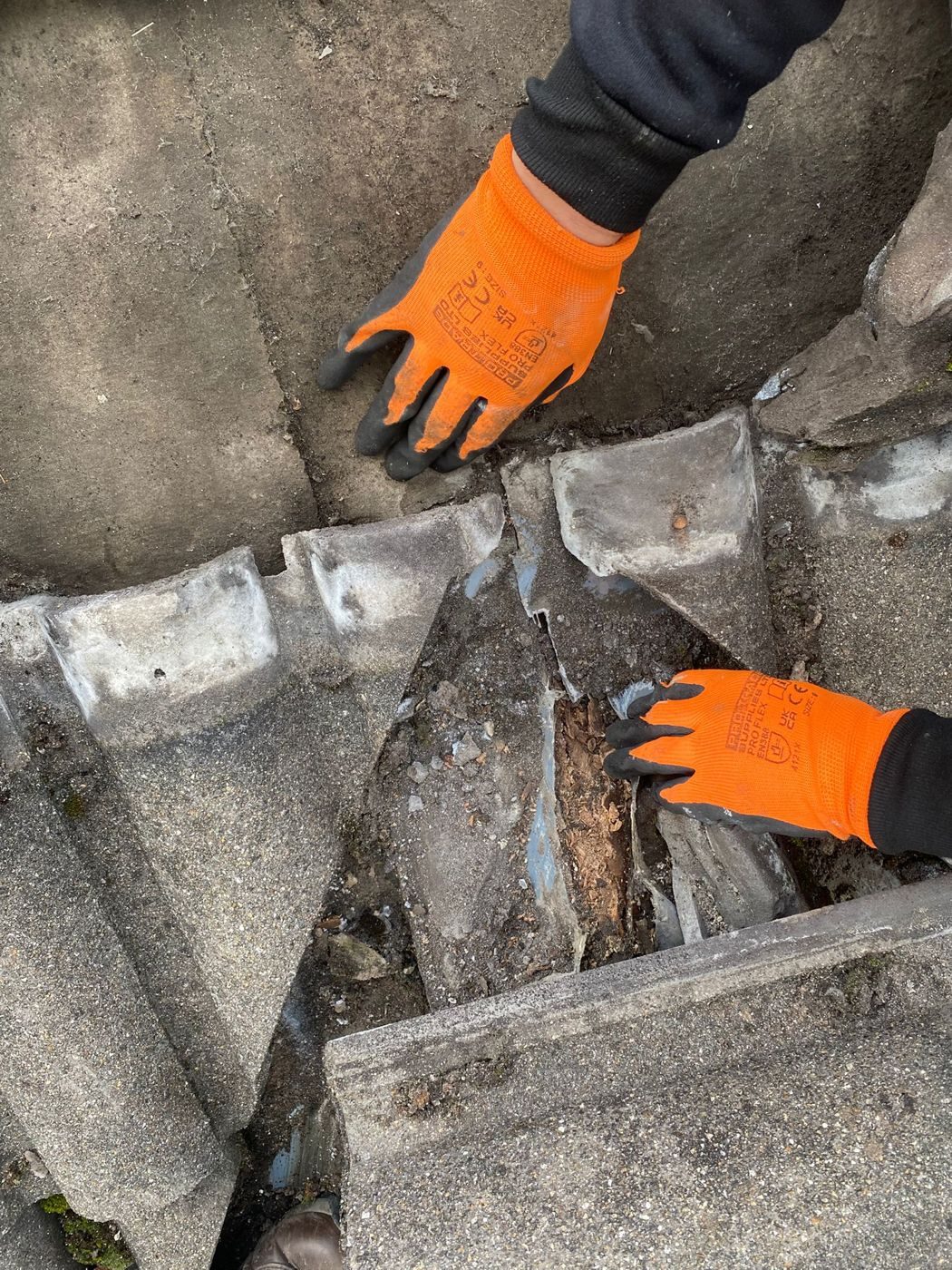
One component does not fit the pattern, and it causes more trouble in a claim than any of the others. A valley is sheltered rather than exposed, so uplift is not really its problem. Water is. What fails is slow and hidden — a split lining, a cracked cement fillet, boards gone soft with damp that never quite dries. All of it can be far advanced with nothing showing on a ceiling, because a valley only has to perform when it rains hard.
Then it rains hard sideways. Driven rain does not run down a valley, it crosses it, climbs the far side and goes over the edge of the lining. The stain appears that same night, during a gale, and everybody understandably concludes the gale did it. So the valley is the component most likely to be reported as weather damage when the weather only revealed it, and the one where the honest finding is often that cause and timing have come apart. Saying so is not a favour to an insurer; it is the difference between a report that survives being read carefully and one that does not. Where a valley or a ridge run crosses a boundary, whose policy it is becomes a question of its own, and the guide to flats and shared roofs takes that up.
The other guides in this set. What happens in the hours right after a storm is covered in detail on our roof repairs section, and linked throughout these pages rather than repeated.
Emergency call-outs across all of it, including Chester, Ellesmere Port, Neston, Runcorn, Frodsham, Helsby, Tarvin, Birkenhead, Wallasey, Heswall, Hoylake, West Kirby, Bebington, Deeside, Flint, Widnes, Warrington, Northwich, Winsford and Tarporley.
Start with the main storm damage page, or the town pages on roof repairs.
“I had a leak in my vally had a number of roofers to come and take a look couldn’t find the problem Roofline’s solutions fixed the problem first time. Very happy with these guys thank you for the brilliant service”
Michael Price“Highly recommend. Very quick and efficient. Great communication. Went above and beyond to work the weekend to complete the work that needed to be done. Very happy with the results.”
Karen Jones“Excellent work from the lads at roofline solutions. I had a leak in my valley, they came out and sorted it within a day.”
Chris HollewellDescribe the roof and roughly where you are, and we will come back to you — usually the same day. If water is coming in now, please call instead.
Prefer to talk? Call 07464 259566 · WhatsApp 0044 7464 259566 · Email Evensbuddy@yahoo.com
We cover Chester, Cheshire, the Wirral and Deeside from Elton, just north of Chester.
2 Manley View
Elton
Chester
CH2 4QF
Almost all of our work happens at your property rather than here, so please call before travelling.
Monday – Friday — 24hrs — Emergency Call-Outs
Saturday — 8:00 – 19:00
Sunday — 8:00 – 19:00
Weekday emergency call-outs are answered around the clock. Weekend cover is 8:00 to 19:00.