★★★★★
“I had a leak in my vally had a number of roofers to come and take a look couldn’t find the problem Roofline’s solutions fixed the problem first time. Very happy with these guys thank you for the brilliant service”
Michael PriceBuildings insurance belongs to whoever owns the building, and on a flat or a leasehold that is almost never the person living under the roof. Who is responsible, whose policy it is, and who to tell first.
Buildings insurance covers the structure — walls, floors, permanent fixtures and the roof over all of it. Contents insurance covers the things that would fall out if you could turn the building upside down and shake it. A roof is structure, every time, on every kind of property, so the policy that matters is a buildings policy and it sits with whoever owns the building.
If you rent on an ordinary residential tenancy, that is your landlord, and it is worth being blunt about it because a lot of tenants spend an evening looking for cover they do not have. A tenant’s own policy, where there is one, is almost always a contents policy. It may look after a soaked sofa. It will not put a ridge back. The exception worth naming is a full repairing and insuring lease, which can put both the repair and the insurance on the occupier — if that phrase is in your agreement, the agreement decides and the general rule does not. Otherwise a tenant reports the damage to the landlord or the letting agent, in writing, on the day, and keeps a copy of what was sent and when.
A tenant who rings a roofer directly, without the landlord agreeing to it first, can very easily end up holding the invoice for work on somebody else’s building. The same trap catches leaseholders, which is the next section, and for the same reason: the person who gives the instruction is the person who gets billed, regardless of who the roof belongs to.
If you own a freehold house outright, none of this applies and the position is as simple as it ever gets. Your building, your policy, your decision about whether to involve it at all.
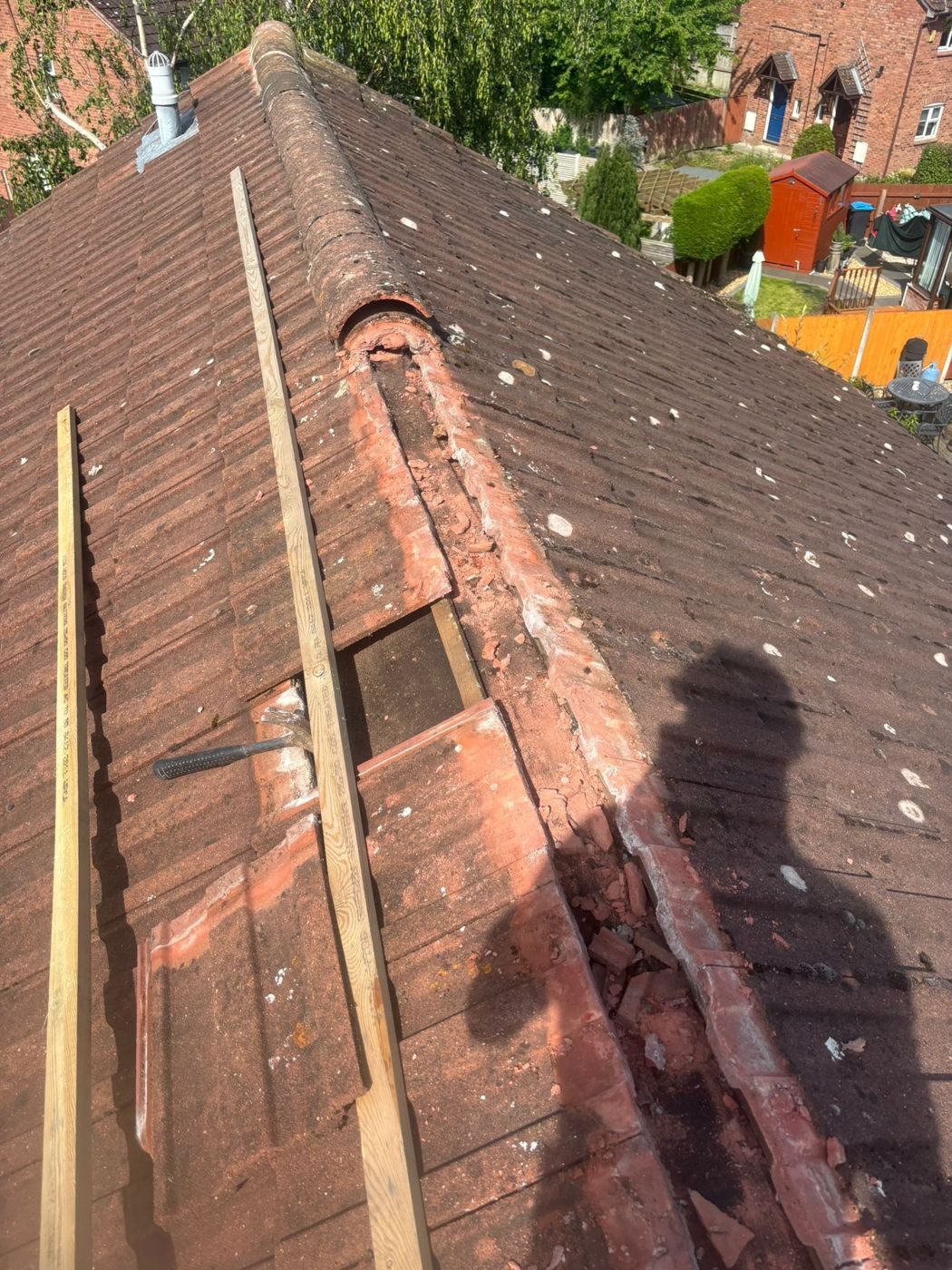
Photograph of our own work.
A long leasehold gives you a defined space rather than a building. What you hold is called the demise, and on a purpose-built flat it is usually the inside — the plaster, the floor surfaces, the fittings, sometimes the internal half of a window. The structure, the common parts and, almost always, the roof stay with the freeholder.
That is why the insurance normally sits in one place. The freeholder, a management company, or a resident-run company where the flat owners have taken over, insures the whole building on a single policy and recovers the cost from the leaseholders through the service charge, often alongside a reserve fund for larger work. So the leaseholder is paying for the cover, and is not the person who holds it. Water coming through a top-floor ceiling is reported upwards; the decision and the instruction come back down.
Then the caveat, and it is a real one rather than lawyers’ hedging. Leases differ. A house converted into two or three flats is the awkward case: some of those leases hand the top-floor flat the roof, or the loft, or the section of roof directly over the demise, and a few split a shared roof down the middle in a way no roofer would ever have drawn. Where the flat owners hold a share of the freehold, they are collectively the landlord and the decision is theirs jointly, which is a different conversation again.
None of that can be worked out from the outside, from the age of the building or from what is normal in the street. The repairing obligations are set out in the lease, usually in a schedule near the back, and a managing agent or the solicitor who did the conveyancing will confirm which clause applies. Read it before you agree to anything, because it also decides who can recover the cost and from whom.
The order matters more than the speed. First, if water is actually coming in, get the building made safe — that is a job that protects everybody’s interest, including the insurer’s, and most arrangements allow for it. Second, tell whoever is responsible, in writing, the same day: the landlord, the letting agent, the managing agent or the freeholder. An email with the time and date on it is worth a great deal more later than a phone call nobody logged.
Third, photograph what you can see from inside and from the ground outside, and note when it started. Nobody should be going up to photograph a roof, and on a block nobody should be going up at all — but a dated picture of a stained ceiling, taken at nine in the evening while it is still happening, is evidence that cannot be reconstructed afterwards. Our own guide to what to do if roof tiles blow off covers the first hour properly and there is no point repeating it here.
Fourth, let the responsible party notify their insurer. That is their policy, their claim and their excess, and it is not something a leaseholder or a tenant can do on their behalf. Fifth, keep everything: the reference number they give you, what you sent, what came back, and how long it took.
Where an emergency runs into a freeholder or an agent who simply cannot be reached, keep the record of trying — the times, the numbers, the messages. Many leases contain a provision for emergency steps and a route to recover what they cost, and many do not, so that record is the thing that makes the conversation afterwards possible. What we would not do in that position is authorise a full permanent repair to a structure that is not yours.
A terrace is one roof with several owners under it. The ridge runs the whole length of the row, the battens and the underlay run through, the party walls come up inside it, and the bedding along that ridge was laid on the same day by the same hand and has weathered the same number of winters. When it lets go it rarely has the manners to stop at a boundary.
Each owner still insures their own property, so the rule is the dull one: your side, your policy. Where a failure starts over one house and ends over the next, that is two insurers looking at the same run of tiles, two excesses, and two sets of paperwork that will be compared. It is also the situation where a single competent report on the whole run, given separately to each owner, saves everybody a fortnight of argument about where the damage began.
Chimney stacks on a party wall are the other shared item, and they catch people out because a stack looks like it belongs to whichever house it appears to sit on. Often it straddles the wall, with flues serving each side. Work to a party structure has its own legal procedure and its own notice requirements, which is ground for a surveyor or a solicitor rather than for a roofer. We will say what has failed; we will not tell you what notice to serve.
Access is the practical one. A repair along a shared ridge, a valley between two properties or a verge on a boundary elevation may need a tower or a scaffold standing on next door’s ground, and scaffolding is quoted separately from the work itself. Ask the neighbour early and in writing, because a polite refusal stops a job dead and is much cheaper to discover before the scaffold is booked than after.
One more thing, and it is the reason this section exists. If tiles have been off for a while and a party wall, a ceiling or a structural timber is involved, that is an engineer’s call rather than a roofer’s. Our guide on whether missing tiles cause structural damage sets out when it stops being a roofing question.
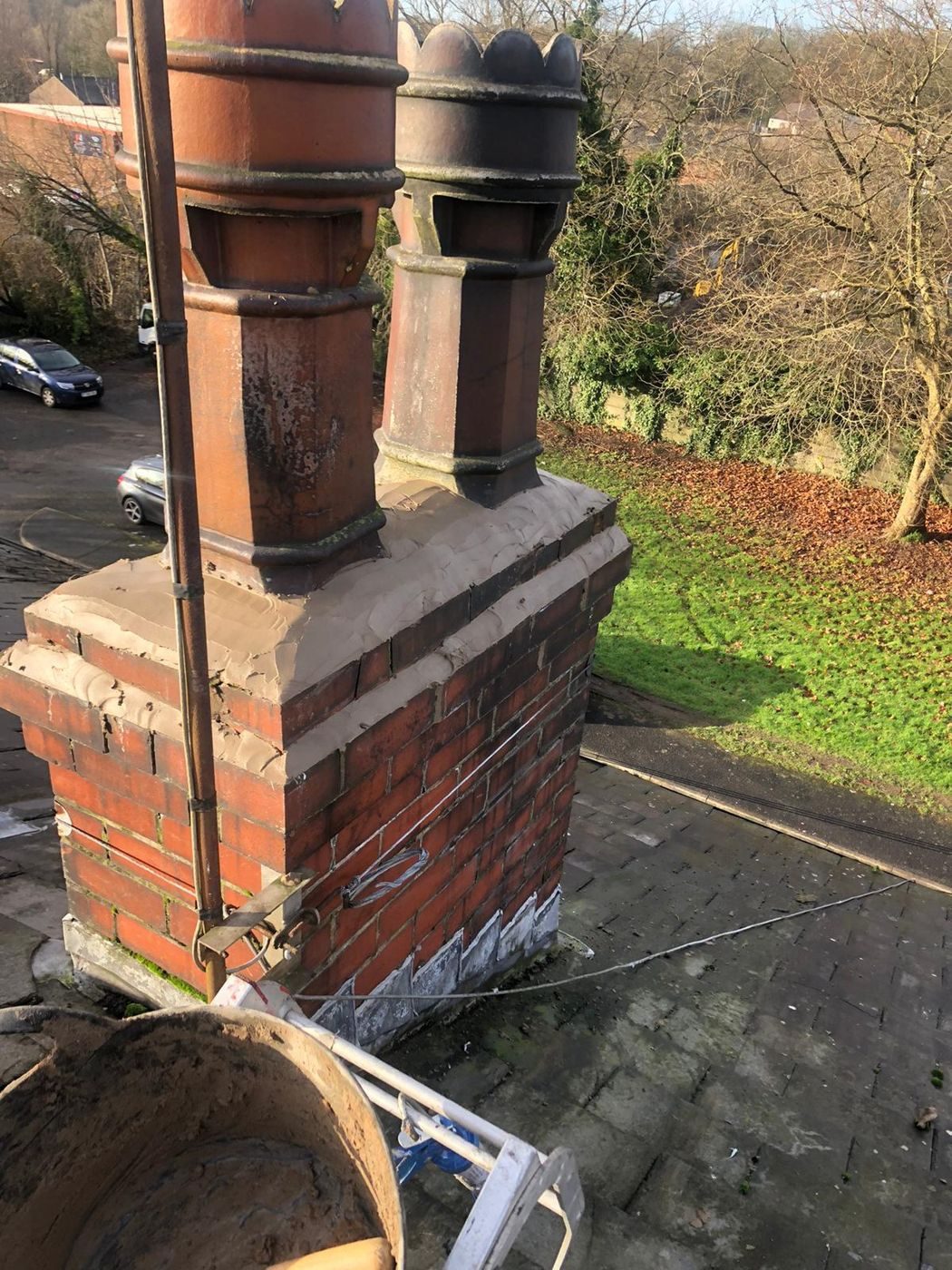
Photograph of our own work.
We attend, we make the roof safe so that it stops adding to the damage every hour it rains, and we put in writing what has failed, where, in what condition, with photographs taken from the roof and from inside. That document goes to whoever instructed us. On a block that is normally the managing agent; on a terrace it is the owner whose side we worked on; and if the person instructing us wants it sent to more than one party, we will send it.
What we will not do is step into the middle of the ownership question. We are roofers rather than loss assessors. Claims are not something this firm touches, conversations with adjusters are not ours to have, and neither a lease nor a policy is a document we are going to interpret for you. Both of those belong to other people with other qualifications, and a roofer reading a lease aloud is exactly as useful as a solicitor guessing at a valley.
Before anything starts we need to know who is giving the instruction, especially where the caller is not the owner. It is not bureaucracy. It is the difference between an invoice that gets paid through a service charge and an invoice that lands on a leaseholder who was only trying to help. Quotations are free and in writing, and the firm is fully insured.
If you are not yet sure what has actually failed up there, the guide to the parts of a roof that fail in wind explains why the ridge and the verge go before anything else, which is usually enough to tell you whether you are looking at a shared element or your own. The storm damage section covers the make-safe, the report and the photographs in more detail.
The other guides in this set. What happens in the hours right after a storm is covered in detail on our roof repairs section, and linked throughout these pages rather than repeated.
Emergency call-outs across all of it, including Chester, Ellesmere Port, Neston, Runcorn, Frodsham, Helsby, Tarvin, Birkenhead, Wallasey, Heswall, Hoylake, West Kirby, Bebington, Deeside, Flint, Widnes, Warrington, Northwich, Winsford and Tarporley.
Start with the main storm damage page, or the town pages on roof repairs.
“I had a leak in my vally had a number of roofers to come and take a look couldn’t find the problem Roofline’s solutions fixed the problem first time. Very happy with these guys thank you for the brilliant service”
Michael Price“Highly recommend. Very quick and efficient. Great communication. Went above and beyond to work the weekend to complete the work that needed to be done. Very happy with the results.”
Karen Jones“Excellent work from the lads at roofline solutions. I had a leak in my valley, they came out and sorted it within a day.”
Chris HollewellDescribe the roof and roughly where you are, and we will come back to you — usually the same day. If water is coming in now, please call instead.
Prefer to talk? Call 07464 259566 · WhatsApp 0044 7464 259566 · Email Evensbuddy@yahoo.com
We cover Chester, Cheshire, the Wirral and Deeside from Elton, just north of Chester.
2 Manley View
Elton
Chester
CH2 4QF
Almost all of our work happens at your property rather than here, so please call before travelling.
Monday – Friday — 24hrs — Emergency Call-Outs
Saturday — 8:00 – 19:00
Sunday — 8:00 – 19:00
Weekday emergency call-outs are answered around the clock. Weekend cover is 8:00 to 19:00.