★★★★★
“job well done good communication throughout the job very clean and tiddy when the job is finish flat roof replacement many thanks.”
Sumit Bal
In Birkenhead’s dense terraces a gale rarely stops at one front door. Slates, pots and ridge land in shared yards and entries, and the roof above belongs to more than one household.
Birkenhead went up quickly and went up tight. The rows around Hamilton Square, out through Tranmere and Rock Ferry, and the later streets behind Claughton, Prenton and Oxton were built as terraces and close semis, with walls shared, roof lines continuous and yards the width of a doorway. That layout changes what a storm does. Wind that would scatter debris across a lawn on a detached house drops it, here, into a slot between two walls, where it stays until somebody deals with it.
The prevailing wind in this country is from the south-west, and a long run of roofs takes it in sequence. A ridge section that lifts at one end of a row has often loosened its neighbours first. So the useful question after a gale is not only what has come off your roof but what has come off the whole run, and where it went. A slate that slid down the back slope is rarely lying where it started.
This page is about that terraced reality: debris in shared yards and entries, party-wall upstands, the awkward business of making a roof safe when the only route to it is through somebody’s house, and the plain question of whose roof you are standing under. The general account of how wind breaks a roof is on our storm damage roof repairs page. What follows is the part that belongs to streets like these.
The components a gale usually finds first, and the repairs that follow them.
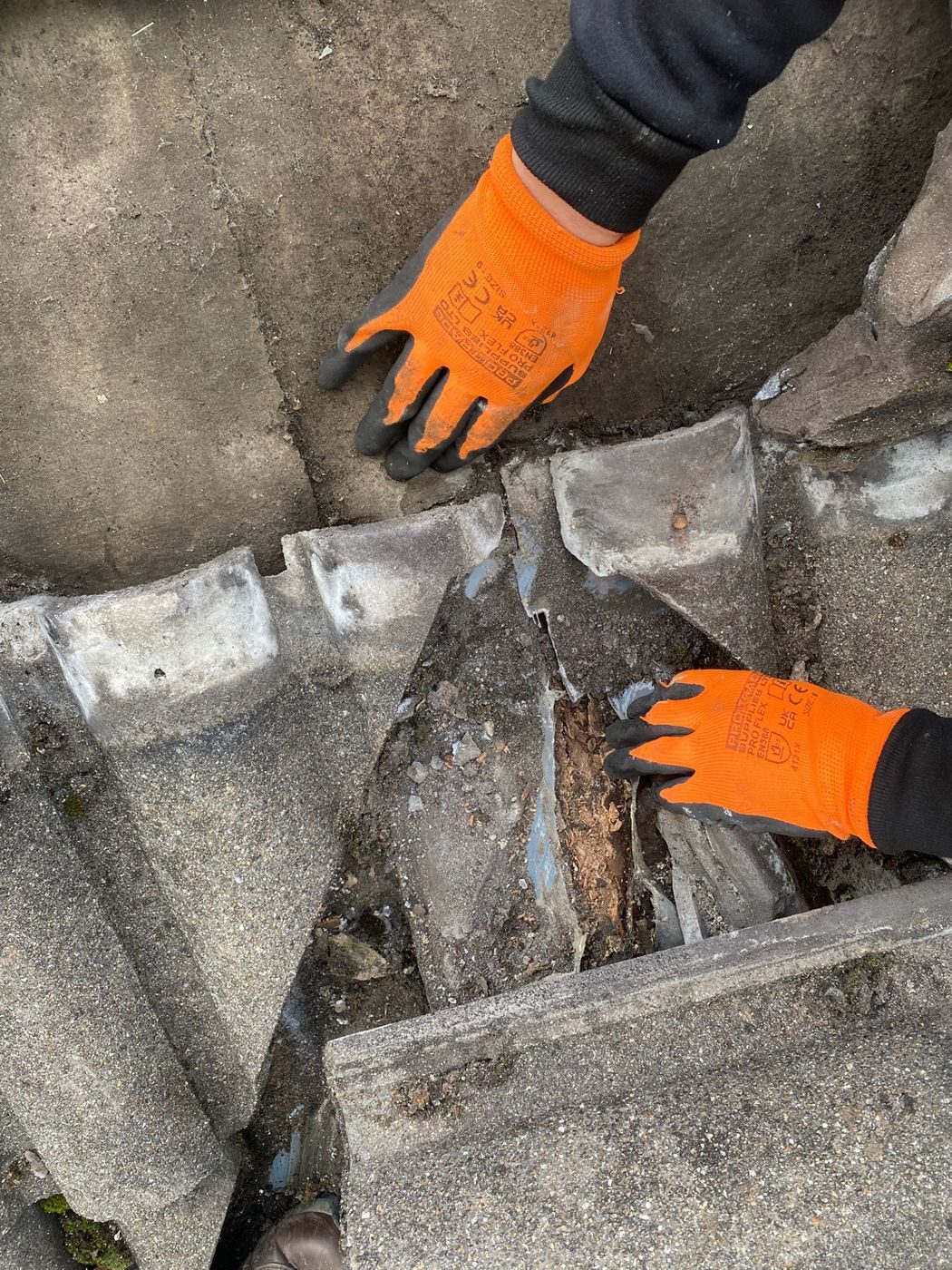
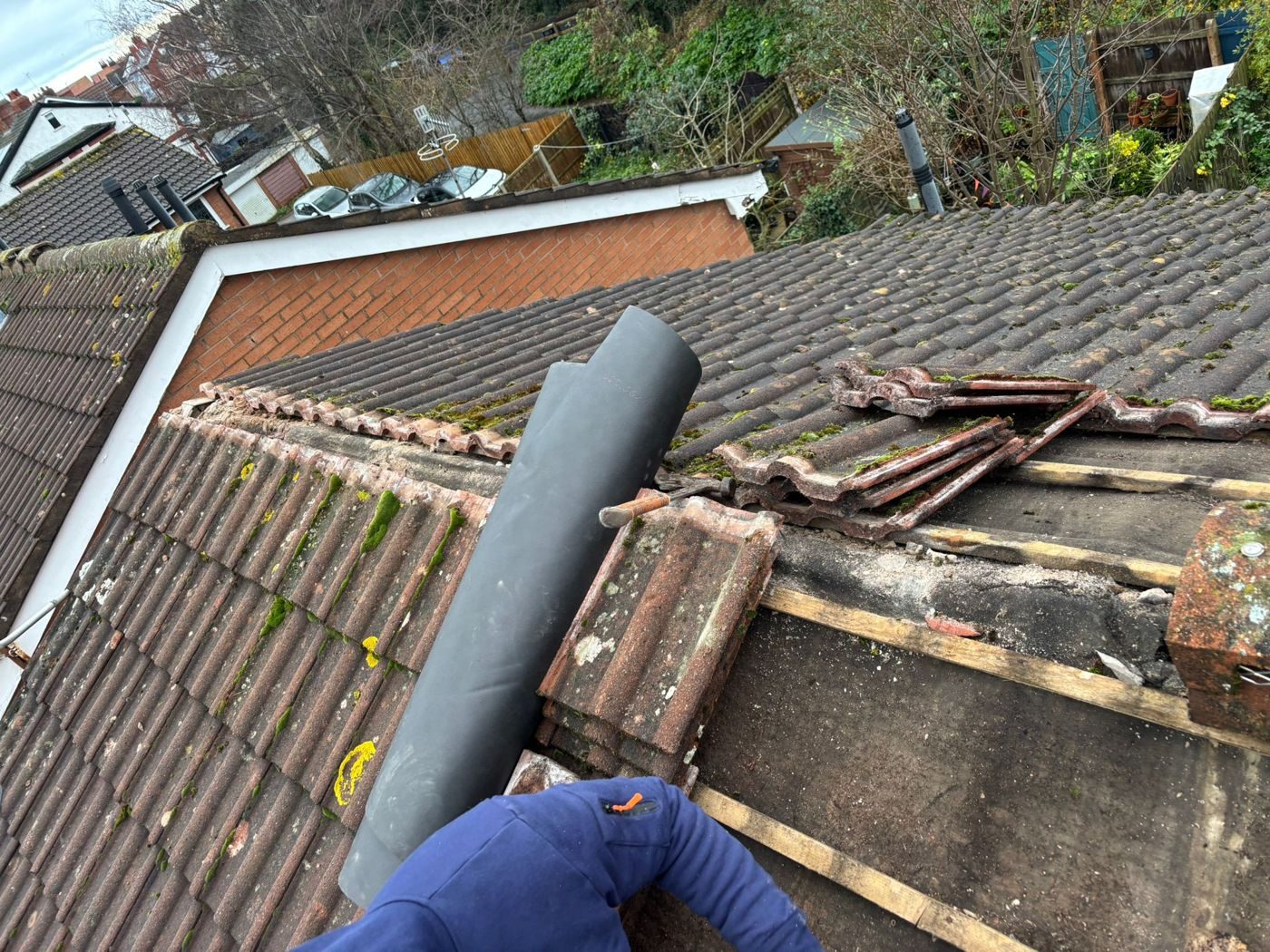
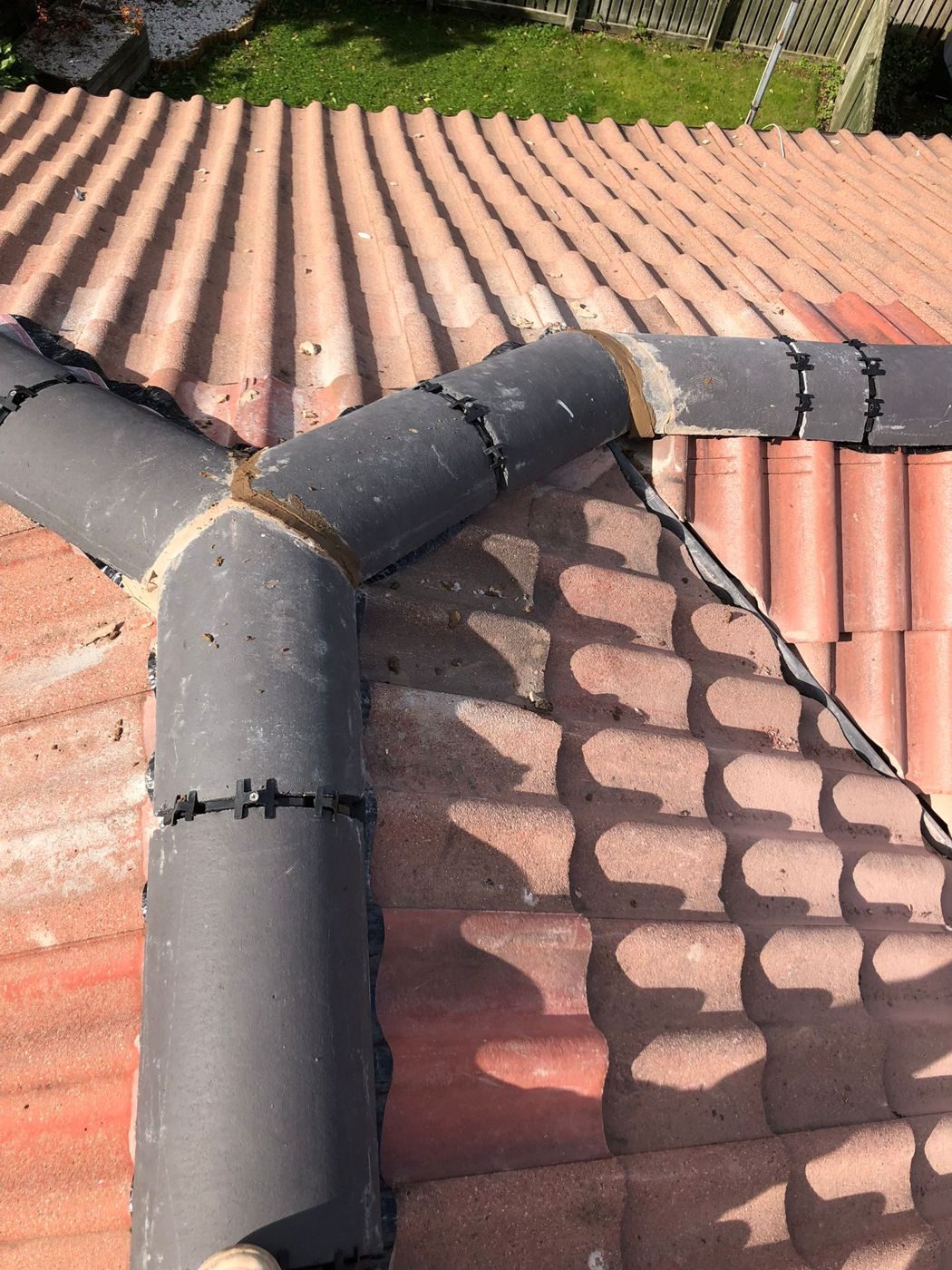
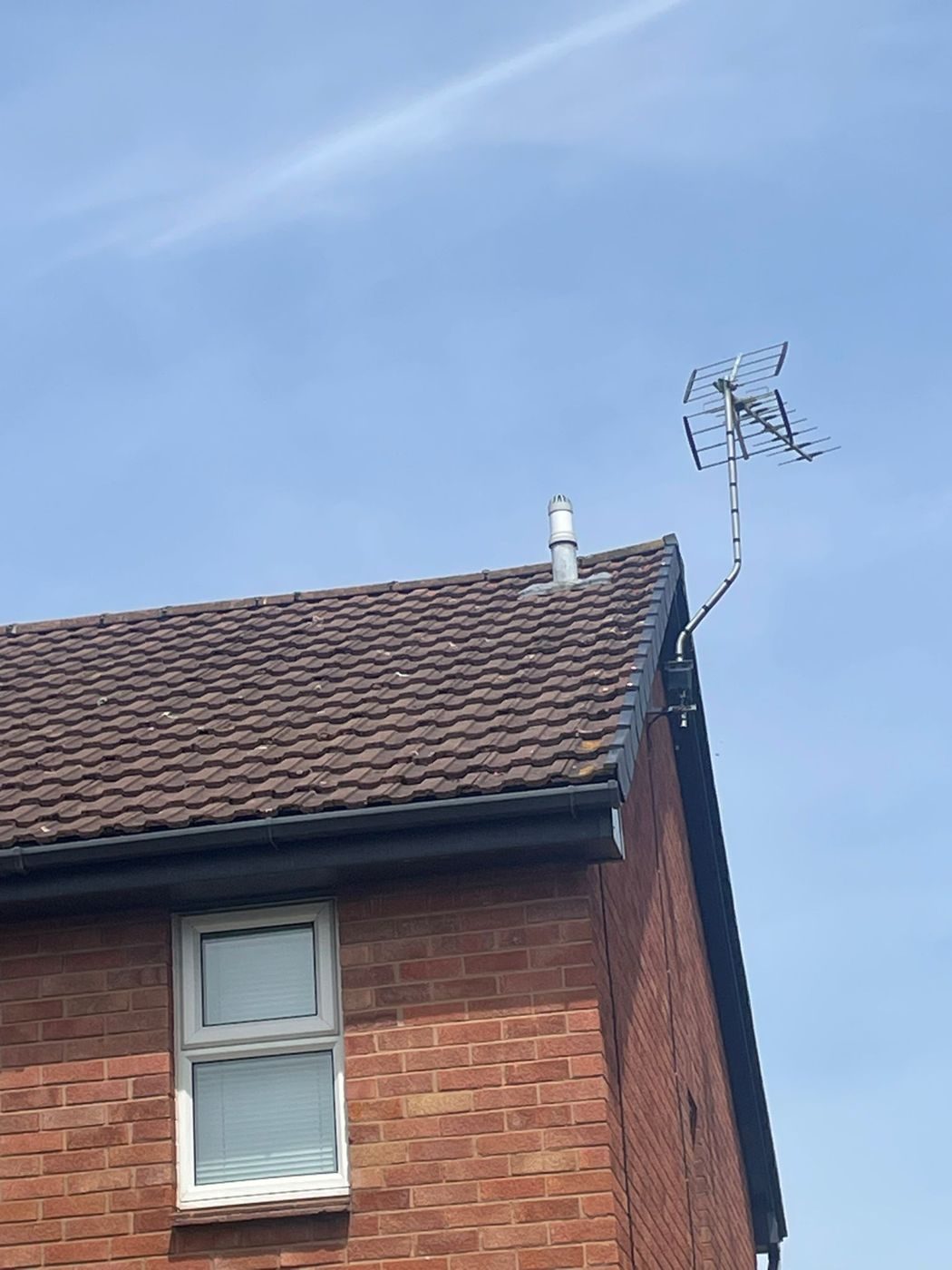
Photographs of our own work. None of them is a storm job — they show the parts that fail and how they are put right. More on the storm damage hub.
Most terraced houses here have a back yard shared in practice if not in law, reached by a narrow entry that serves several doors. When a storm strips slates or knocks a pot off a stack, those pieces fall on ground that nobody single-handedly controls. A neighbour’s bins, a washing line, a gate that opens onto the entry: all of it is in the drop zone, and so are the people who walk through it. Broken slate is sharp, and a clay pot that has landed on a yard floor is heavier than it looks.
Clearing it is not a tidy-up to be done on the first dry morning. Whatever fell came from somewhere, and the roof above it may still have more loose. Picking pieces out from under an edge that is already working free is how a second slate arrives on top of the first. Photograph where things landed before anything is moved, and keep the larger fragments, because their size and the break face tell a reader something about how they came away. Then keep people out of the entry until the roof has been looked at from a safe position.
The other thing a shared yard raises is who is affected. Debris in an entry may have come from your house, from next door or from three doors along, and the damage it did may be to someone else’s property. We write up what we find on the roof in front of us and what we can see of where it fell. Working out whose cover answers for a neighbour’s fence or window is a conversation between owners and their insurers, and our report is only the evidence they start from.
A mid-terrace roof can be read from two places at most, the back bedroom window and the pavement, and neither gives the whole picture. The slope facing the street is visible from the front; the rear slope you see from your own yard or from upstairs. The party wall line, where your roof meets the one beside it, is the part that most often goes unseen and the part wind works on hardest.
Check the yard and entry before you check anything else, because the ground often shows what the roof will not. A scatter of slate or mortar is a direct report from the top of the building. Inside, look at the chimney breast and the party wall in the upper rooms, since water entering at a shared upstand tends to run down the wall that both houses depend on.
Reaching a terraced roof is often the hardest part of the job. The street side usually has front walls on the footway and residents’ parking along both kerbs, so a pavement scaffold needs a licence from Wirral Council and the parking bay under it has to be cleared. At the back, the yard may be big enough for a tower or it may not, and the entry is frequently too narrow to carry a long ladder or scaffold tube down without turning it.
Where there is no side passage at all, the only way to the back of a mid-terrace is through the house. That is a request to the occupier, and sometimes to a neighbour as well if the platform has to stand or tie on both sides of a shared line. We raise it at the survey, not on the morning, so that nobody is waking to find tube coming through the hall. Scaffolding is quoted separately, once we have seen what the access really needs.
The make-safe on a terrace is shaped by the building. Loose slate or ridge is secured or taken off before it comes down into the entry, an open section is sheeted from a proper platform, and anything hanging over a shared yard is dealt with first. Where the damage is at a party-wall upstand or at a stack that stands over the boundary, a temporary cover often has to be fixed to both roofs, so both households need to know before it goes on. We say so, in writing, and we do not decide it for either side.
The permanent repair follows once the roof is dry and the insurer’s position is known. On a terrace the sensible course is usually one job across the shared line rather than two jobs a season apart, which means agreeing the work with the neighbour first. Where the stack itself is involved, the Party Wall etc. Act may apply, and Wirral Council’s Building Control can say; this is general information, not legal advice. Our report, with photographs from the roof, names what failed on your side and what we could see of the rest. See roof repairs in Birkenhead for the wider repair work, and Whose Insurance Is It? Flats, Leaseholds and Shared Roofs for the insurance side.
If water is coming in now, ring rather than fill in a form. Weekday emergency call-outs are answered around the clock; weekend cover runs from eight in the morning until seven in the evening. Please do not go up to look: describe what you can see from the ground.
Photograph everything before anybody tidies or moves anything, because that is the evidence. The steps for the hours after a storm are set out in what to do after storm damage to your roof, and the general picture is on our storm damage hub.
What an insurer means by a storm, why wear and tear turns claims down, what belongs in a roofer's report, who pays for the make-safe, and who is who in a claim. The aftermath itself — what to do first, what to check — is covered in detail on our roof repairs section and linked throughout rather than repeated here.
“job well done good communication throughout the job very clean and tiddy when the job is finish flat roof replacement many thanks.”
Sumit Bal“Excellent service from Buddy and the team in installing a new garage roof in a really professional manner. Was kept updated at all stages and given good advice as to our options. Would highly recommend”
Peter Aspinall“Very professional efficient team great communication
Would definitely recommend made the process quick and easy will definitely look to keep for any future need
Thankyou”
Every town has its own page, written around the roofs that are actually there. Start with the main storm damage page.
Describe the roof and roughly where you are, and we will come back to you — usually the same day. If water is coming in now, please call instead.
Prefer to talk? Call 07464 259566 · WhatsApp 0044 7464 259566 · Email Evensbuddy@yahoo.com
We work across Chester, Cheshire and the Wirral from our base at Elton, just north of Chester.
2 Manley View
Elton
Chester
CH2 4QF
Almost all of our work happens at your property rather than here, so please call before travelling.
Monday – Friday — 24hrs — Emergency Call-Outs
Saturday — 8:00 – 19:00
Sunday — 8:00 – 19:00
Weekday emergency call-outs are answered around the clock. Weekend cover is 8:00 to 19:00.