★★★★★
“job well done good communication throughout the job very clean and tiddy when the job is finish flat roof replacement many thanks.”
Sumit Bal
In Deeside the storm damage we see most often starts at a rendered chimney stack: render lifting in a gale, wind-driven rain behind it, and pieces coming down onto the roof below.
Much of Deeside was built flat out and in a hurry, and the chimneys show it. Across Connah’s Quay, Shotton, Queensferry, Sandycroft and the estates out towards Mancot and Hawarden, a large share of the stacks are covered in render, roughcast or pebbledash. The site is open and the wind has little to stop it. A storm there rarely begins with a dramatic collapse. It begins with a rendered face that was already holding on by its edges.
That is the thread running through this page. Render on a chimney is a coat, not a structure, and in a gale it can lift in a sheet, crack away from the pot or the lead, or shed a piece the size of a paving slab onto the tiles below. Rain driven sideways gets behind whatever has opened. What comes down is heavy, it lands on a concrete tile roof or a flat extension beneath the stack, and the second kind of damage often does more harm than the first.
What follows is what we look for after a blow, how we reach a stack like this, and how we make it safe and then put it right. It builds on our wider guide to storm damage roof repairs, and our chimney repairs in Deeside page explains in more detail why rendered stacks behave as they do.
The components a gale usually finds first, and the repairs that follow them.
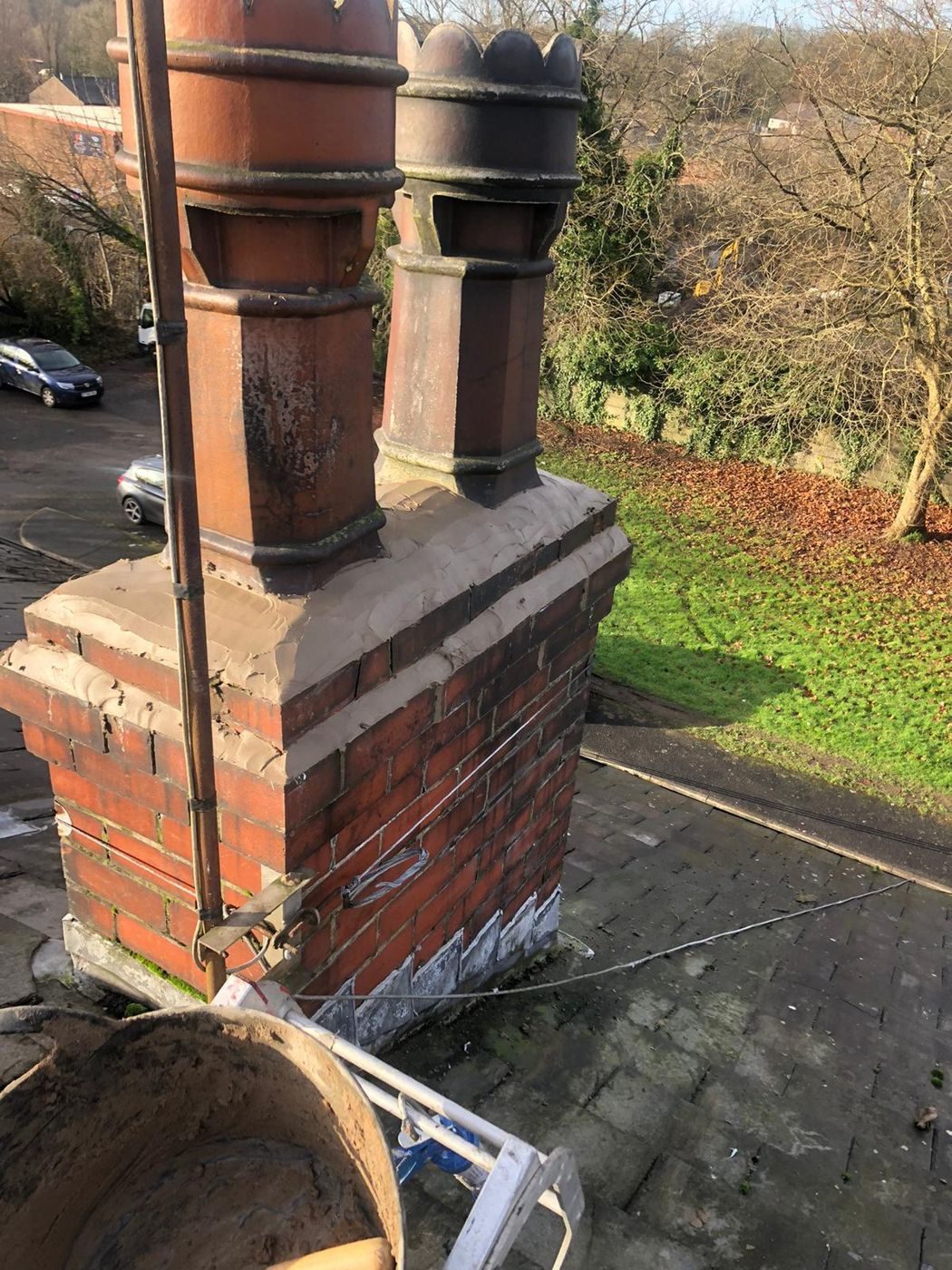
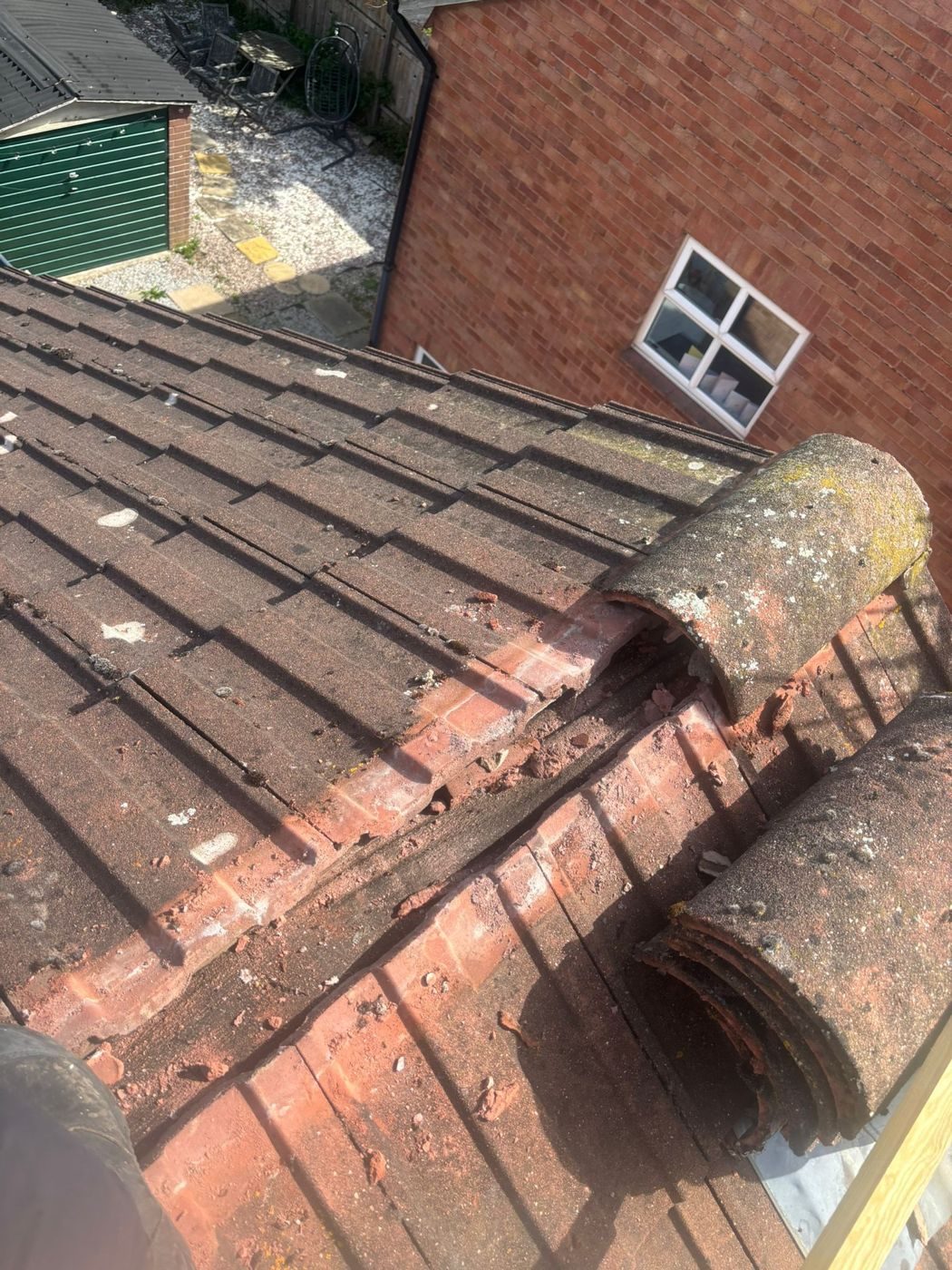
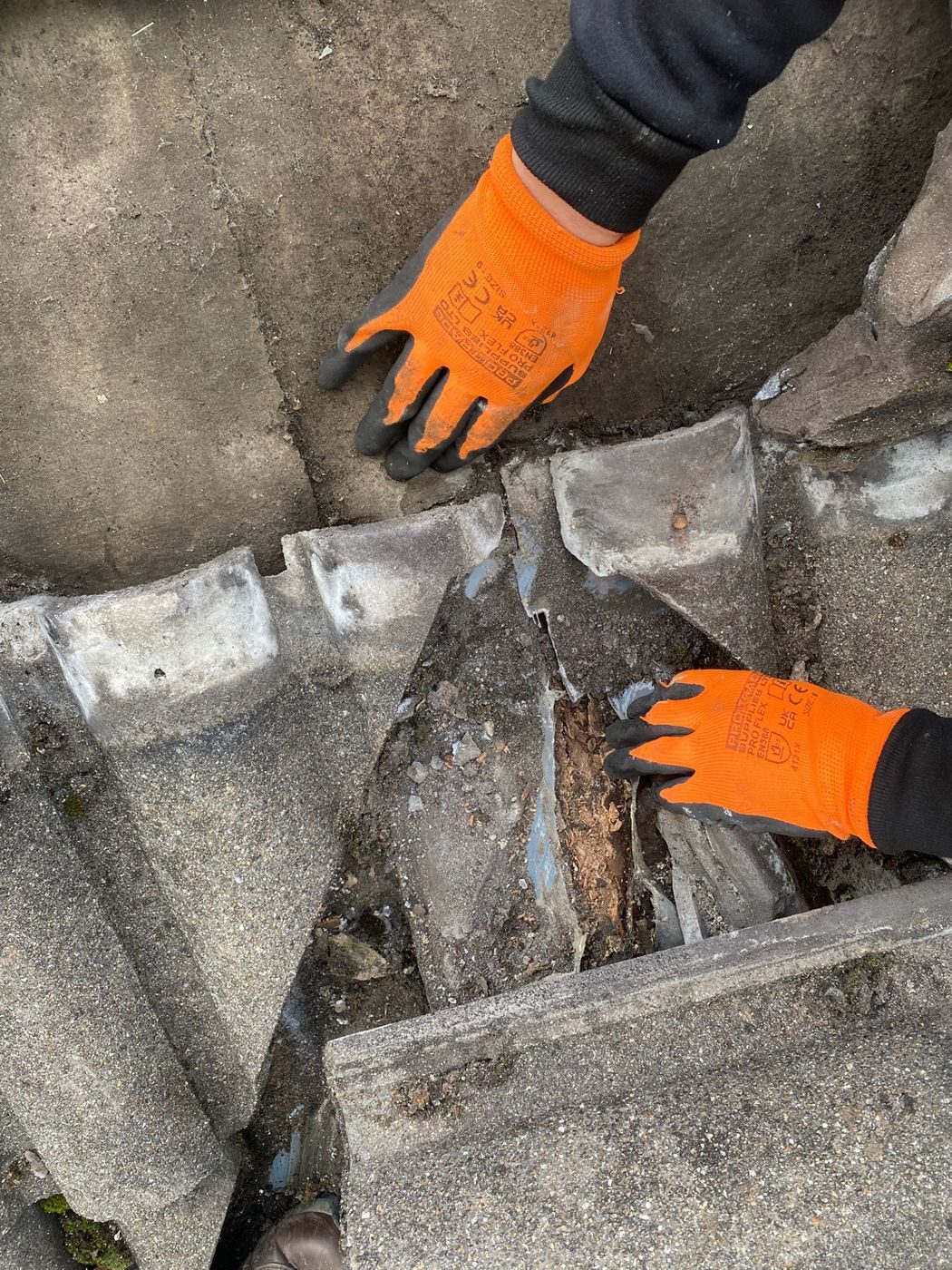
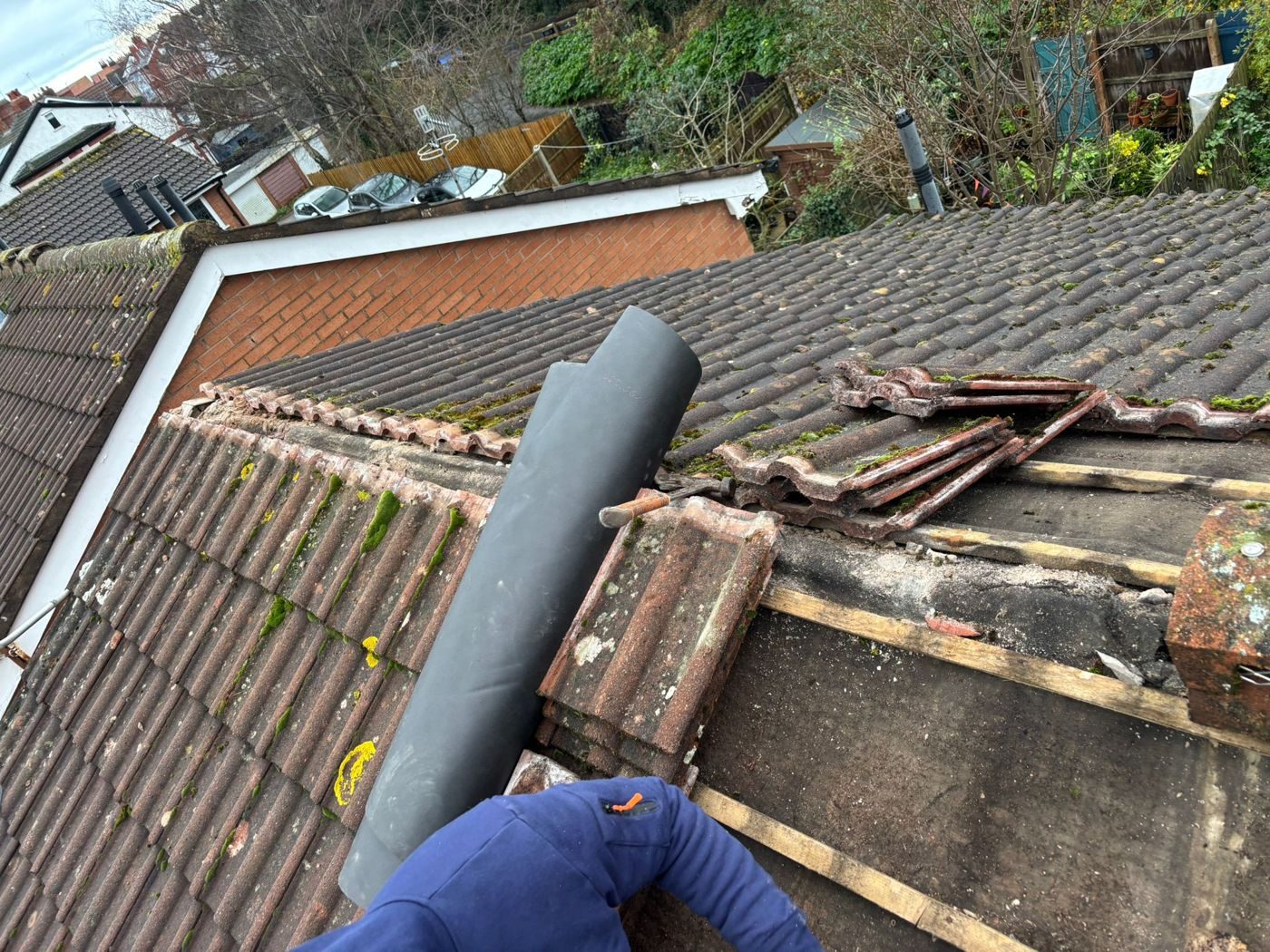
Photographs of our own work. None of them is a storm job — they show the parts that fail and how they are put right. More on the storm damage hub.
Wind does two things to a rendered stack. Air pushed hard against the exposed face puts pressure on any render that has lost its bond, and the suction on the sheltered side pulls at it from the other direction. Render that has sounded hollow for a long time will hold through a calm winter and then let go in one gust. The edges and corners go first, then the top where the coat meets the pot, then the junction at the bottom where it sits against the lead. The prevailing wind here comes from the south-west, so the damage tends to show on that face of the stack first.
Rain is the second half of it. Render sheds most water but not all, and a storm that drives rain sideways forces it into hairline cracks and open edges that stay dry on an ordinary day. Once it is behind the coat it cannot get out, so the brick or block wet through to the inside of the house is a delayed result of the storm rather than a fresh fault. That is also why a stack can look intact from the garden and still be the source of a bedroom stain a few days later.
The part people underestimate is the fall. A piece of render, a handful of pebbledash stones or a cracked collar of mortar from the top of the stack drops straight down the slope. On a concrete interlocking tile roof it can crack tiles, dislodge a ridge or lodge in a valley or gutter. On a flat extension or porch below the stack it can split the covering. So in Deeside a rendered stack that has shed anything is treated as a falling hazard first and a leak second. That order matters when we decide what to do on the day.
Do this from the garden or the pavement, not from a ladder, and keep clear of the ground directly beneath the stack. Render that has come down tends to land where you would not think to look, so check the drive, the borders and the flat roofs and porch tops at the back of the house as well. Look along each face at a low angle with the light across it, because a bulge or a dish in a surface that should be flat is easier to spot that way.
Take photographs before anything is swept up or moved. A picture of the pieces where they fell, and of the face of the stack they came from, is worth far more to an insurer than a description given later. If you can see a stain on a ceiling on the chimney breast, or a wet patch in the loft beside the stack, photograph that too. Then ring us and tell us what you can see.
Most Deeside houses are straightforward to reach. Estate semis and short terraces usually have a drive or side gate, and the stacks are not tall, so a tower or scaffold goes up without much argument. Where an older frontage stands directly on the footway, a pavement scaffold needs a licence from Flintshire County Council and a bay suspended, which takes time and is worth knowing before a quote is expected the same day. Scaffolding is quoted separately, and on a low roof we will tell you if it is not needed.
The difficulty with a rendered stack is that nobody can say what is wrong from the ground. A scaffold may have to go up before the real scope is known, and the make-safe happens at the same time as the inspection. Taking down loose render is dirty work, so we sheet the platform, net the debris and cover plants and cars, and we try to keep the pebbledash out of next door’s garden. Please do not climb up to look or try to knock loose render off yourself.
The first visit is about removing the danger. Loose render is taken off, anything cracked at the top is secured or lifted clear, and the roof below is checked and sheeted where tiles have broken or the covering has split. That work is temporary by nature. We then write up what failed and why, with photographs from the stack, so the report separates what the storm did from the older condition of the render where that can be told apart. Our guide to Storm Damage or Wear and Tear? Why Roof Claims Get Turned Down explains why that distinction comes up, and What Should Be in a Roofer’s Report for an Insurance Claim? sets out what a useful report contains.
The permanent repair depends on what we find once the render is open. It may be rendering patched back properly, a new head formed to a fall around the pot, or lead rewelted so the render stops above it and throws water clear. Where the stack has moved or is past patching, a part rebuild to roof level is a quoted job in its own right. We would sooner say that than patch over a problem. For tile damage lower down, see our roof repairs in Deeside repairs page. Because Deeside is in Flintshire, any question about building regulations goes to the council in Wales, and this is not legal advice. A claim works the same way as in England.
If water is coming in now, ring rather than fill in a form. Weekday emergency call-outs are answered around the clock; weekend cover runs from eight in the morning until seven in the evening. Please do not go up to look: describe what you can see from the ground.
Photograph everything before anybody tidies or moves anything, because that is the evidence. The steps for the hours after a storm are set out in what to do after storm damage to your roof, and the general picture is on our storm damage hub.
What an insurer means by a storm, why wear and tear turns claims down, what belongs in a roofer's report, who pays for the make-safe, and who is who in a claim. The aftermath itself — what to do first, what to check — is covered in detail on our roof repairs section and linked throughout rather than repeated here.
“job well done good communication throughout the job very clean and tiddy when the job is finish flat roof replacement many thanks.”
Sumit Bal“Excellent service from Buddy and the team in installing a new garage roof in a really professional manner. Was kept updated at all stages and given good advice as to our options. Would highly recommend”
Peter Aspinall“Very professional efficient team great communication
Would definitely recommend made the process quick and easy will definitely look to keep for any future need
Thankyou”
Every town has its own page, written around the roofs that are actually there. Start with the main storm damage page.
Describe the roof and roughly where you are, and we will come back to you — usually the same day. If water is coming in now, please call instead.
Prefer to talk? Call 07464 259566 · WhatsApp 0044 7464 259566 · Email Evensbuddy@yahoo.com
We work across Chester, Cheshire and the Wirral from our base at Elton, just north of Chester.
2 Manley View
Elton
Chester
CH2 4QF
Almost all of our work happens at your property rather than here, so please call before travelling.
Monday – Friday — 24hrs — Emergency Call-Outs
Saturday — 8:00 – 19:00
Sunday — 8:00 – 19:00
Weekday emergency call-outs are answered around the clock. Weekend cover is 8:00 to 19:00.