★★★★★
“job well done good communication throughout the job very clean and tiddy when the job is finish flat roof replacement many thanks.”
Sumit Bal
Storm damage on Crewe’s railway terraces: what falls into the yard and the back entry, how we make a confined plot safe, and why one gale tends to catch the whole row together.
A gale in Crewe rarely stays with one house. The streets around the station were laid out as long, matching rows, so the same ridge line, the same party-wall upstands and the same age of slate run unbroken from one end of a block to the other. Whatever the wind finds weak on one roof, it usually finds weak on the next, and the morning after a bad night tends to bring slates and ridge fragments down along the whole run rather than on a single property.
What makes these roofs awkward is where the debris lands. Behind each house is a small paved yard, often roofed in part by a glass or felt addition, and beyond the yard wall is the shared back entry. A slate sliding off the rear slope has nowhere soft to fall. Pieces of ridge mortar, a cracked tile edge or a bedding crumb all arrive on flags, on a gully, or on somebody else’s yard, and that changes how we approach the job as much as the damage itself.
This page is about that setting: what a storm does to a terraced roof in Crewe, how we reach it when the only routes are the entry or the hall, and how the roof is made safe and then put right. The wider picture, including how we split the emergency work from the repair, is on our storm damage roof repairs page.
The components a gale usually finds first, and the repairs that follow them.
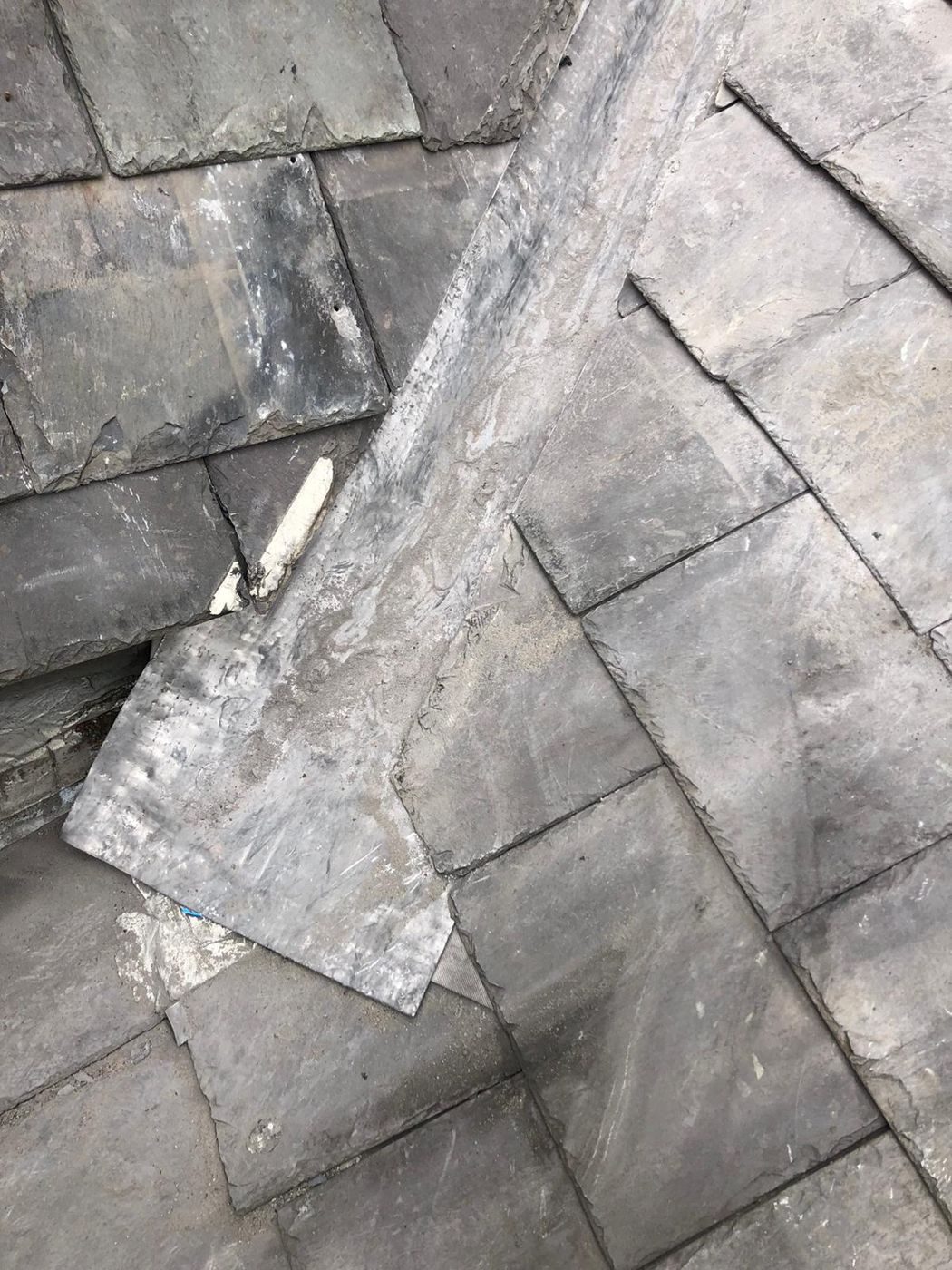
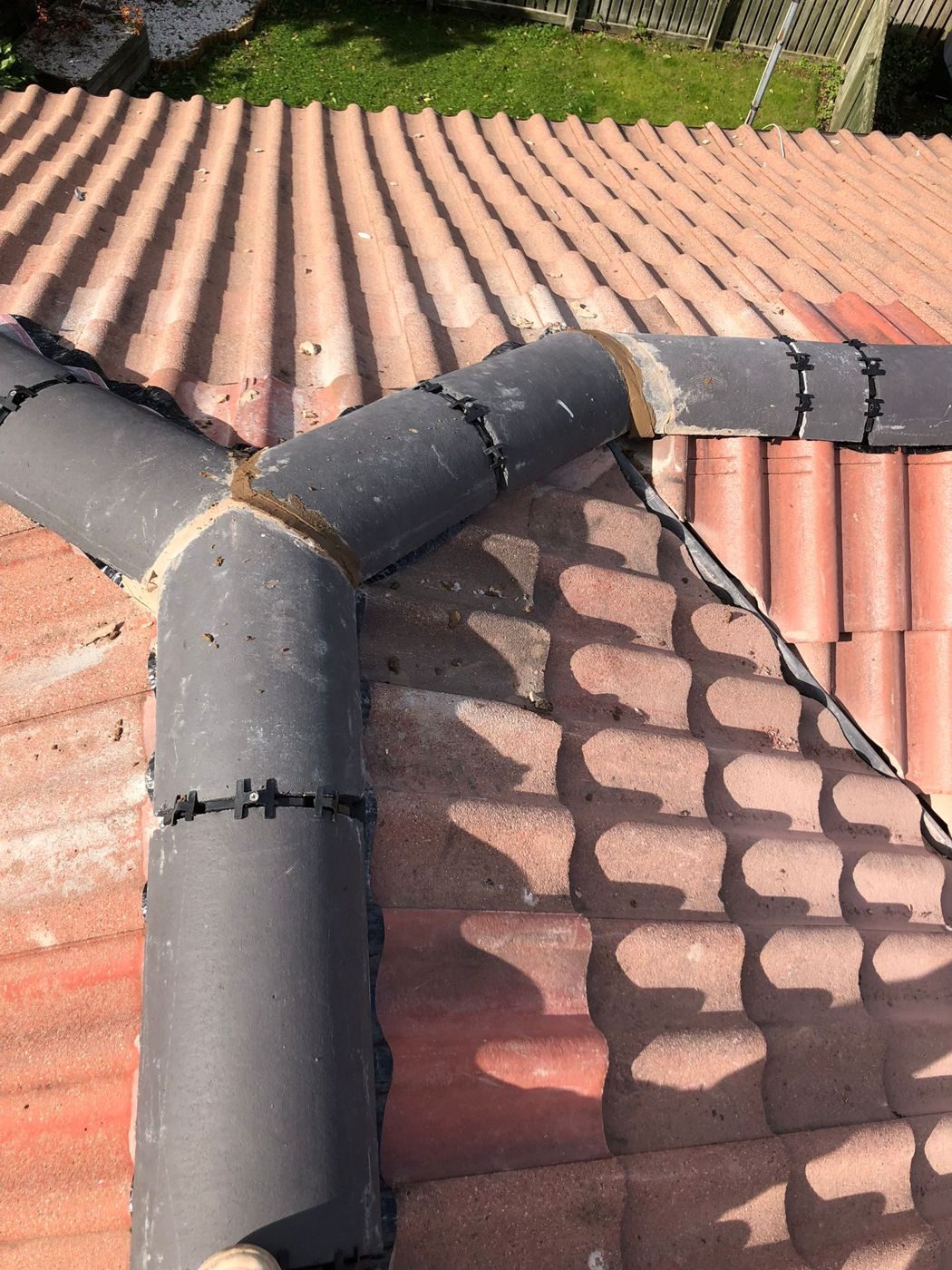
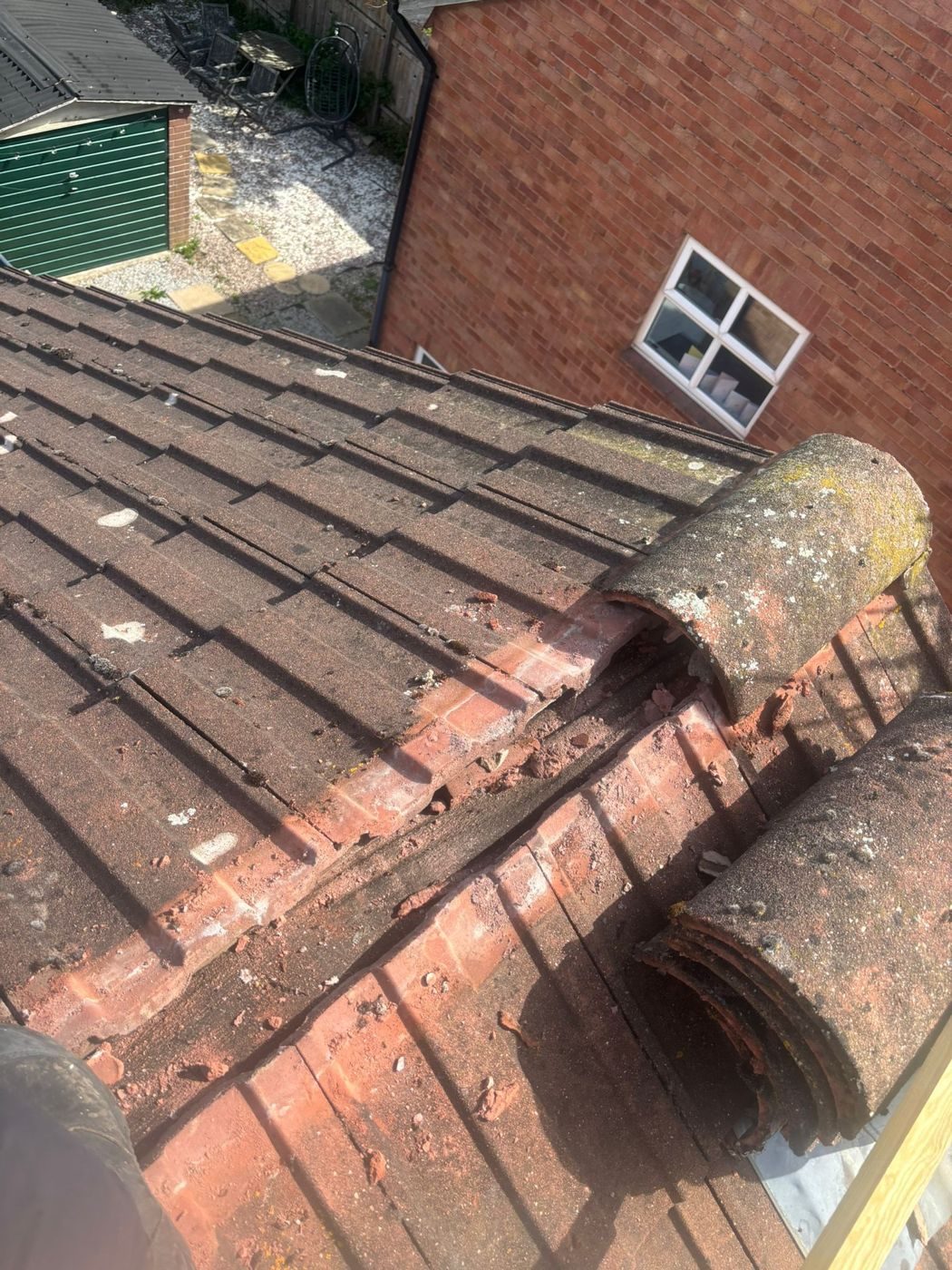
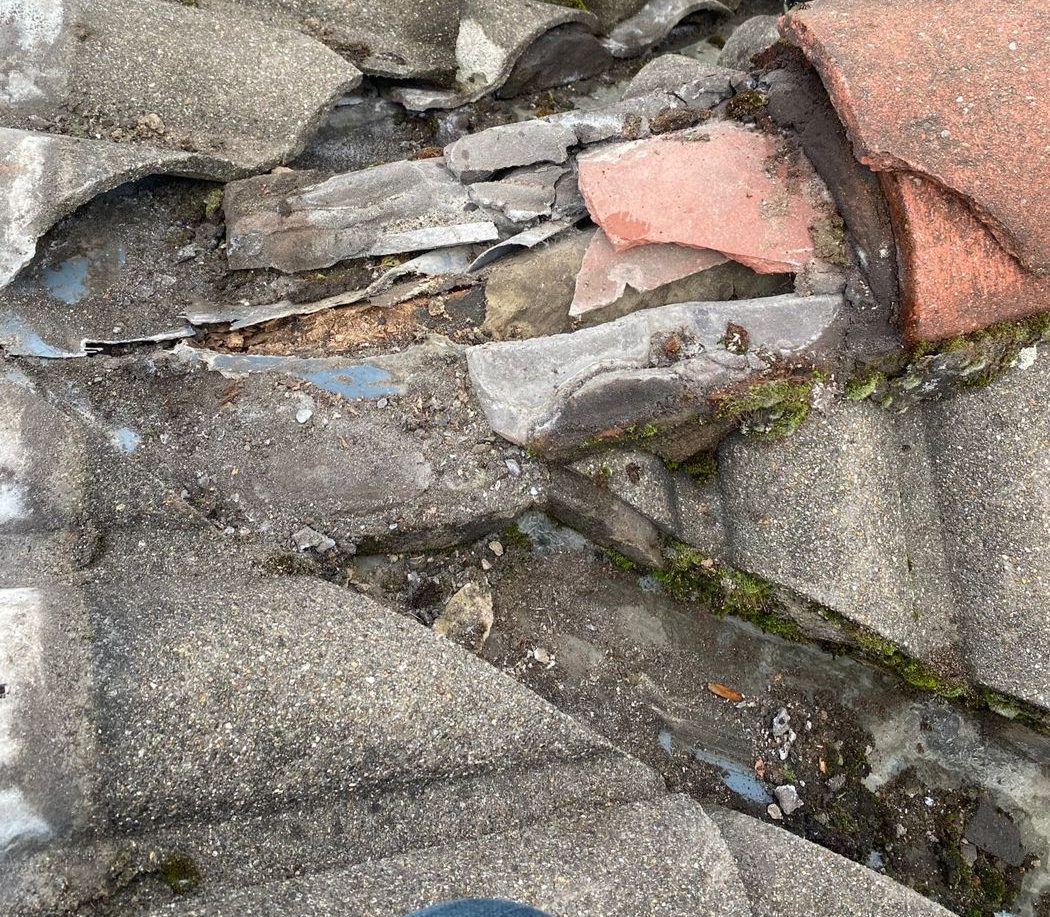
Photographs of our own work. None of them is a storm job — they show the parts that fail and how they are put right. More on the storm damage hub.
Start with what you can see from the back door. Slate that has let go from a rear slope does not slide gently. It drops from the eaves height of a two-storey house onto stone flags, and it shatters into sharp, thin shards that scatter across a yard only a few paces wide. Ridge fragments are heavier and fall straighter. Some land in your yard, some clear the wall and land in the entry, and some drop through the glazing of the addition below. Treat every one of those pieces as evidence of where the roof has opened up.
The reason the same thing happens up and down the row is simple. A terrace is one continuous roof with walls underneath it at intervals, so the weak points repeat: the ridge bedding along the top, the verges at the end of the run, the lead at each party wall, the top courses of slate where the wind gets most leverage. When a gust lifts a ridge tile on one house, the tiles either side of it have usually had exactly the same winters. Neighbours on the same run commonly find that they are all describing the same fault within a day of each other.
That has a practical side. Slates that are only partly dislodged above a shared entry are a hazard to anyone walking through it, so the first job is often to deal with what is hanging rather than what has fallen. Water that gets in at one house can also travel along the battens into the next, so a leak showing in your back bedroom may begin on a roof that is not yours. We tell you plainly when we find that, and put it in writing so there is something to show the neighbour. We cannot go onto another property without the owner’s say-so.
Your yard is the best collector of evidence you have, so look there before anywhere else, and do it from the ground. Slate shards, grey crumbs of mortar and curved red fragments each point to a different part of the roof. Check the gully in the corner too, because a gutter that has been knocked or filled with grit will overflow onto the back wall and show up inside as a damp patch long before it looks serious from outside.
The back entry gives you a long view of the whole rear slope, and the bedroom window gives you a safer one still. A phone held out of an open window will photograph a surprising amount of roof. Take pictures before anyone tidies up, including the pieces on the ground where they landed, then send them to us on WhatsApp. Please do not climb up to look, and do not try to sheet the roof yourself.
On most Crewe terraces the front door opens straight onto the pavement, and there is no drive or side passage. Everything for a make-safe, whether that is a tower, a few lengths of scaffold or the boards and fixings, comes through the back entry by hand, or occasionally through the house. A turn into a narrow yard gate decides what lengths can go through, so we work out the route before we turn up. Where the entry is shared or gated, we want to know about the key and about bins before the day. The entry cannot be blocked and has to remain walkable for everyone on the row.
Waste goes out the same way it came in. Broken slate is bagged and carried, not dropped, because below the roof there is a small yard, sometimes a glass roof and often neighbours. Where a scaffold or tower cannot stand in the yard, the front becomes the option, and a platform over a public pavement needs the council’s consent through Cheshire East, which affects timing. Scaffolding is quoted separately, so what the access involves is visible rather than hidden in a rate. If a low tower will do, we say so.
The make-safe comes first and on a terrace it often means removing loose material before it can fall into a yard or an entry. We take off slates and ridge pieces that are no longer held, cover open areas properly from a safe platform, and keep water out until the weather allows the permanent work. We then write a report with photographs that shows what failed and where, which your insurer can use. We are roofers, not loss assessors, so we do not deal with insurers or say what a policy covers.
The permanent repair is done in dry weather and on the actual fault. On a Crewe terrace that usually means replacement of broken slates with ones that sit properly alongside the old, rebedding or mechanically fixing ridge tiles, and renewing lead at the party wall or chimney junction. Where several houses on a run are at the same stage, working together can make sense for access and for the scaffold, but each owner decides for their own roof. Our roof repairs in Crewe page explains the wider range of repairs. See also Whose Insurance Is It? Flats, Leaseholds and Shared Roofs and What Should Be in a Roofer’s Report for an Insurance Claim?.
If water is coming in now, ring rather than fill in a form. Weekday emergency call-outs are answered around the clock; weekend cover runs from eight in the morning until seven in the evening. Please do not go up to look: describe what you can see from the ground.
Photograph everything before anybody tidies or moves anything, because that is the evidence. The steps for the hours after a storm are set out in what to do after storm damage to your roof, and the general picture is on our storm damage hub.
What an insurer means by a storm, why wear and tear turns claims down, what belongs in a roofer's report, who pays for the make-safe, and who is who in a claim. The aftermath itself — what to do first, what to check — is covered in detail on our roof repairs section and linked throughout rather than repeated here.
“job well done good communication throughout the job very clean and tiddy when the job is finish flat roof replacement many thanks.”
Sumit Bal“Excellent service from Buddy and the team in installing a new garage roof in a really professional manner. Was kept updated at all stages and given good advice as to our options. Would highly recommend”
Peter Aspinall“Very professional efficient team great communication
Would definitely recommend made the process quick and easy will definitely look to keep for any future need
Thankyou”
Every town has its own page, written around the roofs that are actually there. Start with the main storm damage page.
Describe the roof and roughly where you are, and we will come back to you — usually the same day. If water is coming in now, please call instead.
Prefer to talk? Call 07464 259566 · WhatsApp 0044 7464 259566 · Email Evensbuddy@yahoo.com
We work across Chester, Cheshire and the Wirral from our base at Elton, just north of Chester.
2 Manley View
Elton
Chester
CH2 4QF
Almost all of our work happens at your property rather than here, so please call before travelling.
Monday – Friday — 24hrs — Emergency Call-Outs
Saturday — 8:00 – 19:00
Sunday — 8:00 – 19:00
Weekday emergency call-outs are answered around the clock. Weekend cover is 8:00 to 19:00.