★★★★★
“job well done good communication throughout the job very clean and tiddy when the job is finish flat roof replacement many thanks.”
Sumit Bal
Bebington’s hipped semis shrug off most of a gale, which is why the damage that does happen sits at the hips, the ridge junctions and the lead behind the chimney. Here is what to look for and what we do.
A hipped roof is about as good a shape as there is for standing up to a gale. With slopes on every side there is no gable wall for the wind to lean on and no open verge for it to get under, so the air tends to ride up and over rather than pile in. Much of Bebington went up that way, as bay-windowed semis with a short ridge and a chimney stack coming out of a slope, and after a bad night the main slopes of those houses often look untouched. See our roof repairs in Bebington page for the general picture of how these roofs age.
That is exactly the catch. A roof that sheds wind well does not take less force; it hands the force to the places where the slopes meet. The hip lines, the foot of each hip, the point where the hips run into the ridge and the lead trough behind the stack are all bedded, lapped or tucked in rather than simply laid, and they are the parts that give.
What follows is about those places in particular: what the weather does to them, how to read them from the garden without going anywhere near the roof, how we get at a roof with no gable to build against, and how the job is made safe and then put right. The general order in which wind takes a roof apart is on the storm damage roof repairs page; this one extends it for the hipped shape.
The components a gale usually finds first, and the repairs that follow them.
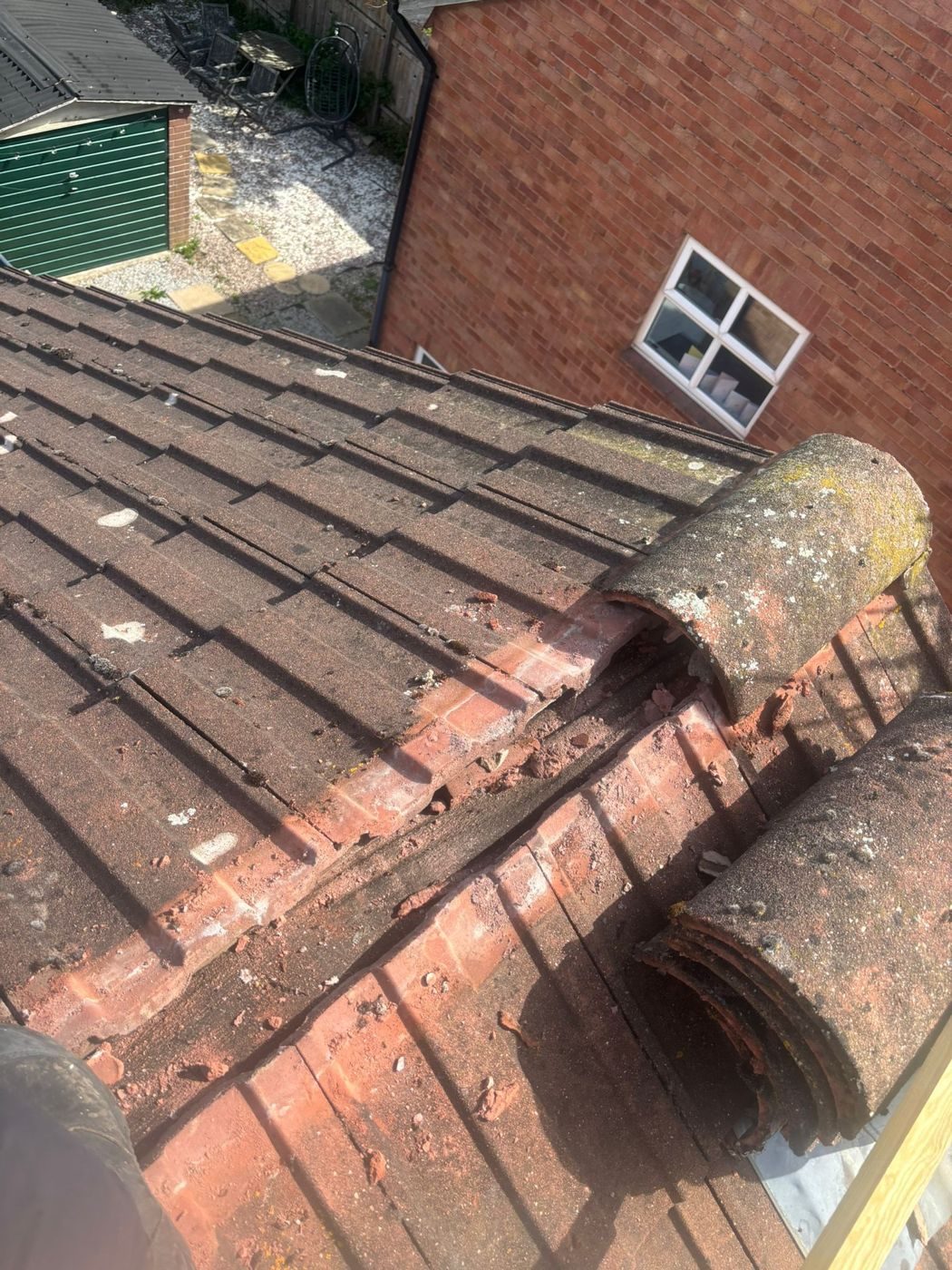
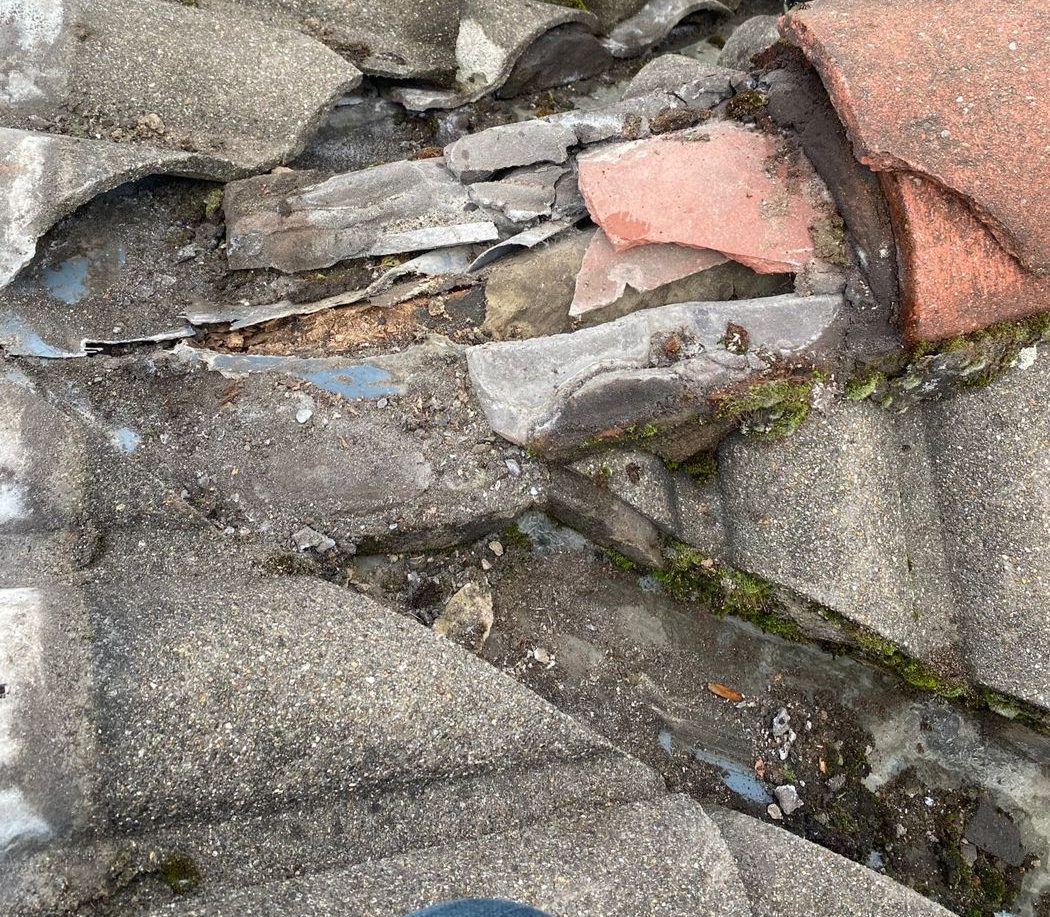
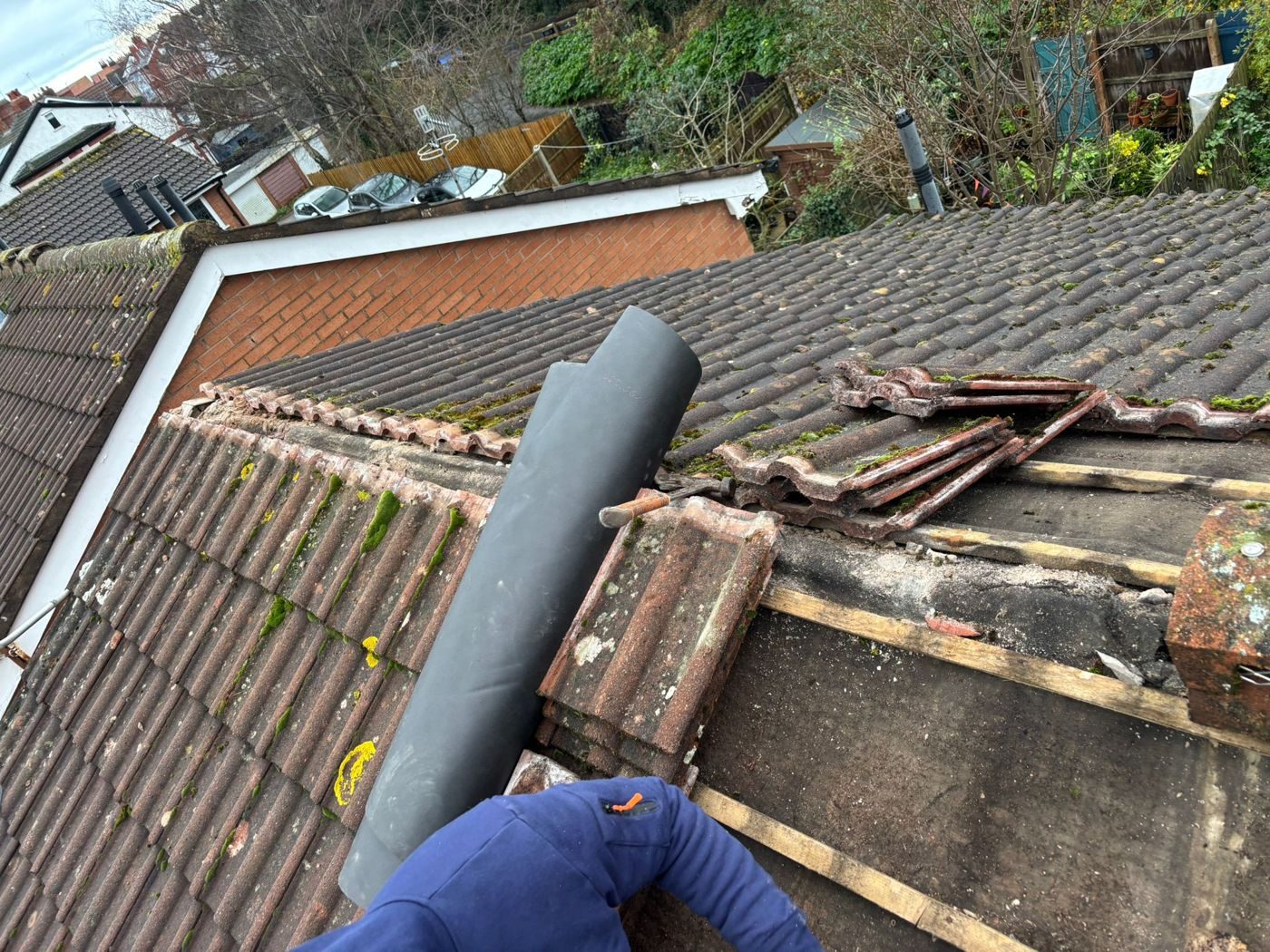
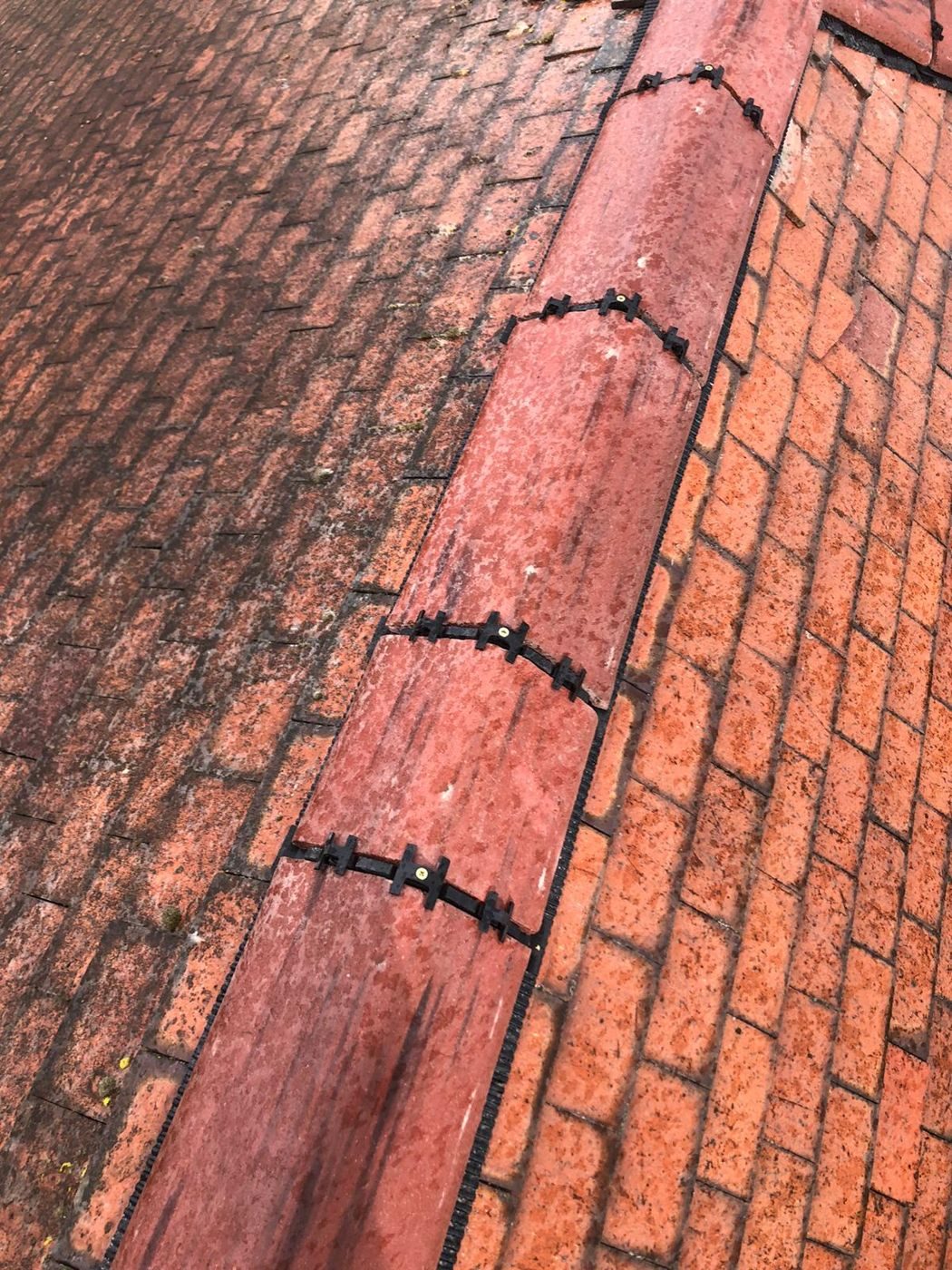
Photographs of our own work. None of them is a storm job — they show the parts that fail and how they are put right. More on the storm damage hub.
Start with the hip itself. It is a line of tiles running diagonally down to a corner, and on the typical inter-war house those tiles were bedded in mortar that has had a very long time to crack. Wind lifts along that line the way it lifts a ridge, and a hip tile with nothing holding it but its own weight and its neighbour goes sideways or slides. A small metal hip iron screwed to the rafter at the foot is meant to stop the bottom tile leaving, and on many of these houses it has rusted away unnoticed. The bottom tile is also the one over the path, the drive or the front door, which makes a moved hip a danger to a person before it is a leak.
The second weak point is the junction at the top, where the hip lines meet the ridge. Several lines of tile converge there on one bed of mortar, and that bed carries more than its share of the movement. When it opens, an end tile or the cap over the meeting point shifts first, and a loosened piece at the highest spot on the roof has a long way to fall down a slope that funnels it toward the eaves.
The third is not about wind at all. Storms bring rain with them, and a cloudburst tests the lead behind the chimney. On a hipped roof the slopes above the stack all drain onto its uphill face, so one narrow back gutter takes everything. If a gale has just dropped mortar, moss and grit into that trough, or it was laid without a proper fall, it fills and spills over its upstand into the brickwork, then shows up indoors as what looks like a chimney that needs repointing. Our chimney repairs in Bebington page covers how the trough is built, and the difference between a wind failure and an overflow is worth stating plainly in any report.
Stay on the ground and use your eyes, or a phone zoomed in on the roofline. On a hipped roof the clues are almost always along the diagonals and around the stack, and it helps to stand back far enough to see each slope in profile rather than from directly underneath.
Photograph anything you notice before it is moved, from more than one position, and take a wider shot that shows where it sits on the house. Pictures from the ground are useful to us, and the closer inspection from the roof is something we do from a tower or scaffold.
A hipped roof gives a scaffold nothing to lean against. There is no gable standing above the eaves, so the platform cannot simply run up one end; it has to be returned round the corner and along the elevation until it reaches a stack standing part way up a slope. It also needs to stand far enough from the wall that the lead behind the stack can be worked on from the platform rather than from the tiles, which is a different set-out from the same job on a gable-ended house and a good reason we want to see the roof before we quote.
The plot adds its own problems. Many of these semis have a drive down one side and a passage down the other that has since been closed by a garage or side extension, so tube and boards may need to go over a garage roof that is boarded first, or through the house. Where the work reaches over the party line, the neighbour needs to know before anything is delivered. The covering, whether clay or an early concrete tile, is not safe to walk on. Scaffolding is quoted separately, and we will say plainly where a tower is enough.
The make-safe comes first and it is mostly about people. A hip tile that has moved is secured or removed from a tower or scaffold, the ground below it is kept clear, and if the back gutter is blocked we clear the outlet so that the next downpour runs away rather than into the wall. That is temporary work and we describe it as such. The report that follows, with photographs from the roof, says what failed, where, and what looks recent as against long-standing, and it is the document to put in front of your insurer; see What Should Be in a Roofer’s Report for an Insurance Claim? and Storm Damage or Wear and Tear? Why Roof Claims Get Turned Down for how that reading works.
The permanent repair is then done in dry weather. Hips and ridge can be rebedded in fresh mortar, which matches what is there, or fixed dry with clips, which does not rely on mortar and does not crack when the roof moves; we will price either and say which we would choose. A missing hip iron is replaced so the bottom tile cannot slide, and a back gutter that has no fall is rebuilt as a proper trough with its side flashings. Where original clay tiles have to be replaced, a salvaged match is better than a few new ones in the middle of an old roof, and Can You Match My Tiles? Part-Repairs, Reclaimed Tiles and “Matching Sets” explains why.
If water is coming in now, ring rather than fill in a form. Weekday emergency call-outs are answered around the clock; weekend cover runs from eight in the morning until seven in the evening. Please do not go up to look: describe what you can see from the ground.
Photograph everything before anybody tidies or moves anything, because that is the evidence. The steps for the hours after a storm are set out in what to do after storm damage to your roof, and the general picture is on our storm damage hub.
What an insurer means by a storm, why wear and tear turns claims down, what belongs in a roofer's report, who pays for the make-safe, and who is who in a claim. The aftermath itself — what to do first, what to check — is covered in detail on our roof repairs section and linked throughout rather than repeated here.
“job well done good communication throughout the job very clean and tiddy when the job is finish flat roof replacement many thanks.”
Sumit Bal“Excellent service from Buddy and the team in installing a new garage roof in a really professional manner. Was kept updated at all stages and given good advice as to our options. Would highly recommend”
Peter Aspinall“Very professional efficient team great communication
Would definitely recommend made the process quick and easy will definitely look to keep for any future need
Thankyou”
Every town has its own page, written around the roofs that are actually there. Start with the main storm damage page.
Describe the roof and roughly where you are, and we will come back to you — usually the same day. If water is coming in now, please call instead.
Prefer to talk? Call 07464 259566 · WhatsApp 0044 7464 259566 · Email Evensbuddy@yahoo.com
We work across Chester, Cheshire and the Wirral from our base at Elton, just north of Chester.
2 Manley View
Elton
Chester
CH2 4QF
Almost all of our work happens at your property rather than here, so please call before travelling.
Monday – Friday — 24hrs — Emergency Call-Outs
Saturday — 8:00 – 19:00
Sunday — 8:00 – 19:00
Weekday emergency call-outs are answered around the clock. Weekend cover is 8:00 to 19:00.