★★★★★
“Excellent work replacing ridge tiles, repointing chimney and repairing flashing. Also fixed other broken tiles. Clean and tidy job. Would definitely recommend.”
Neil
Leaking roofs, slipped and cracked tiles, storm damage, chimneys and flat roofs across Widnes — with weekday emergency call-outs around the clock.
A great deal of Widnes was roofed in the same twenty-five years. The estates that went up either side of the 1960s used interlocking concrete tiles almost without exception, and those roofs are now somewhere between fifty and seventy years old. That single fact explains most of the roof repair calls we take from Widnes.
It matters because a concrete tile roof does not fail the way people expect. The tiles rarely fall apart. What happens instead is slower and less obvious, and it changes what a sensible repair looks like.
We look at the roof before we quote, and on a Widnes estate house that usually means looking at more than the tile someone has spotted from the garden.
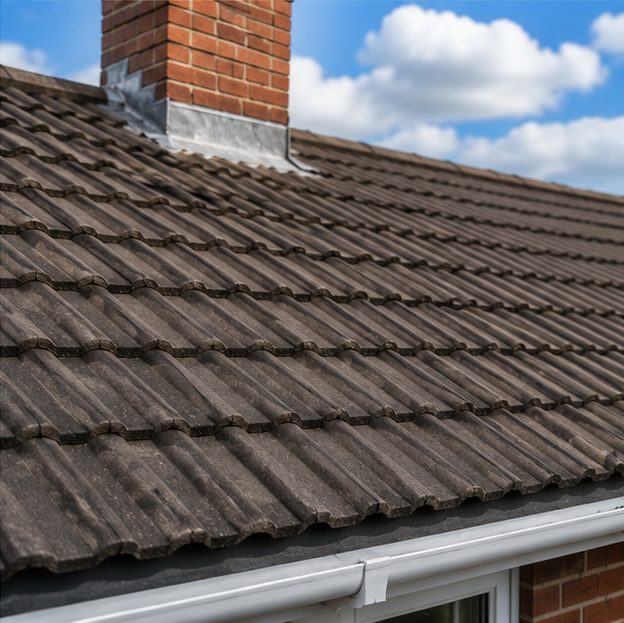
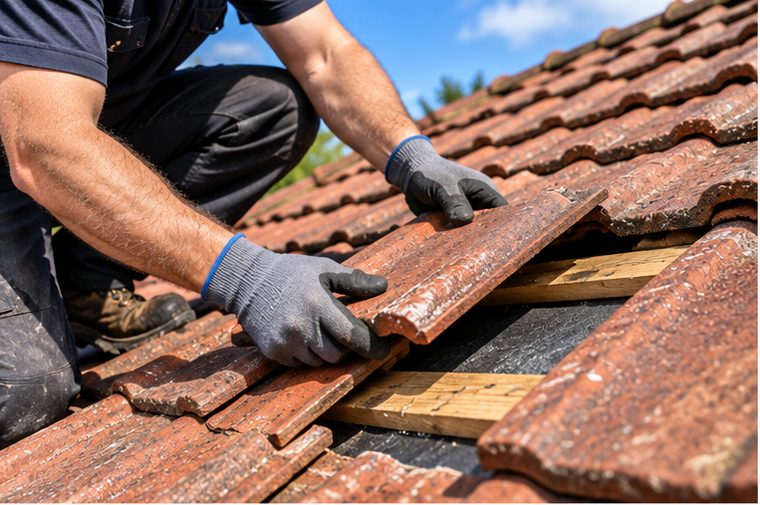
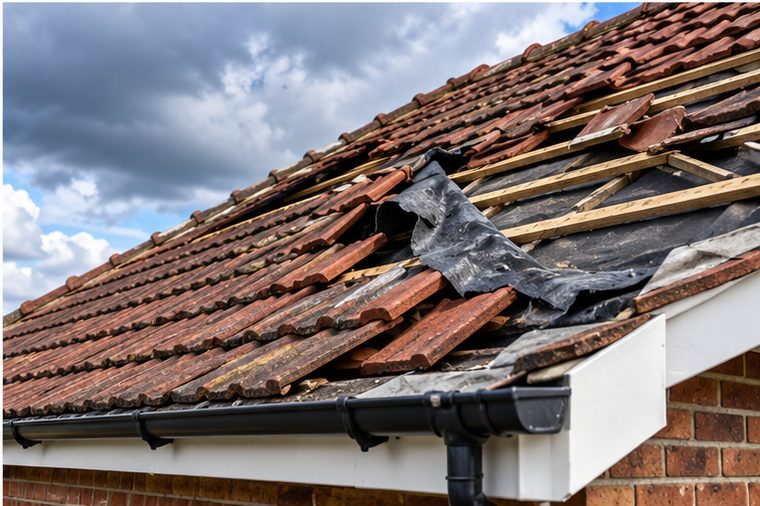
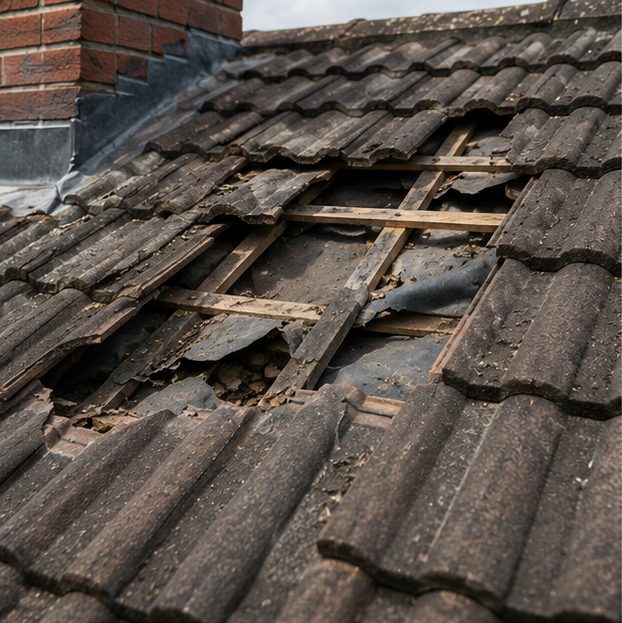
The first thing we check on a concrete tile roof of this age is the surface of the tiles themselves. Concrete tiles are made with a coloured cement slurry on top of a grey body. That surface weathers off over decades, and once it has gone the tile starts to take up water rather than shed it. A roof where the tiles have gone from brown to patchy grey and hold damp for days after rain is telling you something about its remaining life, even if not one tile is broken.
The second thing is the fixings. On roofs of that period only every third or fourth course tends to be nailed, with the rest relying on the tile nibs hooking over the batten. That works perfectly well until a batten softens or a nail corrodes, and then tiles start to creep downwards a few millimetres at a time. A row of tiles sitting slightly lower than the row beside it is worth a look long before anything actually slips.
The third is the ridge. Mortar-bedded ridges from that era have usually been repointed at least once, and mortar applied over old mortar rarely lasts as long as the original. Loose ridge tiles on a two-storey estate house are a safety problem as much as a leak, because there is nothing between them and the path.
Where all of that is sound and one tile has cracked, the repair is a repair and we will say so. Where the tile surfaces have gone, the fixings are tired and the ridge has been patched twice, replacing a single tile is buying a few months. We would rather tell you which of those two situations you are in than sell you the small job and be back in the spring.
Widnes sits on the north bank of the Mersey with very little between it and the estuary, so the wind arrives with a run-up. That does not damage a roof that is in good order, but it finds anything that is already loose. Gable ends, verges and the first course above a gutter are where we most often see the result.
It also produces one of the more useful diagnostic clues. If your roof only leaks when the rain is coming in hard from one particular direction, and stays dry through ordinary vertical rain, the defect is almost always at a junction or an exposed edge rather than in the middle of a slope. Tell us that when you call — it saves time on the roof.
On the Widnes estates the honest answer is that a good many roofs are repairable and a growing number are not, and the two look identical from the pavement. The test we apply is whether there is a reason the failure happened. A cracked tile under a dropped branch, a lifted flashing, a blocked valley — those are reasons, and they are repairs.
A tile that simply gave way, on a roof where two others gave way last year in different places, is not a reason. That is a covering coming to the end of its service life, and each repair is buying less time than the one before it. If that is what we find, we will say so, and the new roof installations page covers what the alternative involves.
Storm damage in Widnes concentrates at the top and the edges of a roof. The estates here are largely two-storey with long unbroken runs of ridge, and a ridge bedded in mortar that has already been repointed once is what a strong westerly finds first.
The other regular one is the verge at a gable end. Once the wind has lifted the first tile at an exposed verge it has an edge to work at, and the rest of that run goes considerably faster than the first one did.
Emergency call-outs run 24 hours a day, Monday to Friday, with Saturday and Sunday cover from 8:00 to 19:00.
Leaking roofs, slipped and broken tiles, damaged slates, storm damage, valleys, chimneys, leadwork, flat roofs, ridges and verges. The main roof repair page has the detail on each of them.
“Excellent work replacing ridge tiles, repointing chimney and repairing flashing. Also fixed other broken tiles. Clean and tidy job. Would definitely recommend.”
Neil“Would highly recommend roofline solutions they arrived in time an explained to me what need to be done well spoken and polite”
Kyle Cummings“Highly recommend. Very quick and efficient. Great communication. Went above and beyond to work the weekend to complete the work that needed to be done. Very happy with the results.”
Karen JonesWritten for Widnes rather than for roofs in general. The ones not yet published are listed rather than linked, because a link to a page that does not exist yet helps nobody.
Every town below has its own page, written around what the roofs there are actually like.
Describe what is happening and roughly where you are, and we will come back to you — usually the same day. If water is coming in now, please call instead.
Prefer to talk? Call 07464 259566 · WhatsApp 0044 7464 259566 · Email Evensbuddy@yahoo.com
We cover Widnes from our base at Elton, just north of Chester.
2 Manley View
Elton
Chester
CH2 4QF
Almost all of our work happens at your property rather than here, so please call before travelling.
Monday – Friday — 24hrs — Emergency Call-Outs
Saturday — 8:00 – 19:00
Sunday — 8:00 – 19:00
Weekday emergency call-outs are answered around the clock. Weekend cover is 8:00 to 19:00.