★★★★★
“job well done good communication throughout the job very clean and tiddy when the job is finish flat roof replacement many thanks.”
Sumit Bal
In Knutsford a storm often lands on a protected roof. We make it safe at once, record what failed in a photographed report, and keep permanent repairs like-for-like until the council has been asked.
A gale does not check whether a roof is protected before it takes a ridge tile. In Knutsford that matters more than in most places we work, because so much of the town sits inside the conservation area around King Street and Princess Street, and so many of the older buildings out towards Tatton are listed in their own right. The wind does the same damage it does anywhere. What changes is what you are allowed to do about it afterwards.
There are two jobs here, and on an old roof they deserve to be kept well apart. The first is the emergency: stopping water, removing or refixing whatever is loose above a pavement or a doorway, and getting the building dry. Nobody sensible argues with that, and it can start straight away. The second is the permanent repair, and that is where a listed or conservation-area roof asks for patience and a conversation with the council before anyone orders materials.
What follows is how we handle both in Knutsford, and why the order matters. It runs on from the general account on our storm damage roof repairs page, which explains what wind breaks and in what sequence, so we have not repeated that here. This is the protected-building end of it.
The components a gale usually finds first, and the repairs that follow them.
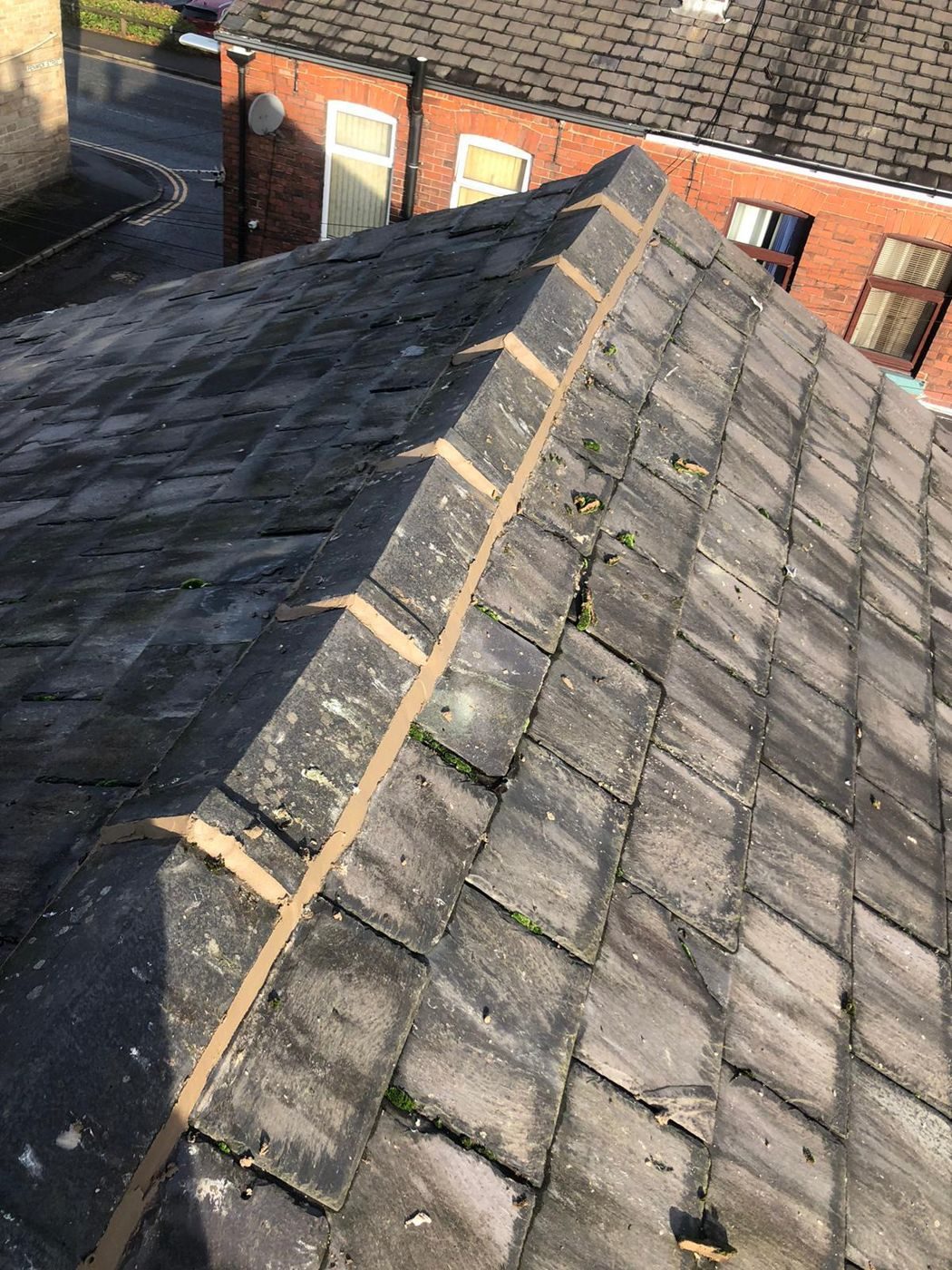
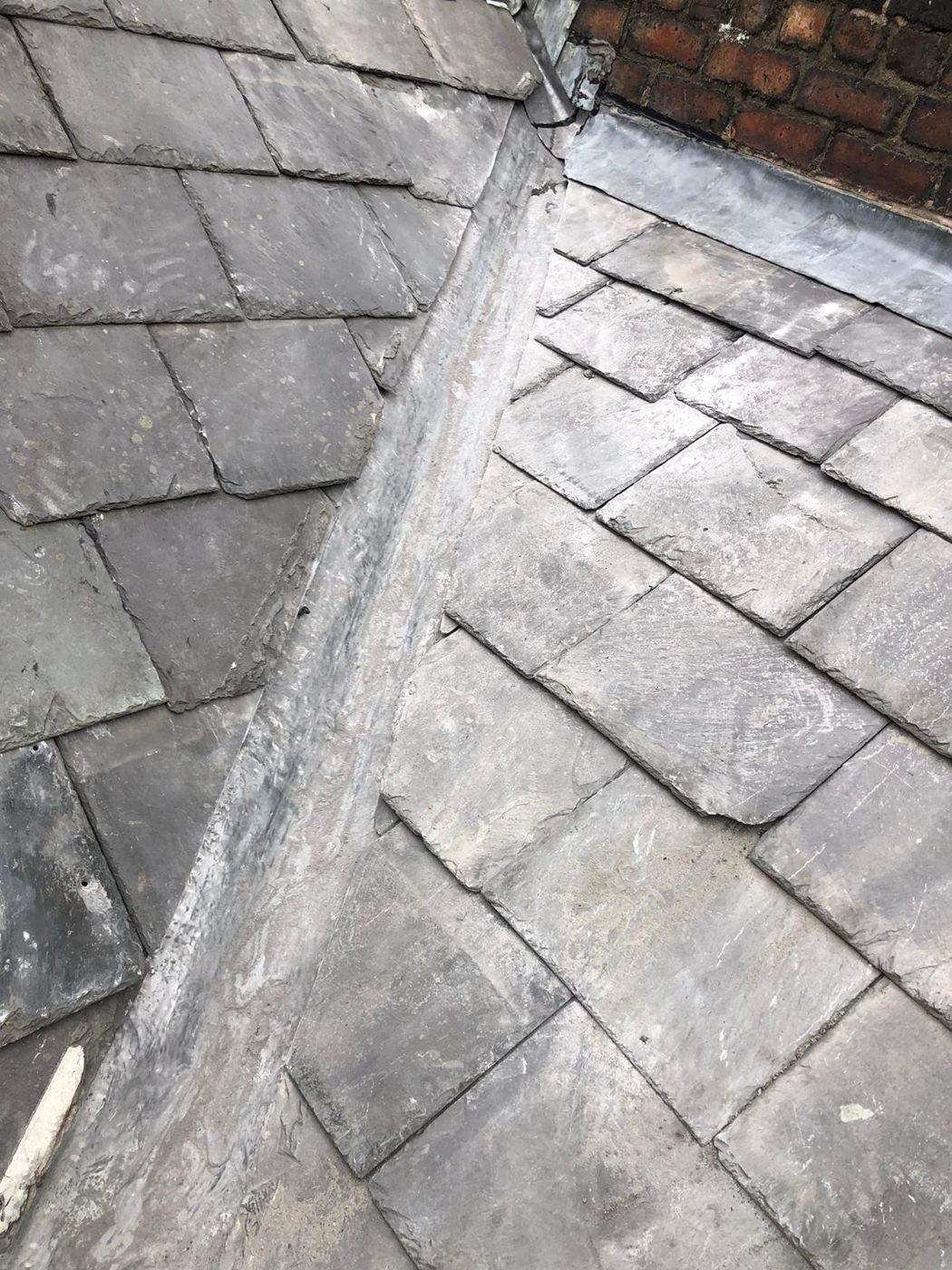
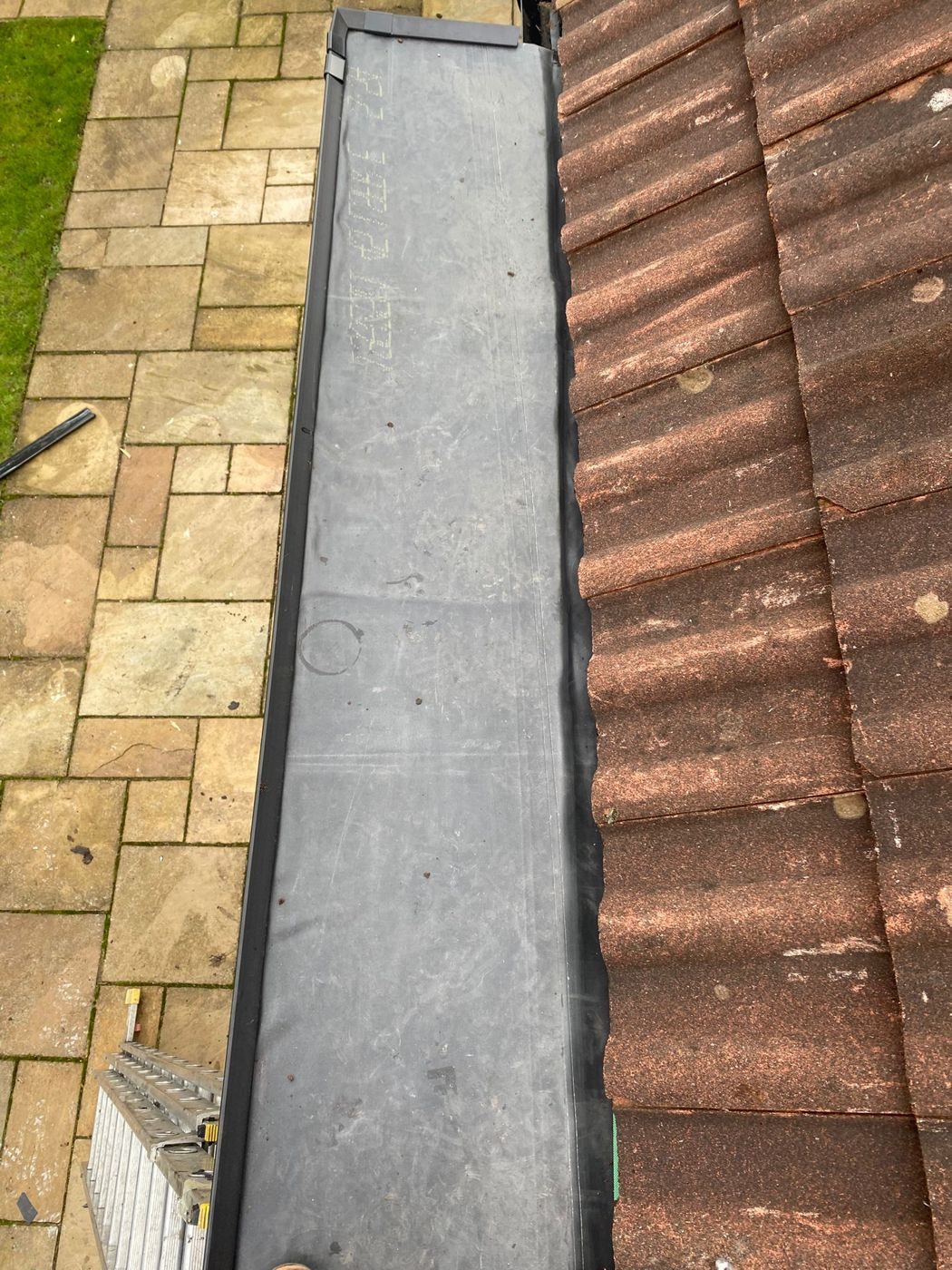
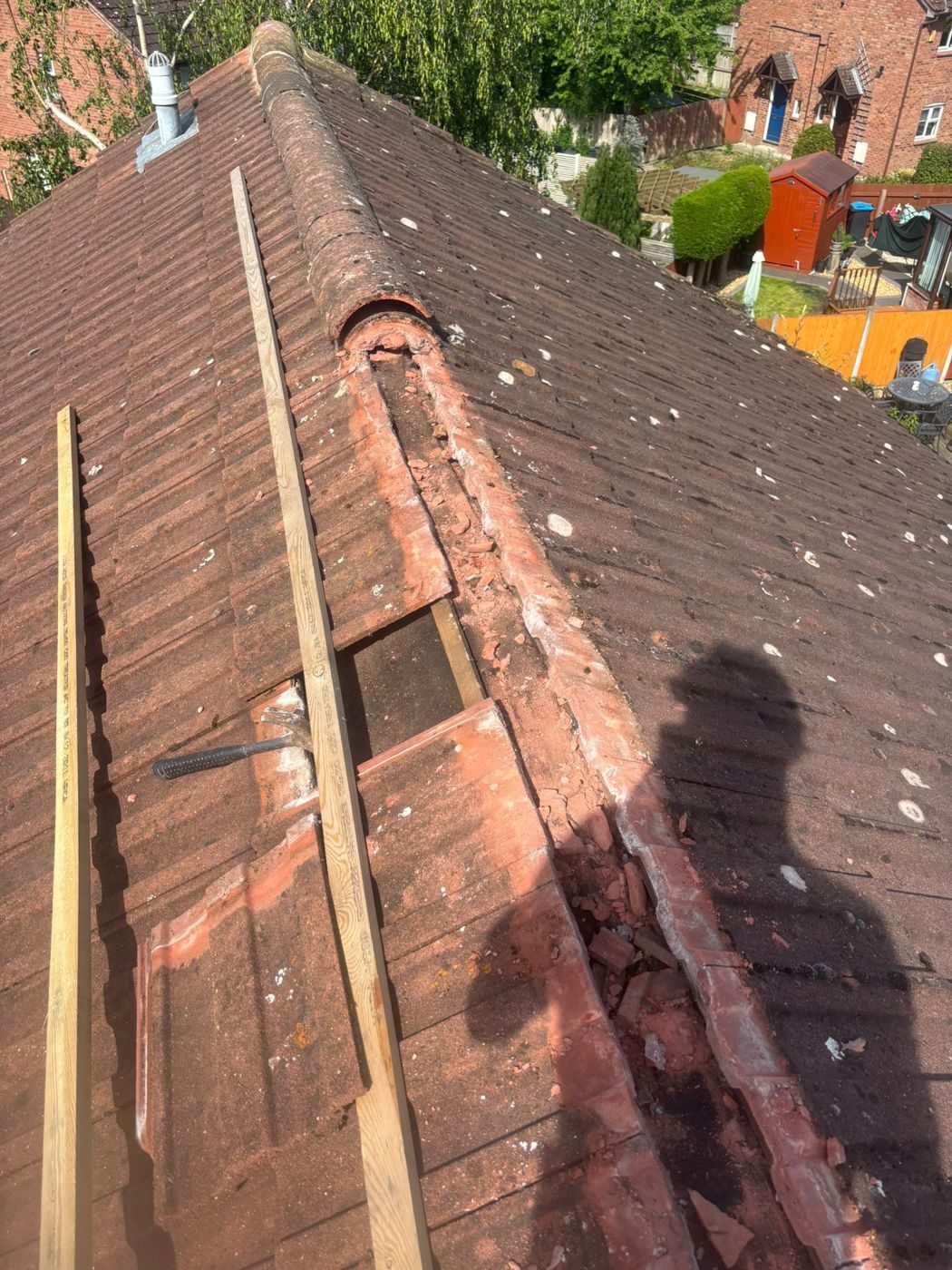
Photographs of our own work. None of them is a storm job — they show the parts that fail and how they are put right. More on the storm damage hub.
The sound principle on an older building is that an emergency measure should protect it without deciding anything about its future. We make a roof safe in a way that can be taken off again: sheeting fixed so that it does not bite into old timber, loose slates secured or lifted clear and kept rather than binned, and nothing bonded to stone or brick that cannot be removed later. Stopping water from entering a historic roof is urgent, and acting quickly to protect the building is the right call. Doing it in a way that leaves the permanent repair open is the part that takes thought.
The permanent repair is a different matter. On a listed building, work that affects its character can need listed building consent, and carrying it out without consent is an offence that stays with the building rather than with whoever did the work. In a conservation area the position is lighter but not absent, and an Article 4 direction can take away rights you might assume you have. Replacing like with like, in the same material, profile and finish, is generally treated as repair. Changing the covering, the ridge detail or the height of a stack is generally treated as alteration. This is general information, not legal advice, and the council is the authority.
So before permanent work on an older roof, talk to the conservation officer at Cheshire East Council. Ask in writing, describe what failed and what you propose to put back, and keep the reply. We will tell you what we think needs checking and supply the photographs and description to go with the question, but we do not apply for consent and we do not decide it. Your insurer will also care about materials, because matching an old covering is rarely a simple matter. How that works for tiles is set out in Can You Match My Tiles? Part-Repairs, Reclaimed Tiles and “Matching Sets”, and what the insurer’s own wording means is in What Do Insurers Actually Mean by “Storm Damage”?.
Older roofs rarely fail in the way a modern one does. A natural slate roof that has been on a building for generations may lose one slate from a course that is otherwise tight, or show a run of slipped slates where the nail holes have worn. Lead that was dressed into a chimney or a parapet gutter can lift at one edge and curl back. A stack built in soft brick or lime can lose its pointing on the weather face, so that mortar and grit arrive in the gutter. Many of these are small, which is why they are easy to miss from the pavement.
Do not go up to look. Stand back, use binoculars or the zoom on a phone, and photograph what you can see before anybody moves it. Pieces on the ground are evidence, and on a protected building they can also be the pattern we need to match, so please leave them where they fell, unless they are in the way of a doorway, and tell us where they came from.
Reaching an old roof in Knutsford is its own problem. On King Street and the lanes off it the buildings stand directly on the footway, there is no set-back to work from, and a platform on the public highway needs a licence from Cheshire East Council, a route kept open for people to pass and a start that avoids market or event days. Railings, thresholds and cast-iron downpipes can be protected features too, so everything the scaffold passes is boarded or wrapped, and ties go into mortar joints or through openings rather than into carved or moulded faces.
Out towards Tatton and the farm buildings the problem turns round. There is plenty of room, but the lanes may not take a scaffold wagon, so the last stretch is carried in by hand. On a low outbuilding we may not need a scaffold at all, and we will say so. Where one is needed it is quoted separately rather than buried in a rate, and the quotation is free and in writing. We are fully insured for this work.
Once the roof is safe and dry we record before we repair. That means photographs of each face, the slate sizes and the way they are laid, the profile of the ridge, the make-up of the lead and a sample of the existing mortar, because its colour comes from the sand and the sand is what a new mix is matched to. The same record goes into our report with the photographs of the damage, so the insurer, the council and the owner are all looking at the same facts. What Should Be in a Roofer’s Report for an Insurance Claim? sets out what a good report ought to contain.
Then comes the repair itself, in materials the building was made with. That usually means salvaged or matched natural slate rather than the nearest modern substitute, lead rather than a tape or coating, and lime mortar rather than cement where the walls are soft, since hard cement traps moisture and pushes damage into the masonry. Our roof repairs in Knutsford page covers the wider rules for protected buildings in Knutsford, and the chimney repairs in Knutsford page covers stacks and pots. We will tell you plainly if something should wait for the council before it is touched.
If water is coming in now, ring rather than fill in a form. Weekday emergency call-outs are answered around the clock; weekend cover runs from eight in the morning until seven in the evening. Please do not go up to look: describe what you can see from the ground.
Photograph everything before anybody tidies or moves anything, because that is the evidence. The steps for the hours after a storm are set out in what to do after storm damage to your roof, and the general picture is on our storm damage hub.
What an insurer means by a storm, why wear and tear turns claims down, what belongs in a roofer's report, who pays for the make-safe, and who is who in a claim. The aftermath itself — what to do first, what to check — is covered in detail on our roof repairs section and linked throughout rather than repeated here.
“job well done good communication throughout the job very clean and tiddy when the job is finish flat roof replacement many thanks.”
Sumit Bal“Excellent service from Buddy and the team in installing a new garage roof in a really professional manner. Was kept updated at all stages and given good advice as to our options. Would highly recommend”
Peter Aspinall“Very professional efficient team great communication
Would definitely recommend made the process quick and easy will definitely look to keep for any future need
Thankyou”
Every town has its own page, written around the roofs that are actually there. Start with the main storm damage page.
Describe the roof and roughly where you are, and we will come back to you — usually the same day. If water is coming in now, please call instead.
Prefer to talk? Call 07464 259566 · WhatsApp 0044 7464 259566 · Email Evensbuddy@yahoo.com
We work across Chester, Cheshire and the Wirral from our base at Elton, just north of Chester.
2 Manley View
Elton
Chester
CH2 4QF
Almost all of our work happens at your property rather than here, so please call before travelling.
Monday – Friday — 24hrs — Emergency Call-Outs
Saturday — 8:00 – 19:00
Sunday — 8:00 – 19:00
Weekday emergency call-outs are answered around the clock. Weekend cover is 8:00 to 19:00.