★★★★★
“Excellent service from Buddy and the team in installing a new garage roof in a really professional manner. Was kept updated at all stages and given good advice as to our options. Would highly recommend”
Peter Aspinall
On a good many newer Warrington roofs the chimney is a moulding or a stainless terminal rather than brickwork. What can honestly be repaired on one, what belongs to the flue installer, and the older brick stacks as well.
Warrington has been built and rebuilt more than most places in the north-west. There are Victorian and Edwardian streets at Latchford, Howley, Orford and Bewsey, older village cores at Stockton Heath, Grappenhall and Lymm, and then forty years of expansion on top of the new town designation — Birchwood, Westbrook, Chapelford and Great Sankey. Two quite separate kinds of chimney, on roofs a few miles apart.
On the newer half of that list the chimney is frequently not a chimney in the sense the word usually carries. A house built with a stove or a gas fire since the 1980s rarely has a masonry flue in it. It has an insulated stainless twin-wall system, and above the tiles that finishes either as a bare terminal standing on a flashing, or inside a moulded stack made of glass-reinforced plastic with a brick pattern pressed into its surface. From the road it reads as brickwork. It is not brickwork.
Roofline Solutions works on the weathering and the masonry: aprons, soakers, stepped flashings, back gutters, lead slates, fixings, pointing, heads, pots, cowls and rebuilds, on both sorts of roof. The flue itself is not ours. Liner joints, seals, clearances to timber and anything to do with how an appliance actually runs sit with a HETAS or Gas Safe registered installer, and sweeping sits with a sweep. Everything we do cover is on the main chimney repairs page.
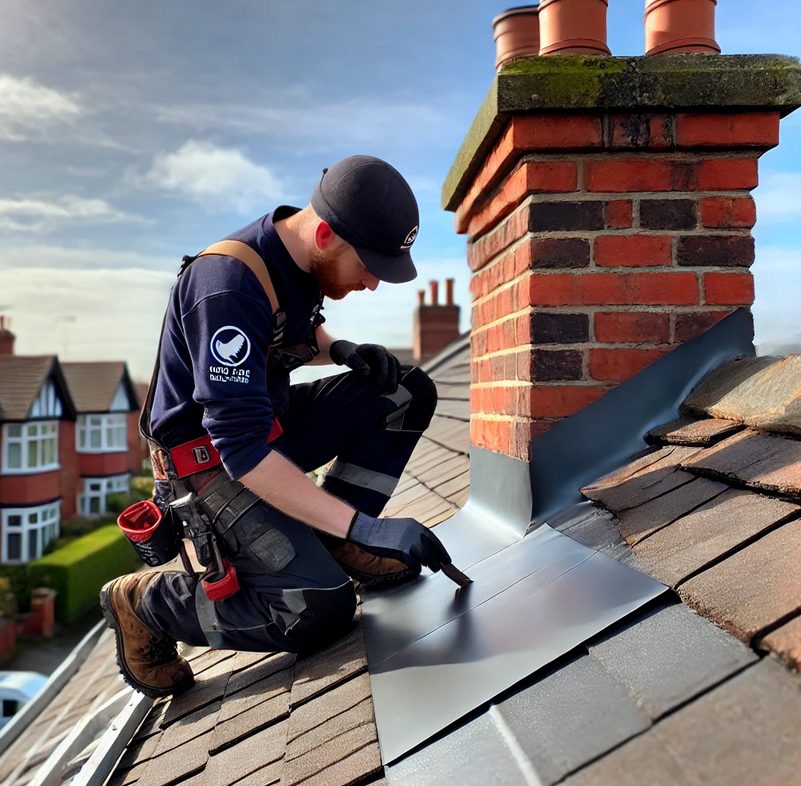
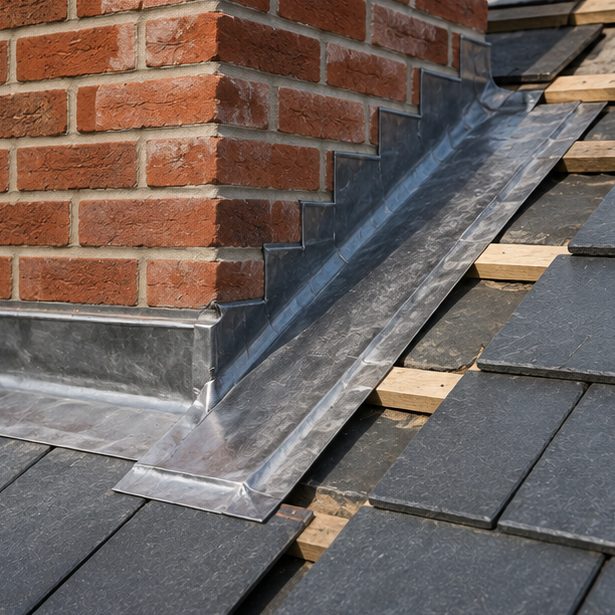
Images above are for illustration purposes only.
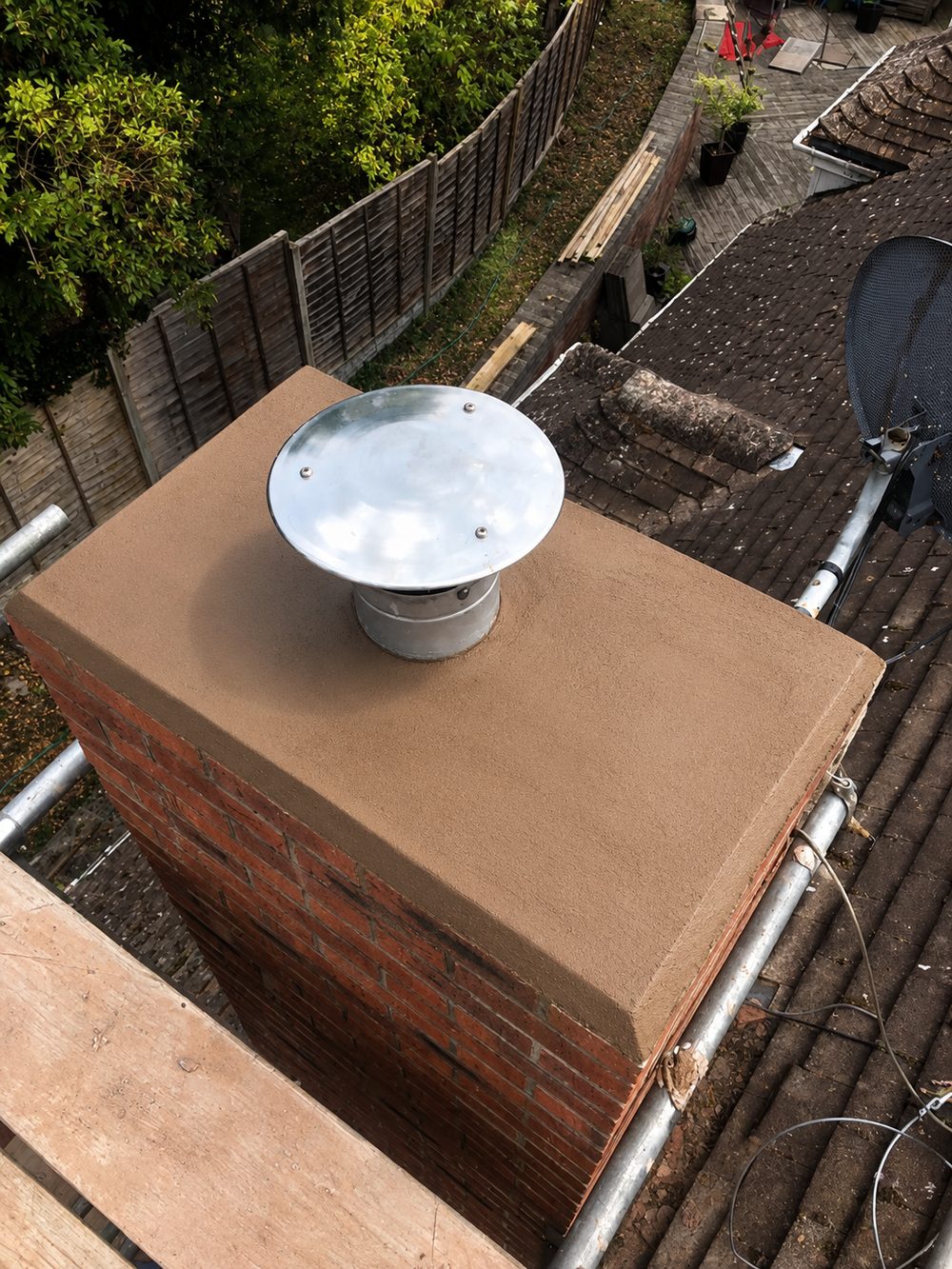
Photographs of our own chimney work. There are more on the main chimney repairs page and in the gallery.
A GRP dummy stack is a single hollow moulding, pressed in glass fibre with the brick or render pattern and the colour in the gel coat on its outer face. It weighs a small fraction of the masonry it imitates, which is the point of it: it sits on a timber kerb built off the rafters and is strapped down, so a builder can give a house a chimney without carrying any load down to a foundation. The twin-wall flue runs up the inside of it and finishes in a terminal poking through the top.
They do not fail the way a brick stack fails, because there is no mortar in them to erode and nothing to spall. What goes instead is the plastic and the fixings. Sunlight takes the gloss off the gel coat and leaves it chalky and faded; fine crazing opens at the corners and around the moulded detail; the straps and screws holding it down work loose in a gale; and the sealant somebody relied on at the terminal collar and along the skirt at the base goes hard, shrinks and lets go. Water then runs down the inside of the moulding, which nobody can see, and arrives at a bedroom ceiling long before anything looks wrong from the garden.
So the honest list of what can be done to one is short, and it is worth having before somebody quotes you for the wrong thing. It cannot be repointed, it cannot have a flaunching formed on it, a pot cannot be bedded into it and a chase cannot be cut into it, because there are no joints and nothing behind the face but air. What it can have is its fixings renewed and tightened back down to sound timber, the weathering at its base made properly in lead rather than topped up with another bead of mastic, a split or holed section repaired or the whole moulding swapped for a replacement, and the collar at the terminal re-formed. And where the flue below has been taken out of use, the moulding and its kerb can come off and the roof be closed up.
Plenty of people have no idea which kind they own, and from the ground there are four fairly reliable tells. The brick pattern repeats exactly — the same brick, the same crease, the same shade in the same place course after course — and the perps line up in a way no bricklayer would set out. There is no shadow in the joints, because the joints are moulded rather than recessed. The arrises are sharp and identical all the way round. And the thing sits on the slope behind a skirt rather than rising out of it behind stepped lead cut into courses.
Once you know what you are looking at, the failures are easy enough to spot. A moulding standing slightly out of upright, or one that visibly shifts in a strong wind, has lost its fixings. A dark gap or a line of daylight at the skirt, or mastic that has pulled away from the tiles and gone black and brittle, is the weathering finished. A terminal leaning in its collar, fine cracks fanning out from a screw head, and rust streaks running down the face all belong on the same list. Indoors the pattern is distinctive too: water showing in the loft alongside the flue pipe, well away from the roof junction, because it has come in at the top and run down inside.
The newer estates are easy to reach and awkward to stand on. Roads are narrow, cars are parked both sides, plots are tight and the gap at the gable is often barely enough for a scaffold base, so where the platform goes is settled at the survey rather than on the morning. Block paving and a resin drive both need boarding and sole plates to spread the load, a platform on the footway or a verge wants a licence from Warrington Borough Council, and solar panels dictate where a lift can be built.
Tying in needs a little more thought here than on an older house. Some of the newer stock is timber-framed behind a brick outer skin, so a tie that would be routine in a solid wall is placed where the structure will actually take it, and through-ties into window openings are often the cleaner answer. One thing we will not do at all is use a GRP stack as a hold, a step or a fixing point. It is a light moulding over fresh air and it was never meant to carry anything, which is also the problem with the aerial brackets and satellite dishes that keep turning up bolted through them.
Where a twin-wall flue comes straight through a tiled roof with no dummy stack around it, the weathering is a lead slate or a flexible flashing sheet dressed into the covering, with a storm collar clamped round the pipe above it to throw water out onto the sheet. Both pieces fail in ways worth knowing. The collar depends on a bead of sealant that perishes in a few seasons of heat cycling, and the lead immediately around the pipe gets worked hard by the same cycling and splits at the upstand. Done properly the sheet is dressed and lapped into the tiles like any other apron and the collar is taken off and renewed rather than buried.
On the older brick stacks around Latchford, Bewsey and the villages the work is the familiar four pieces — apron on the downhill face, soakers and a stepped cover flashing up the sides, back gutter behind — chased into bed joints and wedged, and the pots and their cowls follow whatever the flue is still doing. There is one line worth drawing at the top of a modern flue, though. A cowl or terminal on a twin-wall system is part of that system, and fitting the wrong pattern can change how the appliance below it behaves, so it is the registered installer’s decision and not a roofer’s. A bird guard on a redundant clay pot is ordinary roofing and a different question entirely.
Repointing, flaunching, stack rebuilds and removals, lead aprons, soakers, stepped flashings and back gutters, pots, cowls and bird guards — and the roof around the stack when it needs attention at the same time.
“Excellent service from Buddy and the team in installing a new garage roof in a really professional manner. Was kept updated at all stages and given good advice as to our options. Would highly recommend”
Peter Aspinall“Had Roofline Solutions come and do our guttering today and done a great job. Our guttering was dangerous, after messaging over the weekend, they came Tuesday and sorted it out by Wednesday. Tidy and communicated everything to me. Thanks”
Emma Pickett“Excellent work replacing ridge tiles, repointing chimney and repairing flashing. Also fixed other broken tiles. Clean and tidy job. Would definitely recommend.”
NeilWritten for homeowners working out which part of a chimney has failed, before anyone comes out.
Every town below has its own page, written around the stacks that are actually on the roofs there.
Describe what you can see and roughly where you are, and we will come back to you — usually the same day. If water is coming in now, please call instead.
Prefer to talk? Call 07464 259566 · WhatsApp 0044 7464 259566 · Email Evensbuddy@yahoo.com
We cover Warrington from our base at Elton, just north of Chester.
2 Manley View
Elton
Chester
CH2 4QF
Almost all of our work happens at your property rather than here, so please call before travelling.
Monday – Friday — 24hrs — Emergency Call-Outs
Saturday — 8:00 – 19:00
Sunday — 8:00 – 19:00
Weekday emergency call-outs are answered around the clock. Weekend cover is 8:00 to 19:00.