Chimney repairs, repointing, leadwork and pot replacement across Chester, Cheshire and the Wirral by Roofline Solutions

Chimney Repairs Knutsford

On a listed building the stack, the pots and the mortar between them are all part of what is listed. Repointing, heads, leadwork and matched pots, planned round the consent that has to come first.

★ 5.0 from 63 Google reviews
Repointing, flaunching, leadwork & pots
Fully insured
Free written quotations
Chester, Cheshire & Wirral
HomeChimney RepairsChimney Repairs Knutsford
Knutsford & Surrounding Areas

Chimney Work in Knutsford

Knutsford has more protected building in it than almost anywhere else we work. The conservation area takes in King Street and Princess Street more or less end to end, the Georgian and early Victorian frontages behind them, and the Italianate towers and villas that Richard Harding Watt left along Legh Road and Drury Lane. Add the estate cottages and farm buildings out towards Tatton, Mobberley and Plumley, and a great many roofs here are covered by more than the ordinary planning rules.

Chimneys matter more to that than owners often realise. What a designation protects is largely what can be seen from the street, and on an old roof the stacks and the pots standing above them are the most conspicuous thing on the building. A row of tall clay cans, an unusual profile, a stack built with an oversailing brick head — those are the character the listing describes, and they are protected in the same way the front door and the windows are.

Roofline Solutions does the work on the outside of the stack: repointing, cutting off and re-forming heads, leadwork at the roof junction, lifting, matching and rebedding pots, part rebuilds and removals. What we are not is your agent. The application for consent belongs to you or to whoever advises you, and the conservation officer at Cheshire East Council is the person whose view decides it. Flue lining, sweeping and appliance testing are a HETAS or Gas Safe registered installer and a chimney sweep, not a roofer.

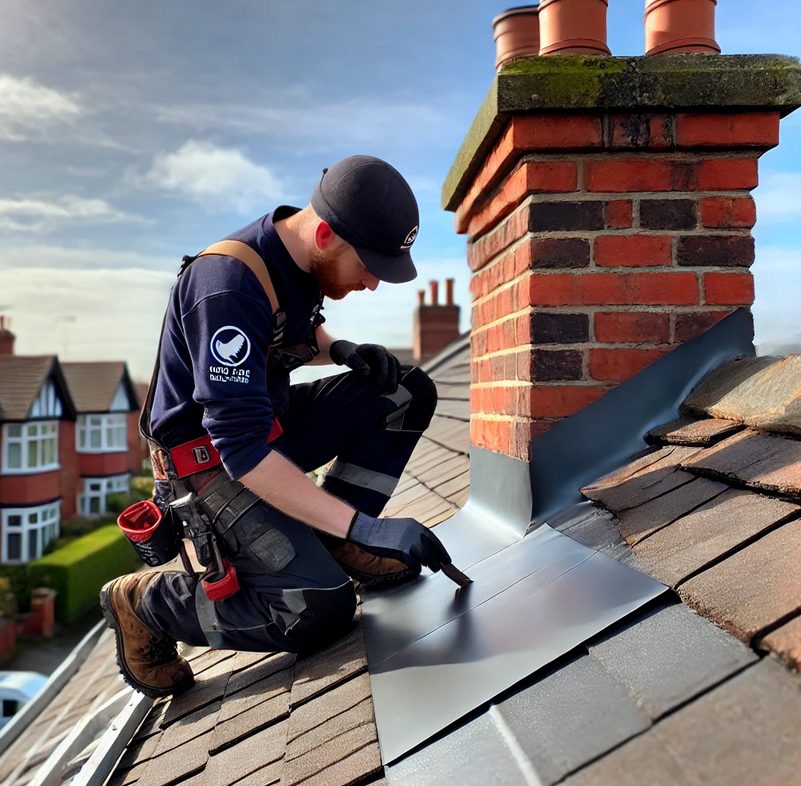
A roofer folding a new front apron down over the tiles where a stack passes through the roof slope

Images above are for illustration purposes only.

Our Own Work

Chimneys We Have Repaired

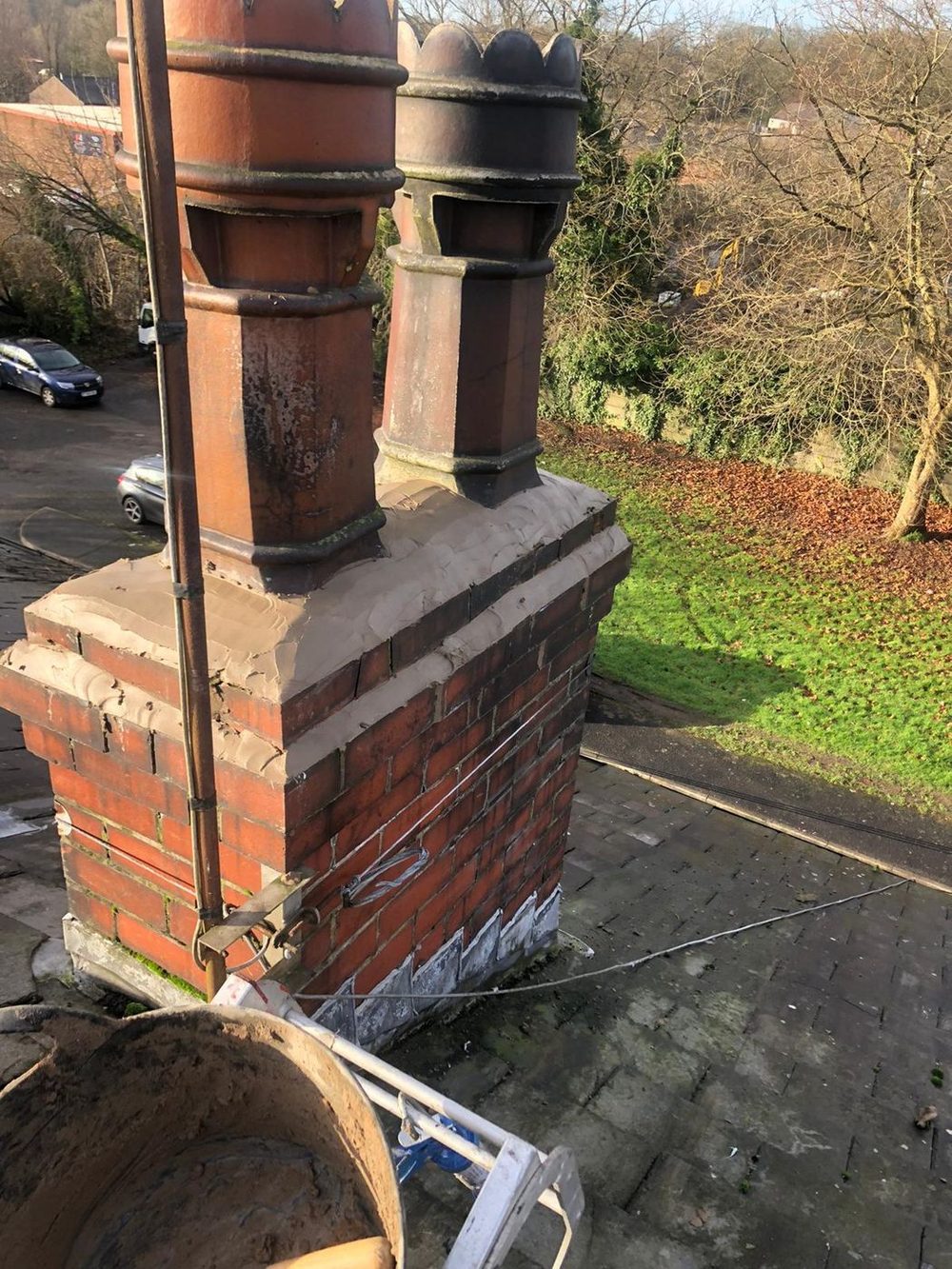
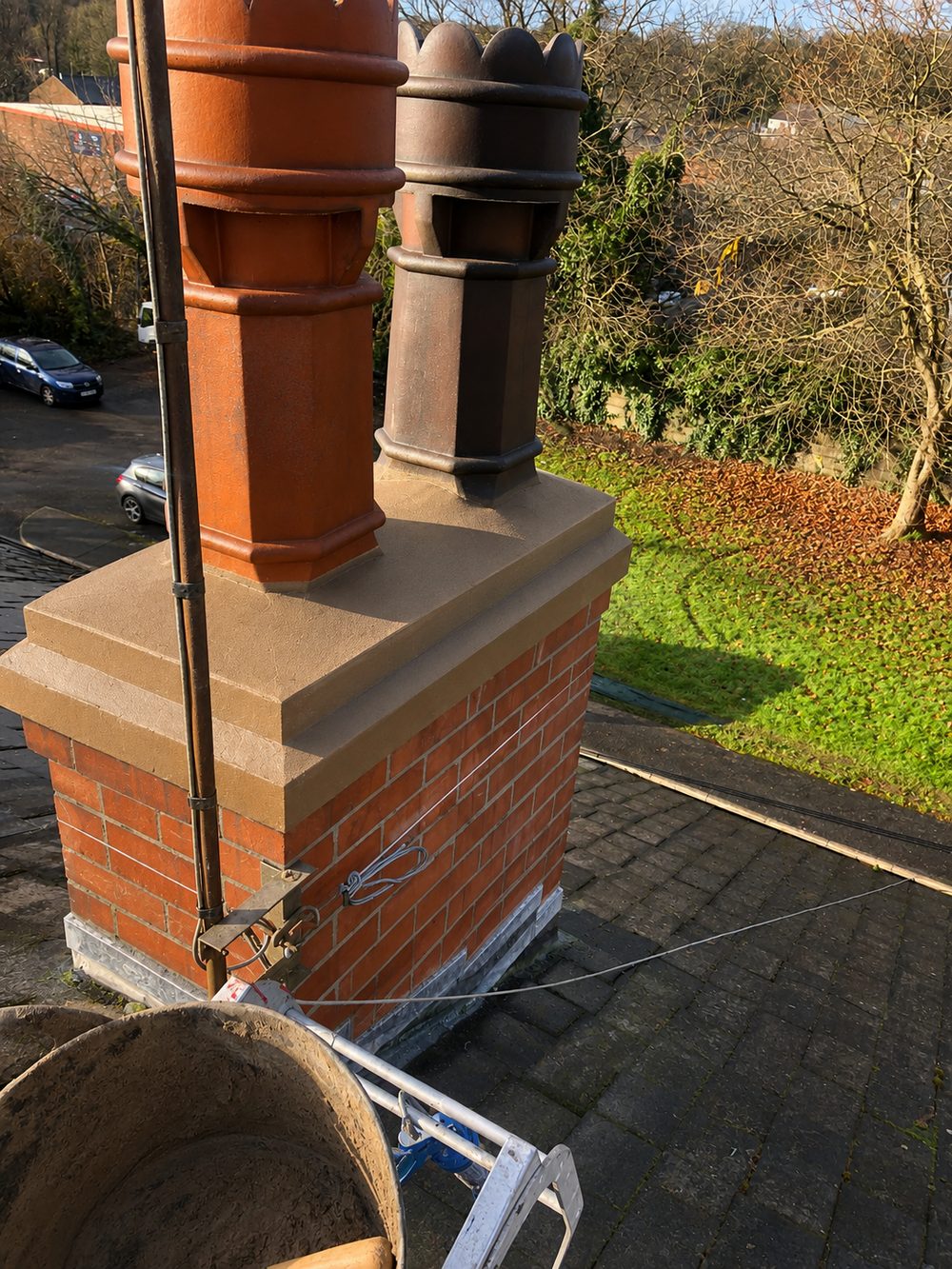
A tall Victorian stack with the head courses stripped and part rebedded, the original clay pots left standing in place while the work goes on The same stack completed — the head weathered off in two steps, the original pots bedded back and every joint below them made good

Photographs of our own chimney work. There are more on the main chimney repairs page and in the gallery.

What Consent Applies Before a Stack Is Touched

Listing and conservation area designation are two different things and they are constantly confused. A listed building is protected as a whole object, outside and in, and that protection reaches the stack, the pots on it, the mortar in its joints and often outbuildings within the curtilage. A conservation area protects the place rather than one building, mainly by controlling demolition and by limiting what can be done without planning permission. The trap in the second is that the right to take a chimney off an unlisted house is a permitted development right, and an Article 4 direction can remove it street by street.

The line that usually decides whether consent is needed is repair against alteration. Putting back what is there, in the same material and to the same profile and finish, is repair and does not normally require listed building consent. Changing what is there does: a pot of a different pattern, a stack reduced in height, cement render or hard modern pointing over soft old work, a stainless terminal appearing on a skyline that never had one. The practical point is that work which needed consent and did not get it is an offence, and it sticks to the building rather than to whoever did it, so it becomes the current owner’s problem at sale. Ask first, in writing, and keep the answer.

What that means on the roof is that recording comes before repair. Before anything is lifted we want photographs of each face and of the head, from the ground and again from the scaffold; the pots measured for height, diameter, taper and the shape of the bead at the rim, and noted for finish, because a salt-glazed buff can and a red moulded one are not interchangeable; and a sample of the existing mortar kept, since its colour comes from the sand and the sand is what a new mix is matched to. On a building of this age what goes back is usually lime-based, so the work is booked into weather that will let it cure and protected while it does.

Recording an Old Stack Before Anybody Goes Near It

A listed stack is worth photographing once a year from the same spot in the garden, because a set of pictures taken over a few years shows what is changing and gives you something to hand over when the time comes. Take binoculars and write down what is actually up there: how many pots, roughly how tall each one is, whether they are plain cans, octagonal, roll-topped or moulded, and what colour. Then look at the head for open joints and missing material, and at the roof junction for lead or for the grey line of a mortar fillet where lead should be.

The other thing that record shows up is what somebody else has already done. A hard grey band of pointing standing proud of the brick, a collar of cement render round the upper courses, a stack visibly shorter than its neighbours in the same terrace, a modern terminal in a row of clay pots, or black mastic smeared along a flashing all say that an earlier repair was made without much thought for what the building is. That matters twice over: it is usually why the stack is deteriorating, and it is what the conservation officer will want put right when the next works are proposed.

Getting to the Stack in Knutsford

On a protected building the ties are the part of the scaffold that actually touches the fabric, so they are the part to settle first. Drilling into the face of a dressed stone, a moulded brick or a decorated band is not acceptable and is not necessary: ties go into mortar joints where they can be made good afterwards, or through window openings so nothing is drilled at all, or the structure is designed with buttressed towers instead. Railings, stone thresholds, boot scrapers and cast-iron downpipes are listed too, and everything the scaffold passes gets boarded or wrapped.

The street is the other half of it. King Street and the lanes off it are narrow, the buildings stand on the footway and there is no set-back to work in, so a platform there needs a licence from Cheshire East Council, the footway kept open for people to get past, and a start date that does not land on a market or an event day. Out towards Tatton and the farms the problem reverses: plenty of room, but lanes a scaffold wagon may not get down, so the last part is carried in.

Leadwork, Pots and Cowls in Knutsford

Leadwork on an old building is expected to be lead, and for reasons beyond appearance. It is repairable, it is recyclable, it outlasts the pointing around it and it is what the details on the building were designed for. Self-adhesive tapes, painted-on coatings and mastic are none of those things, and on a listed building they are both a poor repair and a change to how it looks. The pieces are formed the traditional way, chased into joints rather than into the face of a stone, wedged with lead and pointed, and kept short and lapped so nothing splits as it moves.

At the top, anything fitted to a pot is visible from the street and is therefore a change to the building. A bird guard or a cowl may well be sensible, and on an occupied flue with jackdaws about it usually is, but the pattern is worth choosing with the skyline in mind and worth mentioning while consent is being discussed: a terracotta or dark cap sitting inside the rim is a very different thing from a bright drum clamped over a moulded can. Where a flue is finished with, the tidiest answer here is to keep the pot where it is and close it with a vented cap inside it, so the roofline is unaltered.

Please do not go up to look. A chimney is at the highest point of the roof and the ground below it is usually a path or a drive. Call 07464 259566 and describe what you can see from the garden, or send a photograph on WhatsApp — a phone zoomed in from below shows us more than you would think.

What We Do

Chimney and Roofing Services in Knutsford

Repointing, flaunching, stack rebuilds and removals, lead aprons, soakers, stepped flashings and back gutters, pots, cowls and bird guards — and the roof around the stack when it needs attention at the same time.

Customer Reviews

What Our Customers Say

5.0
★★★★★
63 Google reviews
★★★★★

“I needed help removing a chimney.
Buddy discussed the options available to me, taking into account my budget, timeline and DIY ability.
We settled that his team would remove the chimney to the roofline, using scaffolding and ladders.
He gave a detailed description of the steps his team were going to take, how long it would take them, and provided a fair quote.
His team were pleasant and worked efficiently. They got the job done in the estimated time and I was happy with the end result.”

Bernadett Tildy
★★★★★

“Very pleased with Roofline
Efficient, reliable, fast and friendly”

salah zakzouk
★★★★★

“Excellent service from Buddy and the team in installing a new garage roof in a really professional manner. Was kept updated at all stages and given good advice as to our options. Would highly recommend”

Peter Aspinall

Leave Roofline Solutions a Google review →

Advice Centre

Chimney Guides

Written for homeowners working out which part of a chimney has failed, before anyone comes out.

FAQs

Chimney Repairs Knutsford — Questions

My house is listed. Do I need consent to repoint the chimney?
Often not, if it is genuinely repair — the same mortar, the same joint width, the same finish, put back where the old one has failed. Consent comes into it when something changes, and repointing in a harder modern mix than the original is a change in the eyes of most conservation officers as well as a bad idea for the masonry. The safe course is a short written enquiry to Cheshire East Council describing what is proposed, with photographs, before work is booked.
What is the difference between listed and being in a conservation area?
Listing protects one particular building as a whole, inside and out, including things like a chimney stack and its pots. A conservation area protects the character of a whole neighbourhood, mainly by controlling demolition and by narrowing what can be done without planning permission. A house can be in a conservation area without being listed, and the controls that apply to it are then quite different. Both can be checked against your address before anything is decided.
Can a redundant stack be taken down on a house like ours?
It is not a decision that can be made on the roof. On a listed building taking a stack off is an alteration to the listed fabric and needs consent, and it is frequently refused because the stacks are part of what the listing describes. In a conservation area it may need planning permission, particularly where an Article 4 direction is in force. Find out first, because the work itself is straightforward and the permission is the part that takes time.
Two of our pots are broken. Do they have to be matched?
On a listed building, yes, and it is usually achievable. Salvaged pots in the common Victorian and Edwardian patterns are still to be had, and what has to match is the height, the profile, the taper and the finish rather than the exact shade, which varies along any row. They are measured and photographed before they come off so there is a record of what was there, and sound originals are always kept and rebedded rather than replaced for neatness.
Will you handle the paperwork with the council for us?
No, and it would not help you if we pretended otherwise. Applications for listed building consent and planning permission are made by the owner or by an agent acting for them, and a conservation officer or a surveyor used to historic work is the right person to advise on what will be acceptable. What we can give you is a plain description of the work proposed, photographs of what is there now and a note of the materials, which is most of what an application needs.
Where We Work

Chimney Repairs Across Cheshire & the Wirral

Every town below has its own page, written around the stacks that are actually on the roofs there.

Free Quotation

Tell Us About the Chimney

Describe what you can see and roughly where you are, and we will come back to you — usually the same day. If water is coming in now, please call instead.

Prefer to talk? Call 07464 259566 · WhatsApp 0044 7464 259566 · Email Evensbuddy@yahoo.com

Find Us

Roofline Solutions, Elton, Chester

We cover Knutsford from our base at Elton, just north of Chester.

Where We Are

2 Manley View
Elton
Chester
CH2 4QF

Almost all of our work happens at your property rather than here, so please call before travelling.

Opening Hours

Monday – Friday — 24hrs — Emergency Call-Outs
Saturday — 8:00 – 19:00
Sunday — 8:00 – 19:00

Weekday emergency call-outs are answered around the clock. Weekend cover is 8:00 to 19:00.