★★★★★
“Excellent service from Buddy and the team in installing a new garage roof in a really professional manner. Was kept updated at all stages and given good advice as to our options. Would highly recommend”
Peter Aspinall
Roof repairs across Bebington and the surrounding villages — hips, ridges and 1930s semis a speciality. Weekday emergency call-outs around the clock.
Bebington is dominated by inter-war housing. The 1920s and 30s semi-detached house, with its bay window and its hipped roof, is the shape of a great deal of the area, along with the model housing at Port Sunlight next door and a good stock of older village property at Lower Bebington.
The hipped roof is the detail worth talking about, because it fails in a specific and very predictable way, and because most people do not know what they are looking at when it starts.
A hip is the external angle where two roof slopes meet and run down to a corner. A ridge is the horizontal one along the top. On a 1930s semi you have both, and they were almost certainly bedded in mortar.
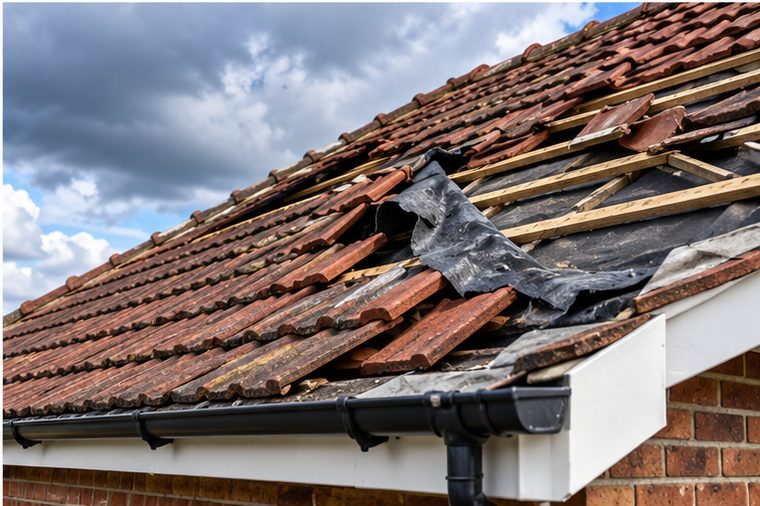
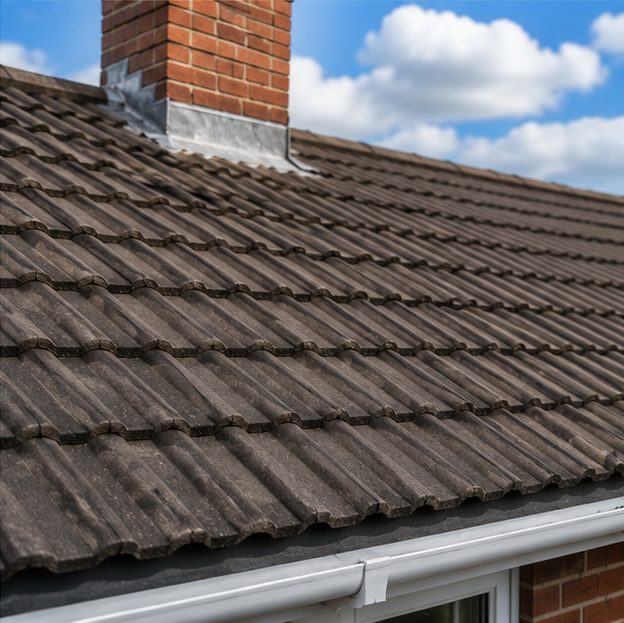
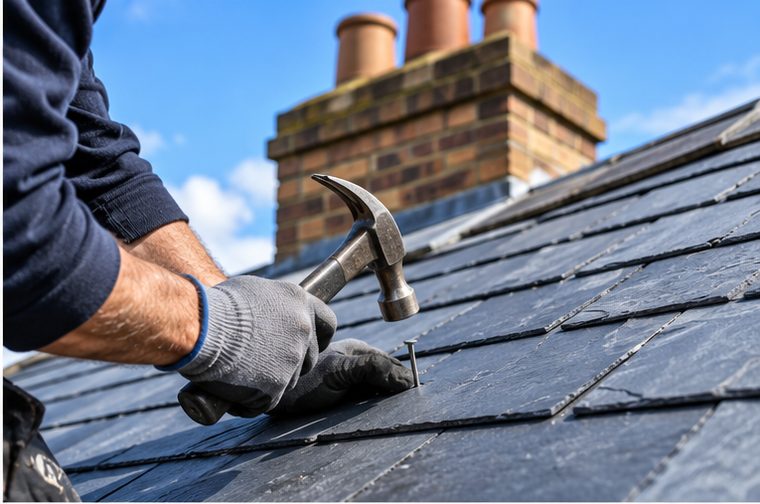
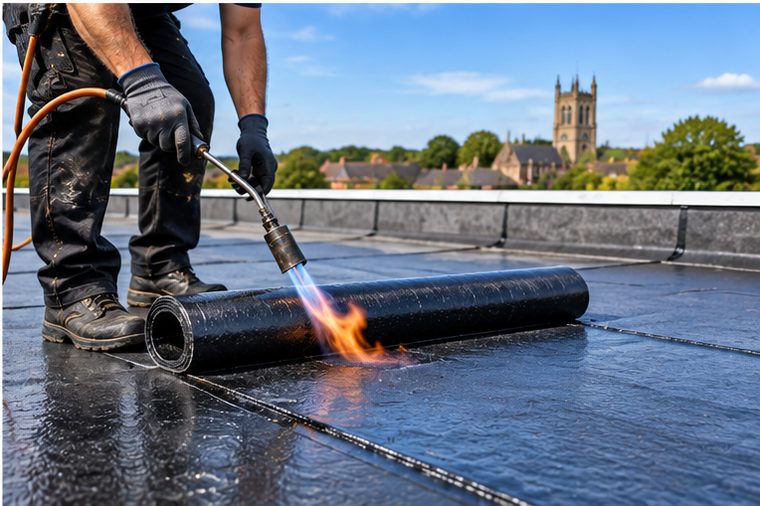
Mortar-bedded hips and ridges have a life, and on inter-war housing that life is up. Ninety years of thermal movement, frost and wind loosens the bedding, the mortar cracks in sections, and eventually a hip tile has nothing holding it but its own weight and the tile below it.
On a hip that is a genuine safety matter as much as a leak, because a hip runs down to a corner and a corner is usually above a path, a drive or a front door. The bottom hip tile is the one that goes first and it is the one directly over where people walk. There should be a hip iron at the foot of every hip — a small metal bracket screwed to the hip rafter that physically stops the bottom tile sliding off. On a lot of Bebington houses it has rusted away, and nobody has looked.
The repair options are bedding or dry-fixing. Rebedding in fresh mortar is the traditional answer, it matches what is there, and it will need doing again in due course. A dry hip and ridge system is mechanically fixed, ventilated, does not rely on mortar at all and does not crack when the roof moves. It costs more up front and looks slightly different close up. Both are legitimate; we will price whichever you want and tell you what we would do on our own house.
The other inter-war Bebington recurring theme is the bay window roof. Those small flat or shallow-pitched roofs over a bay have their own upstand where they meet the wall, their own lead, and their own tendency to be forgotten entirely until the bay ceiling stains. They are small enough that they are cheap to put right and easy to ignore until they are not.
And the third is the original clay tile. A lot of these roofs still carry their original clay or early concrete tiles, and those are worth keeping where they are sound. Matching them is the challenge; salvaged tiles are usually the answer, and we would rather source a match than put four modern tiles in the middle of a ninety-year-old roof.
Port Sunlight is a conservation area and a great deal of it is listed, which changes what can be done to a roof there. Like-for-like repair in matching materials is the normal route; changing a covering is a conversation with the council before it is a conversation with a roofer. We will tell you which of the two you are in.
Lower Bebington has older property again, some of it stone, and the same principle applies: match what is there. Modern materials on an old building look wrong immediately and stay wrong.
On a 1930s Bebington semi the honest answer is usually repair, and often a smaller repair than people fear. Hips and ridges are a defined piece of work with a defined cost, and dealing with them does not require touching the rest of the roof.
What moves the conversation towards replacement is the state of the tiles and the battens underneath. If tiles are delaminating or crumbling at the edges, or if the battens are soft where we lift a tile, the roof is telling you something about the whole covering rather than about its ridge. We will say which we have found.
On a hipped roof the storm damage is concentrated at the hips and the ridge, because those are the raised lines the wind can catch. The bottom hip tile is both the most likely to move and the one directly above a door or a drive.
If a hip tile has visibly shifted, treat that as urgent and keep people from walking underneath it. It is one of the few roofing faults that is a hazard to a person before it is a hazard to the building.
Emergency call-outs run 24 hours a day, Monday to Friday, with Saturday and Sunday cover from 8:00 to 19:00.
Leaking roofs, slipped and broken tiles, damaged slates, storm damage, valleys, chimneys, leadwork, flat roofs, ridges and verges. The main roof repair page has the detail on each of them.
“Excellent service from Buddy and the team in installing a new garage roof in a really professional manner. Was kept updated at all stages and given good advice as to our options. Would highly recommend”
Peter Aspinall“Had Roofline Solutions come and do our guttering today and done a great job. Our guttering was dangerous, after messaging over the weekend, they came Tuesday and sorted it out by Wednesday. Tidy and communicated everything to me. Thanks”
Emma Pickett“The men were genuine and trustworthy. Turned up every time when they said they would, and phoned ahead. Very respectful and did an amazing job.,thank you x”
freda markhamWritten for Bebington rather than for roofs in general. The ones not yet published are listed rather than linked, because a link to a page that does not exist yet helps nobody.
Every town below has its own page, written around what the roofs there are actually like.
Describe what is happening and roughly where you are, and we will come back to you — usually the same day. If water is coming in now, please call instead.
Prefer to talk? Call 07464 259566 · WhatsApp 0044 7464 259566 · Email Evensbuddy@yahoo.com
We cover Bebington from our base at Elton, just north of Chester.
2 Manley View
Elton
Chester
CH2 4QF
Almost all of our work happens at your property rather than here, so please call before travelling.
Monday – Friday — 24hrs — Emergency Call-Outs
Saturday — 8:00 – 19:00
Sunday — 8:00 – 19:00
Weekday emergency call-outs are answered around the clock. Weekend cover is 8:00 to 19:00.