★★★★★
“I had a leak in my vally had a number of roofers to come and take a look couldn’t find the problem Roofline’s solutions fixed the problem first time. Very happy with these guys thank you for the brilliant service”
Michael PriceChimneys and valleys account for most of the leaks that survive their first repair, and they do it for reasons that are recognisable.
Most of the roof sheds water. Chimneys and valleys concentrate it, and that changes how much a small defect matters.
A valley takes the run-off from two slopes and funnels it into a channel a few hundred millimetres wide. A chimney interrupts the flow of water down a slope and makes it go round, so everything above it is directed into a back gutter and out along both sides.
Both are also invisible. You cannot see a valley from the ground on most houses, and you cannot see the back gutter behind a stack from anywhere except the roof. Which means neither gets inspected unless somebody goes looking.
Put those together and you have the two places where a repair is most likely to address the wrong thing.
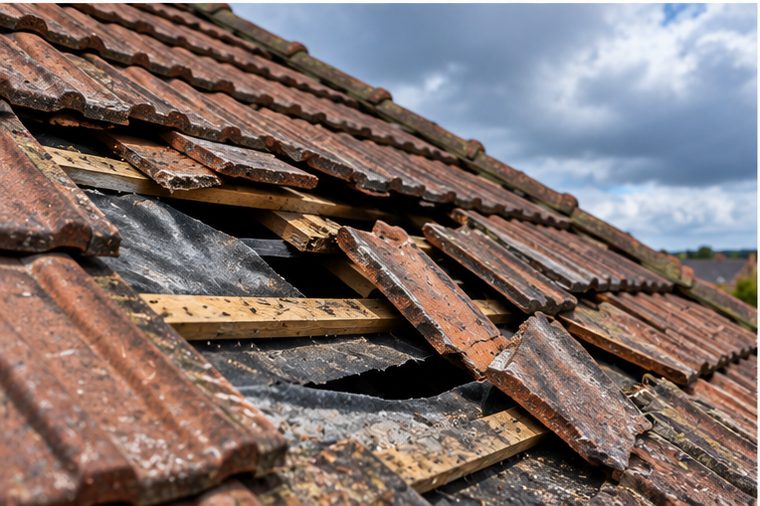
A chimney has five candidates, not one: the flaunching at the top, the pointing, the brickwork itself, the four pieces of lead, and the flue.
Flashing is the visible, understandable one and it is what most people are quoted for. But if the water is coming through cracked flaunching, or through eroded joints on the weather face, or down an unlined flue, new lead changes nothing. The leak continues and the homeowner concludes roofing is a racket.
A valley has fewer candidates but the same trap. If the cause is debris damming the channel, relining it fixes nothing that was broken and the dam rebuilds itself by the following autumn.
Mastic over a failed junction is the single most common bad repair we find on both.
It sheds water for a season, then shrinks and cracks. Because it is bonded at the edges it now holds water against the defect rather than letting it drain, so the leak comes back worse than it was.
Lead junctions work by shape and gravity - laps, upstands and free channels sized for the volume. There is no product you can apply over a failed junction that turns it back into a working one. Anything that has been sealed needs the sealant removing and the detail forming properly, which is more work than if nobody had touched it.
If two defects put water into the same place and only one is fixed, the leak appears to have survived the repair.
This happens at chimneys constantly, because the same stack can have a lifted side flashing and eroded pointing on the weather face. Fix the lead, and the masonry keeps letting water in. From the ground that looks like incompetence; on the roof it is arithmetic.
The defence against it is checking everything uphill of the entry point rather than stopping at the first plausible fault - which takes longer and is the reason a proper inspection is worth what it costs.
This one is specific to valleys and to back gutters, and it explains the "only in heavy rain" leak.
A valley has to have enough clear channel between the cut tiles either side to carry the flow from both slopes. Cut them too tight - a workmanship fault rather than wear - and the valley copes with ordinary rain and overflows sideways in a downpour, entering the roof several courses above where anyone would look.
A back gutter behind a wide chimney on a shallow pitch has the same problem. Formed too shallow, or silted with grit and moss, and it overflows into the roof every time it rains hard.
Neither of those is a hole, so neither shows up on a dry-day inspection. Both are cured by giving the water somewhere to go rather than by patching anything.
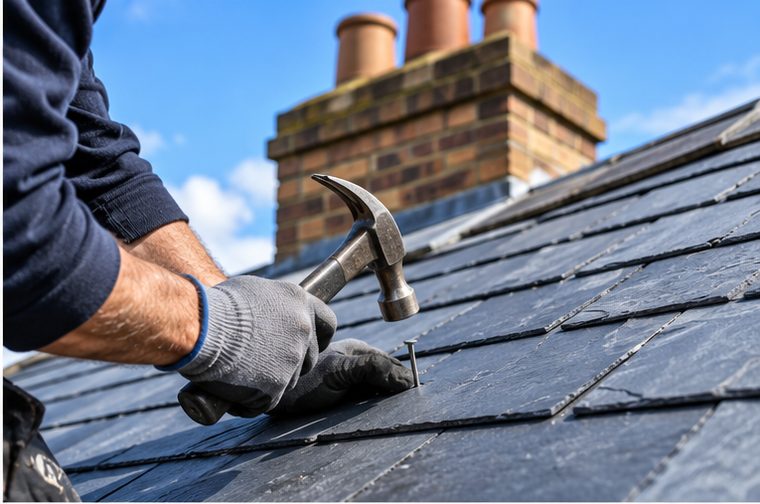
A water test. Wetting one small area at a time, from the bottom of the slope upwards, with somebody watching inside. It is slow and unglamorous and it produces an answer instead of a theory. If a leak has already survived two repairs, it is the right thing to do rather than the third guess.
A written finding that names the defect and its location, not just the work. That is what lets you tell whether the next repair is addressing something different from the last one.
And on a chimney specifically, confirmation that the flaunching, the pointing and the brickwork were looked at as well as the lead. If nobody can tell you what condition those were in, they did not check.
The rest of the series, on the questions people ask most.
Every town has its own page, written around what the roofs there are actually like. Start with the main roof repairs page.
“I had a leak in my vally had a number of roofers to come and take a look couldn’t find the problem Roofline’s solutions fixed the problem first time. Very happy with these guys thank you for the brilliant service”
Michael Price“Excellent work from the lads at roofline solutions. I had a leak in my valley, they came out and sorted it within a day.”
Chris Hollewell“Excellent service from Buddy and the team in installing a new garage roof in a really professional manner. Was kept updated at all stages and given good advice as to our options. Would highly recommend”
Peter AspinallDescribe what is happening and roughly where you are, and we will come back to you — usually the same day. If water is coming in now, please call instead.
Prefer to talk? Call 07464 259566 · WhatsApp 0044 7464 259566 · Email Evensbuddy@yahoo.com
We cover Chester, Cheshire, the Wirral and Flintshire from Elton, just north of Chester.
2 Manley View
Elton
Chester
CH2 4QF
Almost all of our work happens at your property rather than here, so please call before travelling.
Monday – Friday — 24hrs — Emergency Call-Outs
Saturday — 8:00 – 19:00
Sunday — 8:00 – 19:00
Weekday emergency call-outs are answered around the clock. Weekend cover is 8:00 to 19:00.