Checking the Whole Affected Roof Section
A roof is a rigid assembly sitting on a building that can flex. Where a building has settled unevenly — historically or recently — the roof has to take up the difference somewhere, and it does that at its joints. Ridge mortar cracks in a line. A valley opens along one edge. Lead flashing at a chimney pulls out of its chase on one side only. Verge mortar drops out at one end of a gable and not the other.
The clue is asymmetry. Ordinary weathering happens fairly evenly across a whole elevation, because the whole elevation gets the same weather. Movement damage does not: it concentrates at one end, one corner, one side of a chimney. When we look at a Northwich roof we are looking at the whole affected section and its neighbours, not just the bit above the damp patch, because the pattern across the section is what tells us which of the two we are dealing with.
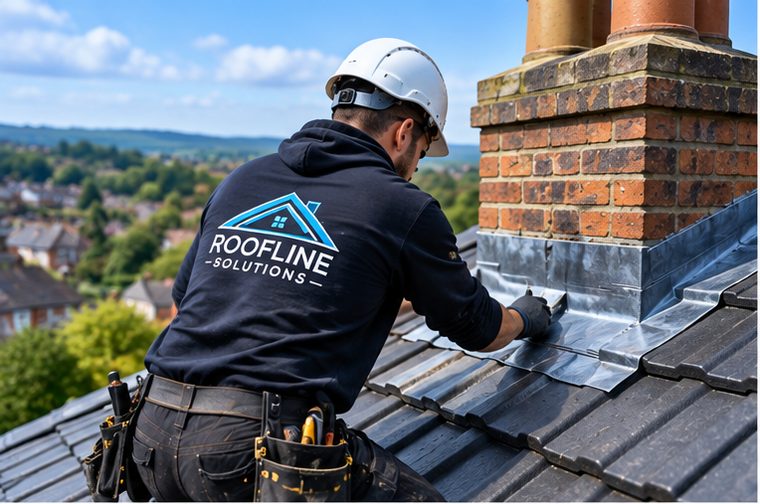
If it is movement, the repair still needs doing — water coming in is water coming in. But it needs doing in a way that can accommodate a bit more movement rather than fighting it. Rigid mortar packed into a joint that is going to open again is a repair with a known expiry date. A mechanically fixed dry ridge, a properly lapped and stepped lead flashing with adequate cover, and a valley detail with room to move all cope far better.
We should be straight about the limits of that. We are roofers. If what we find looks like ongoing structural movement rather than the settled legacy of old movement, the right person to look at it is a structural engineer or a surveyor, and we will say so rather than keep selling you roof repairs. Repairing the roof over a building that is still moving treats the symptom and leaves the cause.
For most Northwich properties none of this applies and a leak is simply a leak. But it is worth knowing why we look at the whole section here, and why we ask whether the same spot has been repaired before.
Northwich’s Older Housing and Its Roofs
Away from the movement question, Northwich has a good stock of Victorian and Edwardian property with natural slate, plus substantial post-war and later estate housing on concrete tile. The town centre’s black-and-white buildings are a special case, and anything listed or in a conservation area needs the covering matched rather than simply replaced.
On slate the usual failure is the nails rather than the slate. On concrete tile it is the ridge and the fixings. Both are ordinary repairs, and neither has anything to do with salt.
Repair or Replace in Northwich?
In Northwich the repair-or-replace question has an extra strand. A roof covering can be in perfectly serviceable condition and still be leaking, because the joints keep being pulled open. Replacing that covering would be an expensive way of not fixing the problem.
So the sequence matters: establish whether the roof is worn out, or being moved. If it is worn out, price the work. If it is being moved, deal with the joints in a way that tolerates movement, and get the right professional to look at the movement itself. We would rather have that conversation with you than take the easy job.
Storm Damage & Emergency Roof Repairs in Northwich
Storms in Northwich rarely create damage from nothing. What they do is find joints that were already slightly open, which is why the same handful of properties come up after every serious blow while their neighbours do not.
If your roof is one of them, that pattern is worth telling us about. A roof that is damaged by every storm is not unlucky; it is a roof whose details are being held open by something.
Emergency call-outs run 24 hours a day, Monday to Friday, with
Saturday and Sunday cover from 8:00 to 19:00.
Please do not go up to look. More people are
hurt inspecting storm damage than by the storm itself. Call
07464 259566 and describe what you can see from the ground.