★★★★★
“I had a leak in my vally had a number of roofers to come and take a look couldn’t find the problem Roofline’s solutions fixed the problem first time. Very happy with these guys thank you for the brilliant service”
Michael PriceFour findings put a flat roof beyond repair, and one of them is invisible from both sides.
Every flat roof covering works by being flexible enough to accommodate movement. When it stops being flexible, it stops working, and no repair changes that.
The test is physical. Sound felt or EPDM gives slightly under thumb pressure. A covering at the end of its life is hard, and if it cracks or crazes when pressed, it is finished.
The visual version is surface crazing - a network of fine cracks across the whole area rather than a split in one place - and, on felt, the mineral finish having weathered off so the bitumen underneath is exposed and shiny.
This is the one people can check themselves from a window or a step ladder, without walking on the roof.
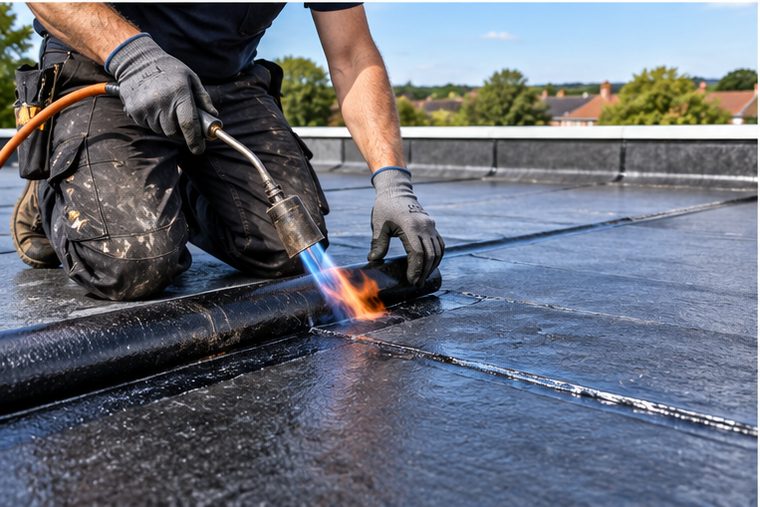
A covering can be perfectly serviceable and the roof still be beyond repair, because what it is fixed to has gone.
A deck that gives underfoot, that is springy in an area, or that sounds different when tapped has absorbed water. Chipboard decks - very common on 1960s and 70s extensions and garages across the peninsula - swell and delaminate and do not recover when they dry.
A new covering fixed to a soft deck will not perform, will not hold its fixings, and will fail early. So a soft deck is not a reason to replace the covering; it is a reason the job is a strip and rebuild rather than a recover.
This is the finding to ask about specifically, because it is invisible from below and it makes the largest difference to the price.
The one that cannot be seen from either side, and the reason overlays go wrong.
A warm-deck flat roof has insulation between the deck and the covering. Once water gets in and reaches that insulation, it does not come out. There is a vapour barrier below it and a waterproof covering above it, so it has nowhere to go.
Saturated insulation stops insulating, adds weight, and keeps the deck permanently wet from above. And because the covering above it may still look intact, a roof in that state can be patched repeatedly by people who have no idea it is there.
The signs from below are a ceiling that stays damp between rainfall rather than drying, and staining that spreads rather than repeating in one spot. From above, blisters that are soft and warm in the sun, and areas that feel different underfoot.
Where it matters commercially - and on larger roofs it does - a moisture survey can map it. On a domestic extension the practical answer is usually a core sample: a small piece cut out and looked at, then made good. It is the only way to know without guessing, and it costs very little.
Once insulation is saturated, an overlay traps it permanently. That is the single most important reason not to lay a new covering over an old one without checking.
None of the above is visible from the ground, so here is the one that is.
Count the patches. A covering with three or four visible repairs on it, of different ages, is a covering that has been producing faults rather than having them.
A roof that has been patched in the same place twice is worse, because it means the material around the patch could not hold it.
In practice this is the signal that most reliably predicts what a proper inspection finds, and you can count them from an upstairs window.
Ask what the deck felt like, and what it is made of.
Ask whether the covering cracked when pressed.
Ask whether anybody has checked whether the insulation is wet, and if not, whether a core sample is worth taking before committing to an overlay.
Ask for photographs, because none of this is visible from where you are standing.
And be wary of any proposal to coat or overlay a roof that has not had those questions answered. Liquid coatings and overlays are legitimate products with real uses - over a sound covering, as a refurbishment. Over a wet one they seal the problem in and it carries on underneath.
The rest of the series, on the questions people ask most.
Every town has its own page, written around what the roofs there are actually like. Start with the main roof repairs page.
“I had a leak in my vally had a number of roofers to come and take a look couldn’t find the problem Roofline’s solutions fixed the problem first time. Very happy with these guys thank you for the brilliant service”
Michael Price“Excellent service from Buddy and the team in installing a new garage roof in a really professional manner. Was kept updated at all stages and given good advice as to our options. Would highly recommend”
Peter Aspinall“Excellent work replacing ridge tiles, repointing chimney and repairing flashing. Also fixed other broken tiles. Clean and tidy job. Would definitely recommend.”
NeilDescribe what is happening and roughly where you are, and we will come back to you — usually the same day. If water is coming in now, please call instead.
Prefer to talk? Call 07464 259566 · WhatsApp 0044 7464 259566 · Email Evensbuddy@yahoo.com
We cover Chester, Cheshire, the Wirral and Flintshire from Elton, just north of Chester.
2 Manley View
Elton
Chester
CH2 4QF
Almost all of our work happens at your property rather than here, so please call before travelling.
Monday – Friday — 24hrs — Emergency Call-Outs
Saturday — 8:00 – 19:00
Sunday — 8:00 – 19:00
Weekday emergency call-outs are answered around the clock. Weekend cover is 8:00 to 19:00.