★★★★★
“I had a leak in my vally had a number of roofers to come and take a look couldn’t find the problem Roofline’s solutions fixed the problem first time. Very happy with these guys thank you for the brilliant service”
Michael PriceA valley collects the water from two roof slopes into one narrow channel. It is the hardest-working part of a roof and the one you cannot see.
Where two roof slopes meet in an internal angle, the water from both of them converges and runs down the join. That join is the valley, and it is lined — traditionally in lead, on modern roofs often in GRP or a preformed trough.
The volume matters. A valley between two large slopes can be shifting several times the water passing over any equivalent area of the roof, concentrated into a channel a few hundred millimetres wide. Everything about how it fails follows from that.
It is also invisible. You cannot see a valley from the ground on most houses, you cannot see it from the loft, and unless somebody goes up and looks along it, it is simply not inspected. That is why valley problems are so often long-running.
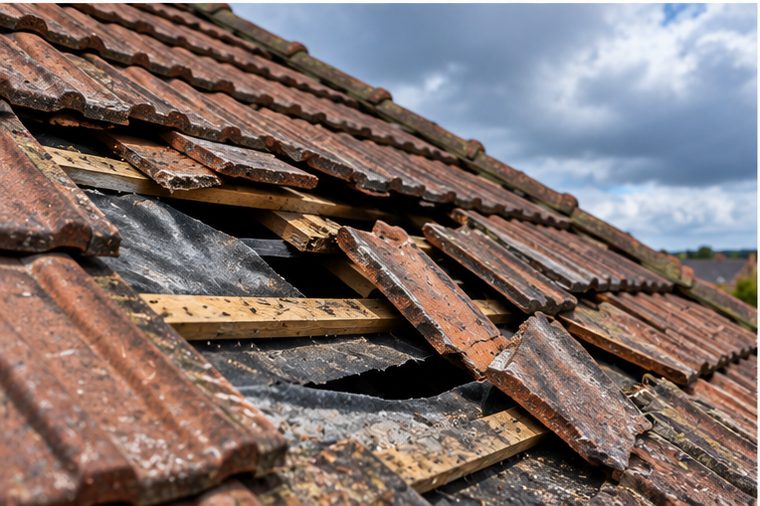
Debris. The commonest by a distance, and the one that needs no roofing work at all. Leaves, moss, twigs and grit wash down both slopes and collect in the valley. A dam forms, water backs up behind it, spreads sideways under the tiles either side, and enters the roof several courses above where anyone would think to look. Clear it and the leak stops. If you have trees near the house, assume this first.
The lining has failed. Lead valleys crack along a fold, usually because the sheet is too long for the movement it has to accommodate — lead expands and contracts a great deal and an oversized piece fatigues rather than flexes. GRP and mortar-bedded valleys crack. Older lead thins where water runs over it constantly.
The tiles are cut too tight. The tiles or slates either side of a valley are cut on the rake, and there has to be a clear channel between the two cut edges for the water to run down. Cut them too close and the free width is too narrow for the volume, so in heavy rain the valley overflows sideways. This is a workmanship fault rather than wear, and it means the valley has leaked in heavy rain since the day it was laid.
The detail at the top or bottom. Where a valley starts at a junction and where it discharges into the gutter are both places it can be formed badly. A valley that stops short of the gutter puts its entire flow behind the fascia.
Because the water enters high and appears low, and because the entry point is under the tiles either side of the valley rather than in the valley itself.
A homeowner looking at a damp patch on a bedroom ceiling near the middle of the house has no reason to suspect a channel four metres away and two metres higher up. A roofer who checks the tiles above the stain finds nothing wrong with them, because there is nothing wrong with them.
It is also intermittent. A valley that overflows only in heavy rain, or only once enough debris has built up, will not leak on the day somebody comes to look. That is precisely the situation where a water test — wetting the valley deliberately, with somebody watching inside — earns its time.
We have two Google reviews on this exact subject. One customer had several roofers look at a leaking valley without finding the cause before we found it. That is not a boast about cleverness; it is what a valley does to a diagnosis.
A valley with debris in it needs clearing, and that is the whole job.
A valley with a locally split lining can sometimes be patched, but lead patched over lead is rarely a long-term answer in a channel carrying that much water. If the lining has failed once through fatigue it will generally do it again nearby.
Relining means lifting the tiles either side, taking the old lining out, renewing the boards or the support beneath if they have suffered, and forming a new valley with correctly sized pieces and proper laps — then re-cutting the tiles with an adequate free channel. It is a proper job rather than a patch, and on a valley that has been leaking for years it is usually the right one.
While the tiles are up is also the moment to fix the too-tight cut, if that is what has been wrong all along.

Valleys and gutters are the two things on a roof that need clearing rather than repairing, and they are the two things almost nobody clears.
If there are trees over or near the house, once a year after leaf fall is the right interval. If there are not, every couple of years is generally enough. It is a small job that prevents one of the more expensive leaks.
What it is not is a job to do yourself off a ladder. Reaching along a valley means leaning, and leaning off a ladder is how people fall.
The rest of the series, on the questions people ask most.
Every town has its own page, written around what the roofs there are actually like. Start with the main roof repairs page.
“I had a leak in my vally had a number of roofers to come and take a look couldn’t find the problem Roofline’s solutions fixed the problem first time. Very happy with these guys thank you for the brilliant service”
Michael Price“Excellent work replacing ridge tiles, repointing chimney and repairing flashing. Also fixed other broken tiles. Clean and tidy job. Would definitely recommend.”
Neil“Highly recommend. Very quick and efficient. Great communication. Went above and beyond to work the weekend to complete the work that needed to be done. Very happy with the results.”
Karen JonesDescribe what is happening and roughly where you are, and we will come back to you — usually the same day. If water is coming in now, please call instead.
Prefer to talk? Call 07464 259566 · WhatsApp 0044 7464 259566 · Email Evensbuddy@yahoo.com
We cover Chester, Cheshire, the Wirral and Flintshire from Elton, just north of Chester.
2 Manley View
Elton
Chester
CH2 4QF
Almost all of our work happens at your property rather than here, so please call before travelling.
Monday – Friday — 24hrs — Emergency Call-Outs
Saturday — 8:00 – 19:00
Sunday — 8:00 – 19:00
Weekday emergency call-outs are answered around the clock. Weekend cover is 8:00 to 19:00.