★★★★★
“I had a leak in my vally had a number of roofers to come and take a look couldn’t find the problem Roofline’s solutions fixed the problem first time. Very happy with these guys thank you for the brilliant service”
Michael PriceWater almost never enters a roof directly above the stain it makes. Here is how the tracing actually works — and what you can establish safely from inside before anyone comes out.
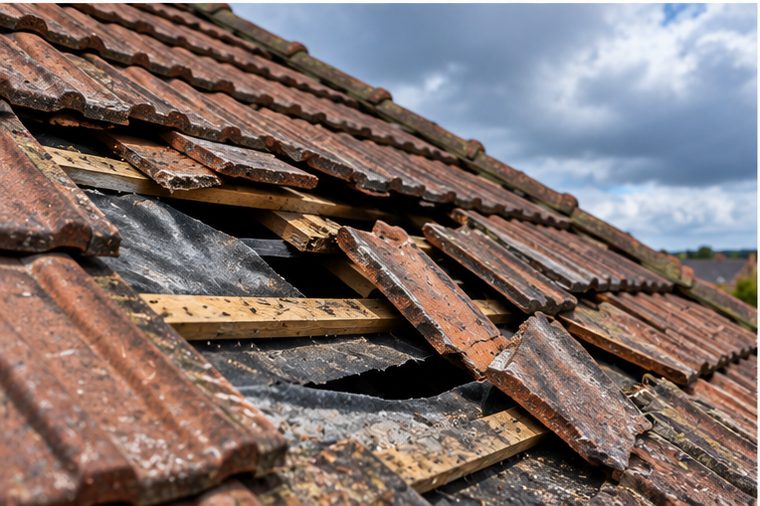
A pitched roof is two barriers, not one. The covering — tiles or slates — sheds the great majority of the water. Beneath it is an underlay, laid in overlapping horizontal courses, which catches whatever gets past and drains it down the slope into the gutter.
That second barrier is what makes leaks so hard to place. Water that gets past a tile lands on the underlay and then travels down the slope until it finds a way off it: a nail hole, a tear, an open lap, or the point where the underlay ends at a wall. Only then does it get into the roof space.
Once it is in the roof space it lands on timber, and timber carries water sideways. A rafter will run water along its length for a couple of metres before it drips off a knot or a joint. So by the time it reaches your ceiling and makes a stain, it can be a long way from the actual defect and on the wrong side of the room.
This is why anybody who looks at your ceiling and then quotes for the tiles directly above it is guessing. Sometimes the guess is right. You will pay for it either way.

Four questions do most of the work, and you can answer all of them from inside.
When does it happen? This is the big one. A leak that appears in prolonged steady rain but not in a windy shower is usually a drainage problem — a blocked valley, a full gutter, an overwhelmed outlet. A leak that appears in wind-driven rain from one particular direction, and stays dry in ordinary vertical rain, is almost always a detail on the exposed side: a verge, a flashing, an abutment, an open lap. Those two point at completely different parts of the building.
Does it happen when it is not raining at all? If damp appears on cold, dry nights — particularly above a bathroom, kitchen or utility room — you may not have a leak. Warm moist air rising into a cold roof space condenses on the underside of the underlay and drips. It looks identical to a leak and it is fixed with ventilation, not roofing.
Is it wet now, or is it a mark? A live leak has a dark, soft-edged, actually damp patch. A historic one is a dry stain with a sharp brown tide line. Knowing which you have changes everything about the urgency and about whether a previous repair worked.
Has anything changed? New loft insulation is the classic. More insulation makes the roof space colder, which makes condensation more likely, and blocked eaves — usually blocked by insulation pushed too far out over the wall plate — stop the roof space breathing at all. If the problem started after the insulation went in, that is close to conclusive.
If you have a loft and you can get into it safely, this is where the answer usually is. Go up in daylight, and turn the light off before your eyes adjust.
Daylight showing through the covering is the quickest possible answer. On a roof with underlay you will not see much, but at a verge, around a chimney or where the underlay has torn, you sometimes see a bright line and the job is done in ten seconds.
Then look at the timber and the underside of the underlay for staining, and find the highest point it reaches. Water does not travel uphill. Whatever is wrong is at or above that point, and everything below it is just the route the water took.
Look for beads of water on nails, nail plates and the underside of the felt, spread over an area rather than concentrated in one spot. That pattern is condensation, not a leak.
And look at the eaves, where the roof meets the wall. You should be able to see light and feel air movement there. If insulation has been stuffed right out to the edge and blocked it, that is worth knowing.
Stay on the joists, take a torch, and if the loft is boarded, cramped or you are not confident, do not do any of this. None of it is worth an injury and we will do it for you.
Once you know roughly where to look, it helps to know what is usually there. Leaks concentrate at junctions and edges far more than in the middle of a slope.
The abutment where a lower roof meets a wall, weathered with lead soakers and a stepped flashing. The valley where two slopes drain into each other, which carries more water than anything else on the roof. The chimney, which has four separate pieces of lead around it and a masonry stack that can soak through on its own. The verge at a gable end, and the ridge. Around a roof window, where the flashing kit is almost always the culprit rather than the window. And on flat sections, the perimeter, the upstands and the outlets.
A tile broken in the open field of a slope does happen, and it does leak. It is just a long way down the list.
Some leaks refuse to appear on demand, and the honest answer is a water test: wetting one small area at a time with a hose, starting at the bottom of the slope and working upwards, with somebody watching inside. Working upwards matters — start at the top and the water runs over everything below it and tells you nothing.
It is slow, it is unglamorous, and it produces an actual answer rather than a theory. If a leak has already survived two repairs, it is usually the right thing to do rather than the third guess.
The rest of the series, on the questions people ask most.
Every town has its own page, written around what the roofs there are actually like. Start with the main roof repairs page.
“I had a leak in my vally had a number of roofers to come and take a look couldn’t find the problem Roofline’s solutions fixed the problem first time. Very happy with these guys thank you for the brilliant service”
Michael Price“Excellent work replacing ridge tiles, repointing chimney and repairing flashing. Also fixed other broken tiles. Clean and tidy job. Would definitely recommend.”
Neil“Highly recommend. Very quick and efficient. Great communication. Went above and beyond to work the weekend to complete the work that needed to be done. Very happy with the results.”
Karen JonesDescribe what is happening and roughly where you are, and we will come back to you — usually the same day. If water is coming in now, please call instead.
Prefer to talk? Call 07464 259566 · WhatsApp 0044 7464 259566 · Email Evensbuddy@yahoo.com
We cover Chester, Cheshire, the Wirral and Flintshire from Elton, just north of Chester.
2 Manley View
Elton
Chester
CH2 4QF
Almost all of our work happens at your property rather than here, so please call before travelling.
Monday – Friday — 24hrs — Emergency Call-Outs
Saturday — 8:00 – 19:00
Sunday — 8:00 – 19:00
Weekday emergency call-outs are answered around the clock. Weekend cover is 8:00 to 19:00.