★★★★★
“I had a leak in my vally had a number of roofers to come and take a look couldn’t find the problem Roofline’s solutions fixed the problem first time. Very happy with these guys thank you for the brilliant service”
Michael PriceEverybody blames the flashing. It is one of five candidates, and new lead on a stack that is soaking through its own brickwork will not stop anything.
A chimney is not a single component, and the reason chimney leaks are so often repaired twice is that people fix the visible one rather than the active one.
The flaunching. The sloped bed of mortar at the top of the stack that holds the pot and sheds water off the top. It cracks with age and frost, and once cracked it collects water rather than shedding it, straight into the top of the brickwork.
The pointing. A stack is exposed on all four faces with nothing sheltering it, so its mortar joints erode faster than anything else on the building. Eroded joints let wind-driven rain in directly.
The brickwork itself. Bricks that have frozen while saturated spall — the hard outer face blows off, leaving a soft open surface that absorbs far more water. A stack with a spalled weather face behaves like a sponge and repointing alone will not cure it.
The lead. Four separate pieces: the front apron below the stack, the stepped flashings and soakers down each side, and the back gutter above it. They fail differently — aprons split from thermal movement, side flashings pull out of their chases, back gutters silt up.
The flue. An open, unlined flue can bring water down from the top of a stack that is otherwise perfectly weathered outside.
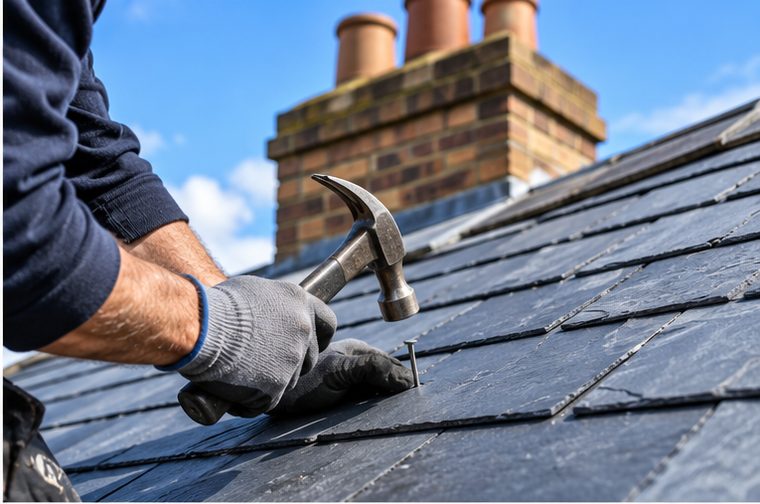
You can narrow this down a long way from inside, before anyone gets a ladder out.
Damp that is worst in cold weather, or that appears after a frost rather than during rain, points at the masonry. Water already absorbed into brick and mortar freezes, expands and is driven inward. Lead does not behave that way.
Damp only when rain is driving in from one particular direction points at that face: eroded pointing, spalled brick, or the stepped flashing on that side. It is one of the most useful things you can notice, because it tells a roofer which elevation to start on.
Damp after prolonged steady rain, regardless of wind, points at drainage — usually the back gutter above the stack, which has to catch everything coming down the slope and take it round both sides. On a wide chimney on a shallow pitch that gutter is doing serious work, and if it has silted up or was formed too shallow it overflows into the roof.
Damp high on the breast, at ceiling level or in the roof space, suggests the stack above the roof line. Damp lower down, in a bedroom or a ground-floor room, can be water tracking down the inside of the flue rather than anything on the roof at all.
White powdery deposits or brown staining on the breast are salts brought out of the brickwork by long-term water movement, often combined with soot residue in an old flue. That is a sign the problem has been running for a while rather than a sign of what caused it.
Leadwork is the visible, understandable part, and it is what most people are quoted for. If the lead has genuinely failed, renewing it works.
But if the water is coming through cracked flaunching, or through eroded joints on the weather face, or down an unlined flue, then the lead was never the route. The new lead is fitted, the leak continues, and the homeowner concludes roofing is a racket.
It is not a racket. It is a diagnosis that stopped at the first plausible answer. The fix is to look at all five, which takes longer and is the whole point.
Do not seal it. Silicone or bitumen smeared over a chimney junction sheds water for a season and then shrinks, cracks and traps water behind itself, so the situation is worse than before. Lead junctions work by shape and gravity, with laps and upstands sized for the job, and there is no product you can apply over a failed one that turns it back into a working one.
Do not render the stack as a waterproofing measure unless somebody who knows the building has recommended it. Impermeable render on an old permeable stack traps moisture inside the masonry, and when it cracks — and it will — water gets in behind and cannot get out.
Do not cap a flue with something airtight. A sealed, unventilated flue is a damp problem in waiting. If a chimney is disused, a proper vented cap keeps rain out and lets the flue breathe, and it is frequently the cheapest permanent answer to the whole category.

Sometimes the honest finding is that the stack is beyond patching: widespread spalling, a lean, joints eroded across whole elevations, or brickwork that has lost its face. At that point flaunching and pointing are money spent twice and the stack needs rebuilding from a sound course upwards.
And if it is redundant, taking it down below the roof line and weathering over is a permanent solution rather than a repeated one. It is not right on a building where the chimney is part of the look, or where the flue might be wanted again — but it deserves to be on the table rather than assumed away.
The rest of the series, on the questions people ask most.
Every town has its own page, written around what the roofs there are actually like. Start with the main roof repairs page.
“I had a leak in my vally had a number of roofers to come and take a look couldn’t find the problem Roofline’s solutions fixed the problem first time. Very happy with these guys thank you for the brilliant service”
Michael Price“Excellent work replacing ridge tiles, repointing chimney and repairing flashing. Also fixed other broken tiles. Clean and tidy job. Would definitely recommend.”
Neil“Highly recommend. Very quick and efficient. Great communication. Went above and beyond to work the weekend to complete the work that needed to be done. Very happy with the results.”
Karen JonesDescribe what is happening and roughly where you are, and we will come back to you — usually the same day. If water is coming in now, please call instead.
Prefer to talk? Call 07464 259566 · WhatsApp 0044 7464 259566 · Email Evensbuddy@yahoo.com
We cover Chester, Cheshire, the Wirral and Flintshire from Elton, just north of Chester.
2 Manley View
Elton
Chester
CH2 4QF
Almost all of our work happens at your property rather than here, so please call before travelling.
Monday – Friday — 24hrs — Emergency Call-Outs
Saturday — 8:00 – 19:00
Sunday — 8:00 – 19:00
Weekday emergency call-outs are answered around the clock. Weekend cover is 8:00 to 19:00.