★★★★★
“I had a leak in my vally had a number of roofers to come and take a look couldn’t find the problem Roofline’s solutions fixed the problem first time. Very happy with these guys thank you for the brilliant service”
Michael PriceStart to finish, including the parts that are not roofing - which are usually the parts people have questions about.
Four questions, and they narrow things a great deal before anybody travels.
Where the water is showing - ceiling, wall, chimney breast, around a window. Each points somewhere different.
What the weather was doing. Wind-driven rain from one direction and prolonged heavy rain find completely different faults.
Whether it is wet now or an old mark.
Whether it has been repaired before, and what was done.
On an emergency we also ask whether anything is loose above a path or a door, and what is underneath the leak - which on a commercial building sets the priority.
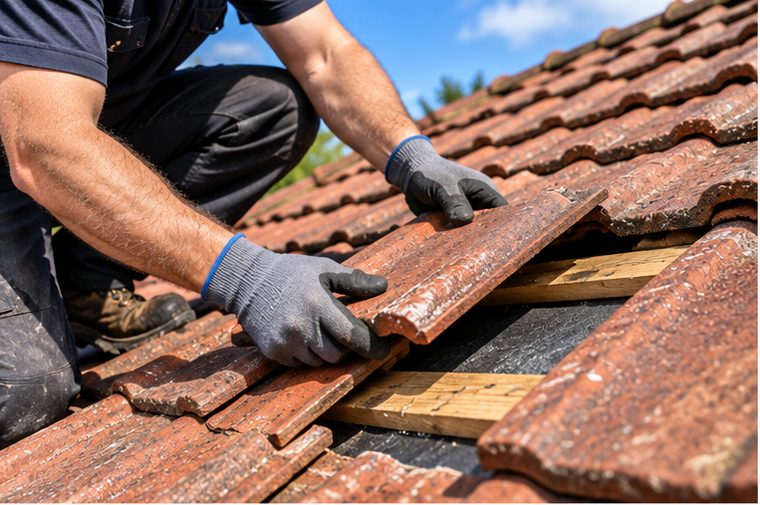
The loft first, where there is one and it is safe to get into. Lights off, looking for daylight, then staining on the underlay and the timbers - and specifically the highest point it reaches, because whatever is wrong is at or above that.
Then the outside: the area the loft pointed at, everything uphill of it, and then the roof generally - covering, ridge, verges, valleys, flashings, chimney, penetrations and the rainwater goods. We look at the gutters whether or not anybody asked, because a real share of "roof leaks" are drainage.
Where a roof cannot be safely reached without a scaffold or a tower, we say so rather than guessing from a ladder. That occasionally means the inspection itself has to wait for access, which is frustrating and is better than the alternative.
It should name the defect, not only the work. "Renew lead soakers and stepped flashing to the east abutment, 4 metres" is comparable with somebody else's; "roof repairs" is not.
It should be clear about access - whether a scaffold or tower is included, and what is assumed. Two quotations that differ by hundreds usually differ because one includes access and the other assumes a ladder.
It should say whether what is proposed is a repair or a holding measure. Both are legitimate; being told which you are buying is not optional.
And it should say what happens if something is found once the covering is off - soft battens, decayed boards - because that is the finding that changes the job and it cannot be established beforehand.
Access first, and on many jobs it is the longest part. A scaffold has a delivery date and a collection date, and the roofing happens between them.
The repair itself is usually the shortest phase. A chimney flashing renewal is a day; getting to the chimney can be two.
Weather is a real constraint rather than an excuse. Mortar will not cure in a frost, adhesives need dry surfaces, lead work wants reasonable conditions. Work done in the wrong weather fails in a few years, so a postponement is usually somebody protecting you rather than themselves.
And clearing up: old mortar, offcuts and debris out of the gutters and valleys, because that is the next leak if it is left.
Photographs. This is the one to insist on. You cannot see any of the work from the ground, and a set of before-and-after pictures is the only way you will ever know what was done.
A written description of what was found and what was renewed - not "roof repairs". That is what tells the next person, if there ever is one, what has already been tried.
And, where relevant, what was ruled out. Knowing the back gutter was clear and the pointing sound is genuinely useful information a year later.
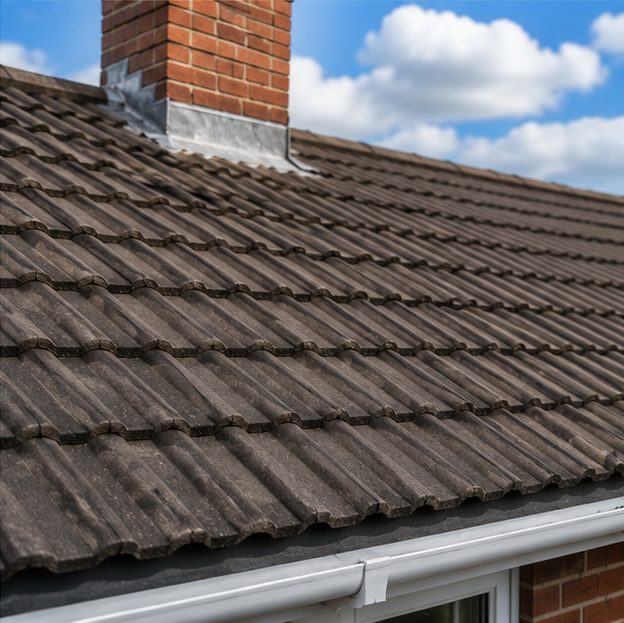
The method is the same everywhere; what changes is what we expect to find and how it gets specified.
On the west coast - Hoylake, West Kirby, Meols - non-ferrous fixings and clips at the perimeter as standard, because salt and uplift take out an ordinary specification years early.
On the older terraced stock in Birkenhead and Wallasey - shared chimney stacks, continuous roofs across party walls, and the question of who instructs the work on a converted or rented building.
On the inter-war housing in Bebington and the suburbs - hips, ridges and hip irons.
And in Heswall - complicated roofs with a great many junctions, where the answer is nearly always a detail rather than a tile.
The rest of the series, on the questions people ask most.
Every town has its own page, written around what the roofs there are actually like. Start with the main roof repairs page.
“I had a leak in my vally had a number of roofers to come and take a look couldn’t find the problem Roofline’s solutions fixed the problem first time. Very happy with these guys thank you for the brilliant service”
Michael Price“Excellent service from Buddy and the team in installing a new garage roof in a really professional manner. Was kept updated at all stages and given good advice as to our options. Would highly recommend”
Peter Aspinall“Excellent work replacing ridge tiles, repointing chimney and repairing flashing. Also fixed other broken tiles. Clean and tidy job. Would definitely recommend.”
NeilDescribe what is happening and roughly where you are, and we will come back to you — usually the same day. If water is coming in now, please call instead.
Prefer to talk? Call 07464 259566 · WhatsApp 0044 7464 259566 · Email Evensbuddy@yahoo.com
We cover Chester, Cheshire, the Wirral and Flintshire from Elton, just north of Chester.
2 Manley View
Elton
Chester
CH2 4QF
Almost all of our work happens at your property rather than here, so please call before travelling.
Monday – Friday — 24hrs — Emergency Call-Outs
Saturday — 8:00 – 19:00
Sunday — 8:00 – 19:00
Weekday emergency call-outs are answered around the clock. Weekend cover is 8:00 to 19:00.