★★★★★
“I had a leak in my vally had a number of roofers to come and take a look couldn’t find the problem Roofline’s solutions fixed the problem first time. Very happy with these guys thank you for the brilliant service”
Michael Price
Roof repairs across Runcorn — old town, new town and riverside. Leak tracing, tiles, slates, chimneys and flat roofs, with weekday emergency call-outs around the clock.
Almost every roof repair job starts with the same question, and it is not "what needs replacing". It is "where is the water actually getting in".
That sounds obvious. It is not, because the place water appears inside a building is very frequently nowhere near the place it entered the roof. Runcorn spans Victorian terraces in the old town, the new town estates built either side of 1970, and the riverside — and on every one of those the same principle applies.
This page sets out how a leak is actually traced, because if you understand that, you will know very quickly whether the person quoting you has looked or guessed.


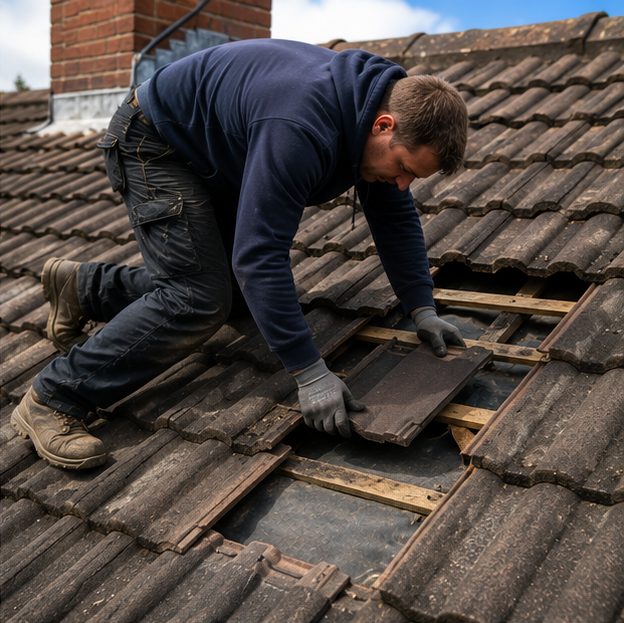
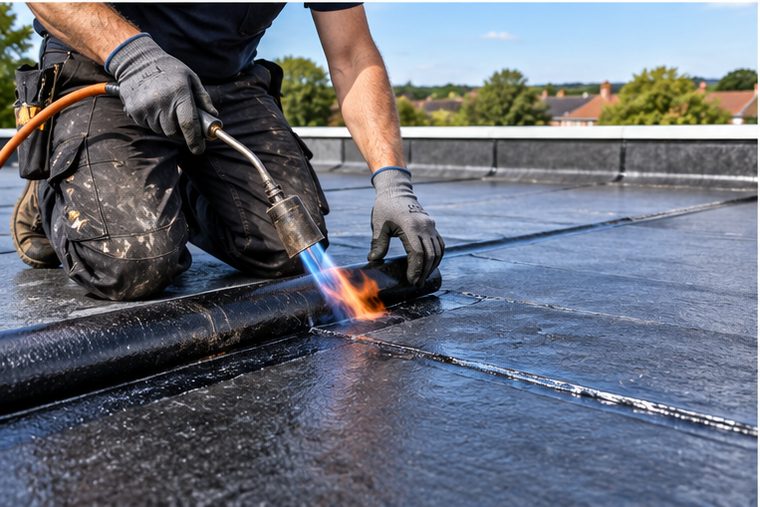
Water that gets past a roof covering does not drop straight down. It lands on the underlay, and underlay is laid in overlapping courses that drain downwards, so the water runs down the slope until it finds somewhere to leave. That might be a nail hole, a tear, a lap that has opened, or the point where the underlay stops at a wall.
If it gets past the underlay it lands on a rafter or a purlin, and timber will carry water sideways for a surprising distance before it drips. By the time it reaches a ceiling and shows as a stain, it can be several metres from the defect and on the wrong side of the room.
So the first place we look is not the outside of the roof. It is the loft, in daylight, with the lights off. Daylight showing through a covering tells you a great deal in about ten seconds. After that it is staining on the underside of the underlay, on the rafters and on the wall plate — and crucially, the highest point where staining appears, because water runs down, never up. Whatever is wrong is at or above that point.
Old stains and live stains look different, and that matters. A dry, sharply edged ring is historic. A dark, soft-edged, damp patch is current. If a roof has been repaired before, the loft usually tells us whether the repair worked long before anyone goes up on the tiles.
Only then does it make sense to go on the roof, because by that point we know roughly where to look. The outside inspection is checking the specific area the loft pointed at, plus everything uphill of it: the covering, the laps, the flashings, the valley, the verge and any penetration through the slope.
Where a leak still will not show itself, water testing is the honest answer — wetting one small area at a time, from the bottom of the slope upwards, with someone watching inside. It takes time and it is not glamorous, but it produces an answer rather than a theory. Nobody who has looked at your ceiling from the pavement can tell you where your roof is leaking.
A quotation that names the defect is worth considerably more than one that names a price. "Replace slipped tiles" is not a diagnosis. "The lead soaker at the third course where the extension meets the main roof has failed, water is running down the inside of the wall plate and appearing four feet away" is.
If someone has quoted you without going into the loft and without going on the roof, they have priced a guess. It might be the right guess. But you will find out either way, and you will pay for it either way.
Runcorn has enough variety in its housing that there is no single answer here. The old town terraces raise the slate-and-nails question; the new town estates raise the concrete tile and mortar question; and both raise it at different ages.
The test is the same wherever you are: is there a reason this part of the roof failed, and is everything around it sound. A single defect with an identifiable cause on an otherwise sound roof is a repair, straightforwardly. Failures appearing in new places each year, with no particular cause each time, are a covering telling you something about itself.
Storm work is the one situation where the order changes. Normally we diagnose and then repair; in an emergency we stop the water first and work out the whole picture afterwards, because a roof that is open is doing damage every hour it stays open.
What that usually means in Runcorn is sheeting or temporarily refixing whatever has moved, then coming back in daylight and settled weather to establish what actually failed and why.
Emergency call-outs run 24 hours a day, Monday to Friday, with Saturday and Sunday cover from 8:00 to 19:00.
Leaking roofs, slipped and broken tiles, damaged slates, storm damage, valleys, chimneys, leadwork, flat roofs, ridges and verges. The main roof repair page has the detail on each of them.
“I had a leak in my vally had a number of roofers to come and take a look couldn’t find the problem Roofline’s solutions fixed the problem first time. Very happy with these guys thank you for the brilliant service”
Michael Price“Excellent work from the lads at roofline solutions. I had a leak in my valley, they came out and sorted it within a day.”
Chris Hollewell“Excellent work replacing ridge tiles, repointing chimney and repairing flashing. Also fixed other broken tiles. Clean and tidy job. Would definitely recommend.”
NeilWritten for Runcorn rather than for roofs in general. The ones not yet published are listed rather than linked, because a link to a page that does not exist yet helps nobody.
Every town below has its own page, written around what the roofs there are actually like.
Describe what is happening and roughly where you are, and we will come back to you — usually the same day. If water is coming in now, please call instead.
Prefer to talk? Call 07464 259566 · WhatsApp 0044 7464 259566 · Email Evensbuddy@yahoo.com
We cover Runcorn from our base at Elton, just north of Chester.
2 Manley View
Elton
Chester
CH2 4QF
Almost all of our work happens at your property rather than here, so please call before travelling.
Monday – Friday — 24hrs — Emergency Call-Outs
Saturday — 8:00 – 19:00
Sunday — 8:00 – 19:00
Weekday emergency call-outs are answered around the clock. Weekend cover is 8:00 to 19:00.