★★★★★
“A great team that really looked after us and have continued to support us. I wouldn’t hesitate to use roofline again or recommend them to family and friends. Buddy takes pride in his work and customer service.”
Samantha MerrickBecause it is a capacity problem rather than a hole. Your roof has a rate of rainfall it can handle, and heavy rain exceeds it.
Rainwater goods are not sized for "rain". They are sized for a rate of rainfall - so many millimetres per hour - based on the roof area draining into them.
Below that rate, the system carries the water away and everything works. Above it, the water arrives faster than it can leave, and it goes wherever it can: over the front of a gutter, sideways out of a valley, backwards out of a back gutter.
That is why the leak is intermittent and why it correlates with intensity rather than duration. A whole day of drizzle produces nothing; twenty minutes of a downpour produces a leak.
And nothing is broken. That is the part people find hard to believe.
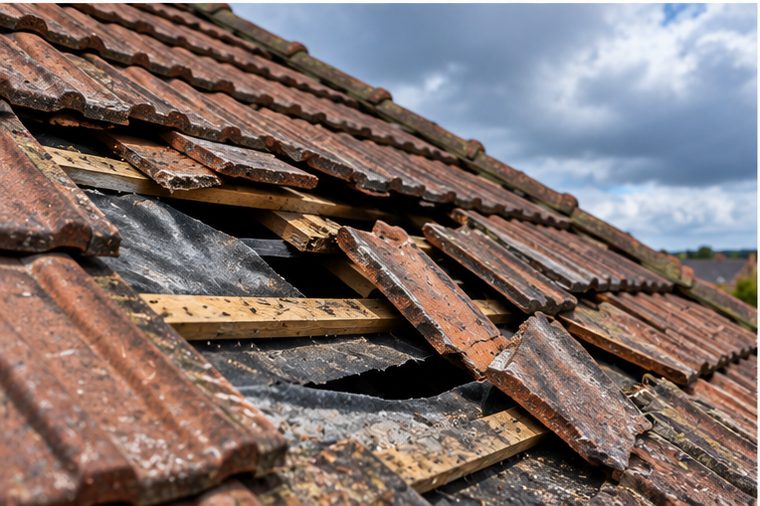
Blockage, long before it is a blockage. A gutter with two centimetres of silt in the bottom has lost a disproportionate amount of its capacity, because the cross-section available to carry water is what matters. It still drains in ordinary rain and overflows in heavy rain.
Falls that have gone. Gutters are hung to a fall towards the outlet. Brackets fail, fascias sag, and a gutter that has lost its fall holds water along its length and carries much less.
Valleys cut too tight. The clear channel between the cut tiles either side of a valley is what carries the water. Cut too close - a workmanship fault rather than wear - and the valley has been under-capacity since the day it was laid.
Outlets and downpipes. One partly blocked downpipe backs the whole gutter up.
More roof draining into the same place. An extension, a conservatory or a porch added at some point, with its water routed into rainwater goods that were sized for the original building.
Knutsford has a great deal of Georgian and Victorian property, and older rainwater goods were frequently sized by convention rather than calculation.
That was usually adequate. What has changed is not the rain so much as everything else: extensions added, roof areas increased, valleys and hidden gutters that have never been cleared, and cast iron that has corroded internally and lost section.
Hidden and parapet gutters are the specific one on the larger and older houses here. A box gutter behind a parapet, or a valley gutter between two roof slopes, is out of sight, carries a great deal of water, and has usually never been looked at. When it overflows, it overflows inside the building envelope rather than over the edge - so a modest capacity problem produces a serious leak.
On a listed building or in a conservation area, upgrading rainwater goods is a materials question as much as a capacity one: cast iron replaced with cast iron or a convincing equivalent rather than with plastic, and any change that affects appearance worth checking with the council before it happens.
Go out during heavy rain, with a coat, and look.
Water pouring over the front lip of a gutter means the gutter is at capacity or blocked.
A vertical curtain of water at one point on the gutter means a failed joint.
A downpipe that is dry while the gutter is full means the outlet is blocked.
Water visibly running down a wall below the eaves means it is going behind the gutter rather than into it.
And if all of the rainwater goods are visibly coping, the capacity problem is higher up - a valley, or a chimney back gutter - and that needs somebody on the roof.
Five minutes in the rain is worth an hour of theory.
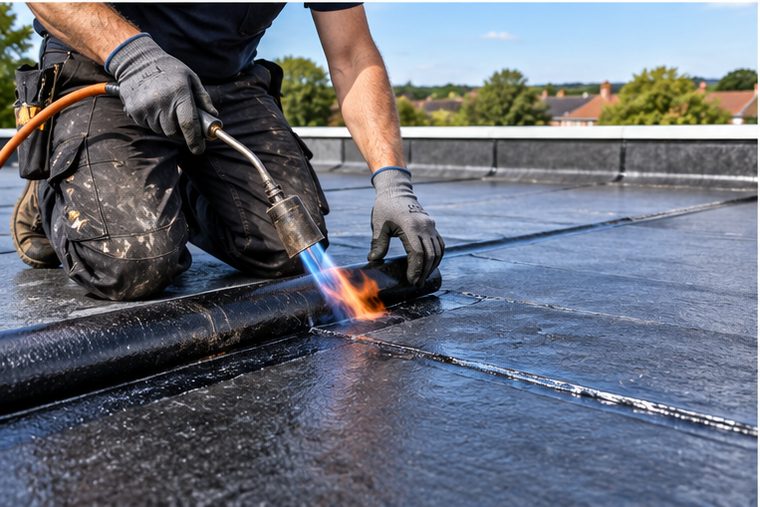
Frequently nothing more than clearing, which is the cheapest outcome in roofing and a meaningful share of these cases.
Sometimes re-hanging a gutter to restore its fall, or renewing a failed joint.
Occasionally increasing capacity - a larger gutter profile, an additional downpipe, or an additional outlet on a hidden gutter. On a protected building that is where the materials conversation comes in.
And where the fault is a valley cut too tight, it means lifting the tiles either side and re-cutting them to leave an adequate channel - which is a proper job rather than a clean-out, and it is the permanent answer to a valley that has overflowed since it was built.
The rest of the series, on the questions people ask most.
Every town has its own page, written around what the roofs there are actually like. Start with the main roof repairs page.
“A great team that really looked after us and have continued to support us. I wouldn’t hesitate to use roofline again or recommend them to family and friends. Buddy takes pride in his work and customer service.”
Samantha Merrick“Highly recommend. Very quick and efficient. Great communication. Went above and beyond to work the weekend to complete the work that needed to be done. Very happy with the results.”
Karen Jones“I needed help removing a chimney.
Buddy discussed the options available to me, taking into account my budget, timeline and DIY ability.
We settled that his team would remove the chimney to the roofline, using scaffolding and ladders.
He gave a detailed description of the steps his team were going to take, how long it would take them, and provided a fair quote.
His team were pleasant and worked efficiently. They got the job done in the estimated time and I was happy with the end result.”
Describe what is happening and roughly where you are, and we will come back to you — usually the same day. If water is coming in now, please call instead.
Prefer to talk? Call 07464 259566 · WhatsApp 0044 7464 259566 · Email Evensbuddy@yahoo.com
We cover Chester, Cheshire, the Wirral and Flintshire from Elton, just north of Chester.
2 Manley View
Elton
Chester
CH2 4QF
Almost all of our work happens at your property rather than here, so please call before travelling.
Monday – Friday — 24hrs — Emergency Call-Outs
Saturday — 8:00 – 19:00
Sunday — 8:00 – 19:00
Weekday emergency call-outs are answered around the clock. Weekend cover is 8:00 to 19:00.