★★★★★
“A great team that really looked after us and have continued to support us. I wouldn’t hesitate to use roofline again or recommend them to family and friends. Buddy takes pride in his work and customer service.”
Samantha MerrickUsually it is a job for next week. There are five positions where the same single tile is a job for today.
One tile missing from the open field of a slope, with nothing showing inside and no weather forecast that frightens anybody, is not an emergency.
The underlay beneath it is designed to catch what gets past the covering, and for a few weeks it will. What it is not designed for is being exposed to daylight and wind, which degrades it - so the job is weeks rather than months, and ideally before the next windy spell.
That is the honest general answer and it covers most cases. What follows is the exceptions, because they matter and nobody lists them.
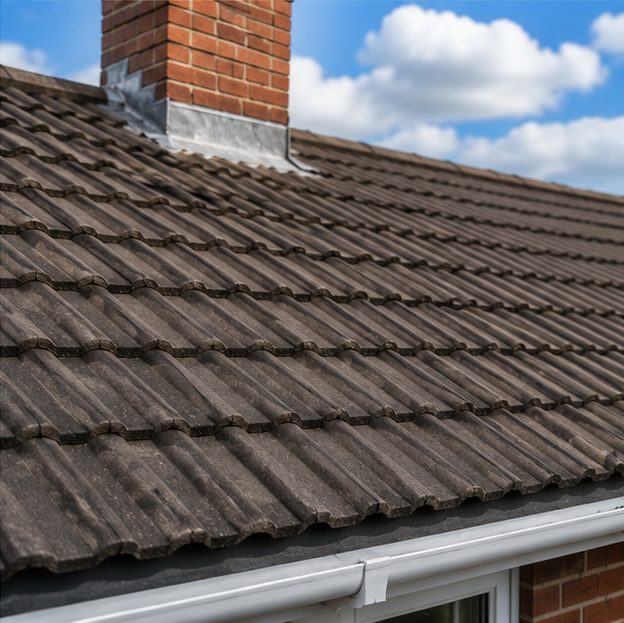
1. Above a door, a path, a drive or a pavement. If the tile is gone the ones around it now have a free edge, and on a hip or a verge the next one along may follow. Anything that can come down on a person changes the category entirely.
2. In or beside a valley. A valley carries the run-off from two slopes into a narrow channel. A gap beside one is not a gap over an underlay catching an occasional splash - it is a gap beside the highest-volume water on the roof.
3. At an abutment or beside a chimney. Same reason, and there is usually leadwork underneath that relies on the tile above it staying put. A missing tile there frequently means a soaker is now exposed and unsupported.
4. On a roof with no underlay, or with failed underlay. On older Knutsford and village property - unlined slate roofs and roofs with perished torching - there is no second barrier. A missing slate there is a hole straight into the roof space.
5. On a hip, particularly the bottom tile. A hip runs downhill to a corner and gravity is pulling the tiles off the end of it. The bottom hip tile is usually directly above a front door or a drive.
Knutsford has a substantial conservation area and a great many listed buildings, and on those the urgency shifts for a different reason: not danger, but time.
Matching the covering takes longer. Salvaged slate or clay of the right size, colour and thickness has to be sourced rather than picked off a shelf, and on a listed building substituting a modern equivalent may not be acceptable.
So the practical advice is the opposite of what you might expect: on a protected building, start the process sooner, precisely because the permanent repair takes longer to arrange. A gap that would be a fortnight's job on a modern house can be a month on a listed one.
Emergency make-safe work on a listed building is normally uncontroversial - stopping water entering an historic roof is urgent and nobody sensible argues about it. What we do is keep the make-safe reversible and in sympathetic materials wherever possible, so it does not compromise the permanent repair or the fabric.
And where a repair might amount to alteration rather than like-for-like, the council is the authority. We will say what we think needs checking rather than quietly getting on with it.
Look at where the gap is, not just that there is one. Which of the five positions above is it in?
Look along the rest of the roof line from the ground with the light behind you. A single gap plus three slipped-but-not-fallen tiles is a different situation from a single gap.
Keep the tile if you have found it. On an older property it is the fastest route to a match.
Check the loft, if it is safe, for daylight and for damp - and note the highest point any staining reaches.
And do not go up.
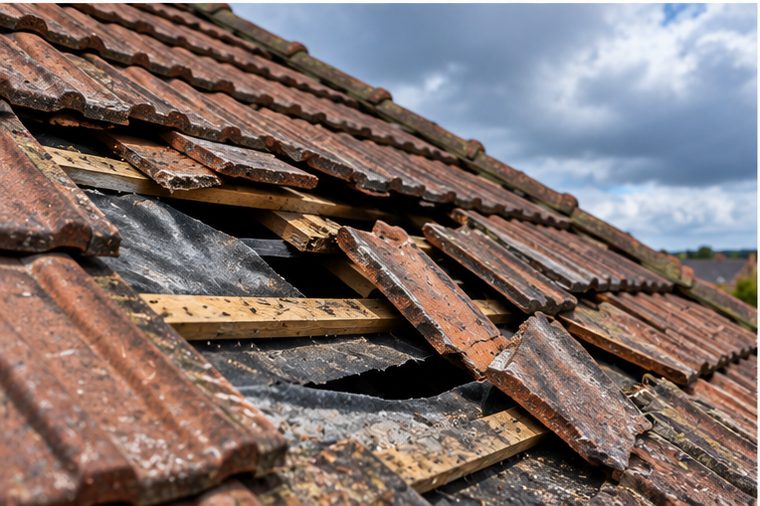
Treating every missing tile as an emergency wastes money on out-of-hours call-outs that achieve a make-safe you did not need.
Treating a tile in one of the five positions as routine costs considerably more, because a gap beside a valley or on an unlined roof does damage from the first proper rain rather than from the first proper winter.
Ring and describe where it is. That conversation costs nothing and it puts you in the right tier.
The rest of the series, on the questions people ask most.
Every town has its own page, written around what the roofs there are actually like. Start with the main roof repairs page.
“A great team that really looked after us and have continued to support us. I wouldn’t hesitate to use roofline again or recommend them to family and friends. Buddy takes pride in his work and customer service.”
Samantha Merrick“Highly recommend. Very quick and efficient. Great communication. Went above and beyond to work the weekend to complete the work that needed to be done. Very happy with the results.”
Karen Jones“I needed help removing a chimney.
Buddy discussed the options available to me, taking into account my budget, timeline and DIY ability.
We settled that his team would remove the chimney to the roofline, using scaffolding and ladders.
He gave a detailed description of the steps his team were going to take, how long it would take them, and provided a fair quote.
His team were pleasant and worked efficiently. They got the job done in the estimated time and I was happy with the end result.”
Describe what is happening and roughly where you are, and we will come back to you — usually the same day. If water is coming in now, please call instead.
Prefer to talk? Call 07464 259566 · WhatsApp 0044 7464 259566 · Email Evensbuddy@yahoo.com
We cover Chester, Cheshire, the Wirral and Flintshire from Elton, just north of Chester.
2 Manley View
Elton
Chester
CH2 4QF
Almost all of our work happens at your property rather than here, so please call before travelling.
Monday – Friday — 24hrs — Emergency Call-Outs
Saturday — 8:00 – 19:00
Sunday — 8:00 – 19:00
Weekday emergency call-outs are answered around the clock. Weekend cover is 8:00 to 19:00.