★★★★★
“A great team that really looked after us and have continued to support us. I wouldn’t hesitate to use roofline again or recommend them to family and friends. Buddy takes pride in his work and customer service.”
Samantha MerrickOften yes, and on a protected building there may be a positive reason to. What decides it is thickness, work-hardening and whether it was the right size to begin with.
Unlike almost every other roofing material, lead does not have a service life in the ordinary sense. It develops a protective carbonate patina in its first few weeks and then sits there. Lead on cathedral roofs has been in place for centuries.
It is also completely recyclable without loss of quality, which is why reclaimed lead has a real market value and why lead theft is a problem.
So the instinct that old lead should automatically be thrown away is wrong, and on the older property around Knutsford and the surrounding villages it is worth resisting.
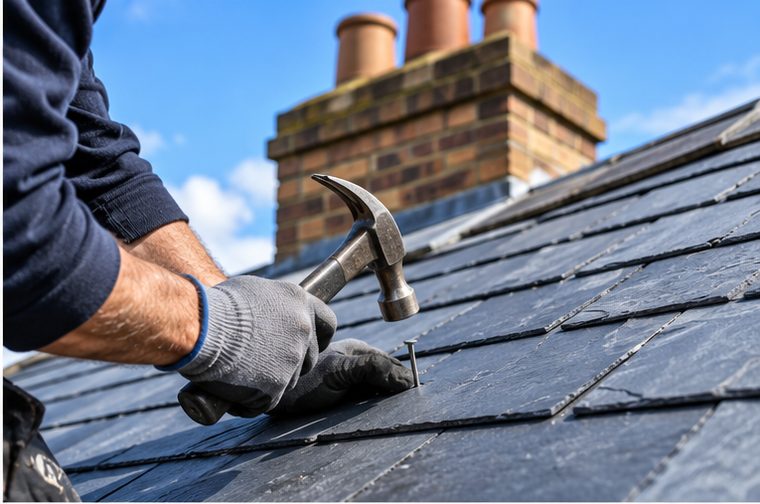
Work-hardening. Lead is dressed - beaten and shaped - to fit what it covers. Every time it is worked, it becomes slightly harder and less ductile. Lead that has been taken off, re-dressed and refitted several times over a century is measurably more brittle than new sheet, and at some point it will crack when bent rather than move.
Thinning. Where water has run over the same line for decades - in a gutter, a valley, at the foot of a slope - lead erodes very slowly. A sheet that has gone papery in one place is finished in that place.
Fatigue damage. A sheet that has already split along a fold has been flexing there for years. Even if the split is repaired, the metal either side of it has a history.
Those three are what an assessment is actually looking at. Age on its own decides nothing.
When the lead is thick enough for its position - correctly specified in the first place - and has not been repeatedly re-dressed.
When it has simply come out of its chase or lifted, which is a fixing failure rather than a material one. Re-dressing it back in, re-wedging and repointing is a proper repair.
When the roof is being disturbed for another reason and the flashing has to come off and go back anyway - a stack repoint, for instance.
And when the building is listed or in a conservation area, where there is a positive argument for retaining original fabric where it can still perform. Knutsford has a substantial conservation area and a large number of listed buildings, and on those the presumption runs towards repair and retention rather than renewal.
When the piece was the wrong size to begin with. This is the important one. Lead expands and contracts a great deal, and guidance puts sensible maximum lengths for cover flashings at around a metre and a half with lapped joints. A single continuous run down a long stack splits along a fold - and putting that same oversized piece back, however carefully, produces the same split again.
When it is too thin for its position - a code lighter than the job needs.
When it is papery, heavily fatigued, or has multiple splits.
And when it is a cement fillet rather than lead at all, in which case there is nothing to reuse.
On a listed building, work affecting the character of the building can require listed building consent, and the protection covers the whole building rather than just the front. In a conservation area, like-for-like repair in matching materials is generally repair rather than alteration, while changing a material can matter.
In practice, for leadwork on a Knutsford property that means: renewing lead with lead is normally straightforward; substituting a lead alternative may not be; and the council is the authority rather than us.
We will tell you what we think needs checking and we will not quietly get on with something that ought to have been asked about. Doing work that needed consent without it is a criminal offence rather than a paperwork problem, and it is not worth the risk to either of us.
The related point on old buildings: lime mortar rather than cement where the building is built in lime. Cement is harder and less permeable than soft brick or stone, so it traps moisture and pushes the damage into the masonry instead of the joint. That applies to the pointing over a flashing chase as much as anywhere else.
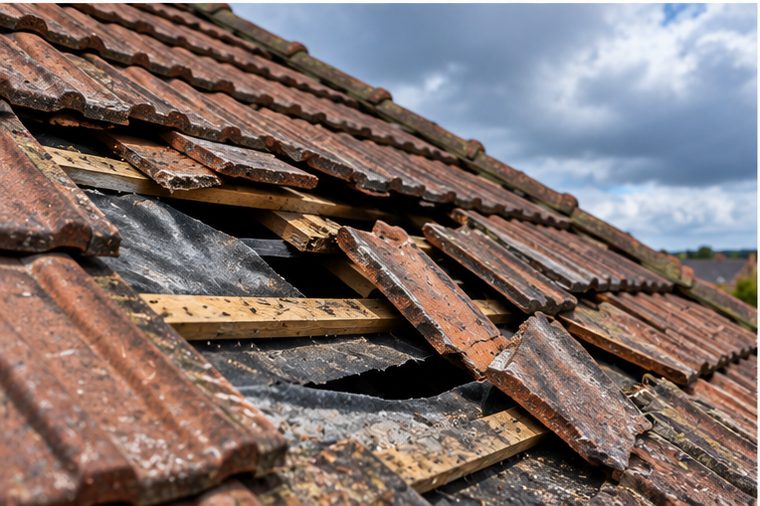
Lead has scrap value, and stripped lead from an unoccupied or secluded property is not a rare event. Larger houses set back from a road are exactly the profile.
If lead has gone missing rather than failed, that changes the sensible replacement: on a property that has been targeted before, a lead alternative or additional fixing arrangements may be worth considering - subject, on a protected building, to what is permitted.
On an ordinary occupied house, lead remains the right material.
The rest of the series, on the questions people ask most.
Every town has its own page, written around what the roofs there are actually like. Start with the main roof repairs page.
“A great team that really looked after us and have continued to support us. I wouldn’t hesitate to use roofline again or recommend them to family and friends. Buddy takes pride in his work and customer service.”
Samantha Merrick“I needed help removing a chimney.
Buddy discussed the options available to me, taking into account my budget, timeline and DIY ability.
We settled that his team would remove the chimney to the roofline, using scaffolding and ladders.
He gave a detailed description of the steps his team were going to take, how long it would take them, and provided a fair quote.
His team were pleasant and worked efficiently. They got the job done in the estimated time and I was happy with the end result.”
“Highly recommend. Very quick and efficient. Great communication. Went above and beyond to work the weekend to complete the work that needed to be done. Very happy with the results.”
Karen JonesDescribe what is happening and roughly where you are, and we will come back to you — usually the same day. If water is coming in now, please call instead.
Prefer to talk? Call 07464 259566 · WhatsApp 0044 7464 259566 · Email Evensbuddy@yahoo.com
We cover Chester, Cheshire, the Wirral and Flintshire from Elton, just north of Chester.
2 Manley View
Elton
Chester
CH2 4QF
Almost all of our work happens at your property rather than here, so please call before travelling.
Monday – Friday — 24hrs — Emergency Call-Outs
Saturday — 8:00 – 19:00
Sunday — 8:00 – 19:00
Weekday emergency call-outs are answered around the clock. Weekend cover is 8:00 to 19:00.