★★★★★
“I had a leak in my vally had a number of roofers to come and take a look couldn’t find the problem Roofline’s solutions fixed the problem first time. Very happy with these guys thank you for the brilliant service”
Michael PriceThe New Town estates were built with far more flat and shallow-pitched roofing than the older parts of Runcorn, and those roofs fail in recognisable ways.
Runcorn New Town was built either side of 1970, in an architectural period that used flat and very shallow-pitched roofing far more readily than the decades before or since. Garages, link blocks, canopies, porches, whole terraces of housing with monopitch or near-flat roofs.
Add to that the extensions and garages added to the older Runcorn housing over the same period, and the town has a considerably higher proportion of flat roofing than its size suggests.
Most of those roofs are now on their second or third covering, and what is underneath them is the same as it was in 1970.
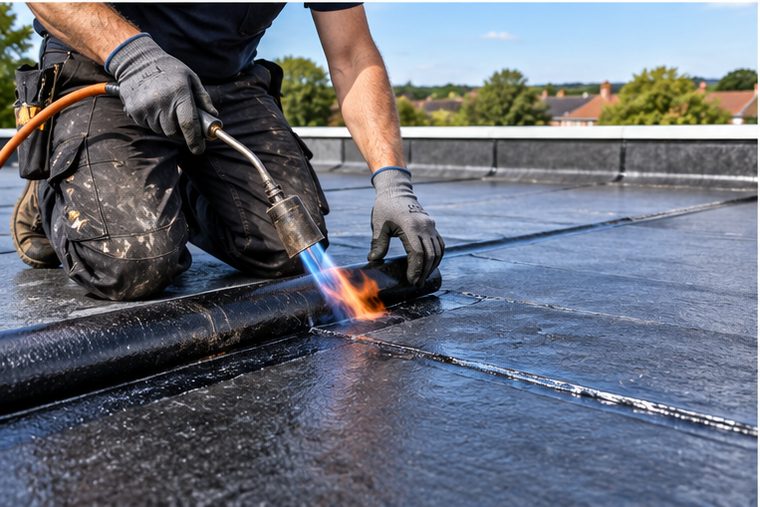
A flat roof is a covering on a deck, and the deck decides almost everything about whether a leak is a repair or the beginning of a replacement.
Roofs of this era commonly used chipboard - specifically the ordinary, non-moisture-resistant board that was standard at the time. Chipboard is strong and cheap and it behaves very badly when it gets wet: it swells, delaminates and loses its strength, and it does not recover when it dries.
That produces the specific Runcorn finding. A covering that could have been patched sits on a deck that has already gone soft, so patching it puts a new covering on something that cannot support it.
You can often feel it. A deck that gives underfoot, or has a soft or springy area around a leak, has taken water. If it feels solid, the covering is the whole question.
Better decks - plywood, and later oriented strand board or insulation-based warm deck build-ups - cope considerably better, and roofs recovered in the last twenty years may well have had the deck replaced at the same time.
A number of the New Town designs used pitches too shallow for the covering to work as a conventional tiled roof but not flat either.
That matters because every covering has a minimum pitch below which it will not shed water reliably, and below that pitch wind-driven rain gets under the laps.
On those roofs the underlay is doing far more work than it would on a steeper roof, and when it ages the roof starts leaking in weather that would not trouble a conventional pitch.
They also collect debris rather than shedding it, which blocks the outlets and gutters and produces the same standing-water problems a flat roof has.
Almost never in the middle. The field of a flat roof is a continuous sheet with nothing happening to it.
The upstand, where the roof meets a wall. On a garage or an extension against the house, this is the commonest single cause. The covering has to be carried up the wall high enough and capped or tucked in properly; carried up too low, or with the flashing over it lifted, driving rain runs straight down behind it.
The edge trim. Wind lifts hardest at edges and corners. One corner with an air path under it becomes a peeled covering.
The outlet. Blocked outlets are the single most preventable flat roof problem there is, and on the estates here the outlets are frequently small and unguarded.
Penetrations - soil vents, flues, rooflight kerbs. Every one is a joint.
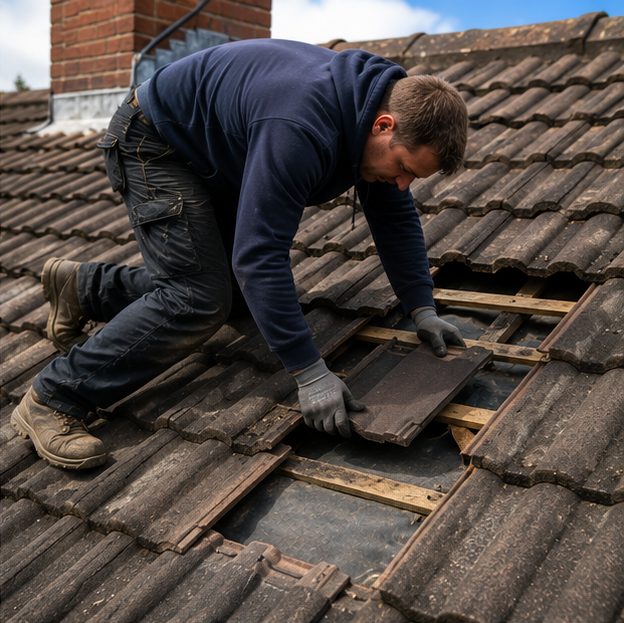
Establish whether the deck is sound, because that is what decides the size of the job and it is invisible from below.
Ask whoever comes out to tell you specifically what the deck felt like and what it is made of. On a Runcorn roof of this age, "chipboard, soft in the corner by the outlet" is a different job from "plywood, sound throughout".
And ask whether they are proposing to overlay or to strip. Laying a new covering over an old one that is saturated, or over a deck that has taken water, seals the moisture in and the roof deteriorates underneath while looking fine on top.
The rest of the series, on the questions people ask most.
Every town has its own page, written around what the roofs there are actually like. Start with the main roof repairs page.
“I had a leak in my vally had a number of roofers to come and take a look couldn’t find the problem Roofline’s solutions fixed the problem first time. Very happy with these guys thank you for the brilliant service”
Michael Price“Excellent work replacing ridge tiles, repointing chimney and repairing flashing. Also fixed other broken tiles. Clean and tidy job. Would definitely recommend.”
Neil“Highly recommend. Very quick and efficient. Great communication. Went above and beyond to work the weekend to complete the work that needed to be done. Very happy with the results.”
Karen JonesDescribe what is happening and roughly where you are, and we will come back to you — usually the same day. If water is coming in now, please call instead.
Prefer to talk? Call 07464 259566 · WhatsApp 0044 7464 259566 · Email Evensbuddy@yahoo.com
We cover Chester, Cheshire, the Wirral and Flintshire from Elton, just north of Chester.
2 Manley View
Elton
Chester
CH2 4QF
Almost all of our work happens at your property rather than here, so please call before travelling.
Monday – Friday — 24hrs — Emergency Call-Outs
Saturday — 8:00 – 19:00
Sunday — 8:00 – 19:00
Weekday emergency call-outs are answered around the clock. Weekend cover is 8:00 to 19:00.