★★★★★
“I had a leak in my vally had a number of roofers to come and take a look couldn’t find the problem Roofline’s solutions fixed the problem first time. Very happy with these guys thank you for the brilliant service”
Michael PriceAlmost always yes. The three things that actually decide it are the tile profile, the state of the battens, and whether a match can be found.
A broken or missing tile on an otherwise sound roof is a repair. It does not require re-roofing, it does not require a slope to be stripped, and anybody quoting you for a new covering on the strength of a handful of tiles is selling rather than advising.
The genuine exceptions are narrow. If the battens under the tile have softened, if the surrounding tiles are so weathered that lifting them breaks them, or if the profile cannot be matched at all, the job grows. None of those is decided by how old the roof is; they are decided by what is found when a tile is lifted.
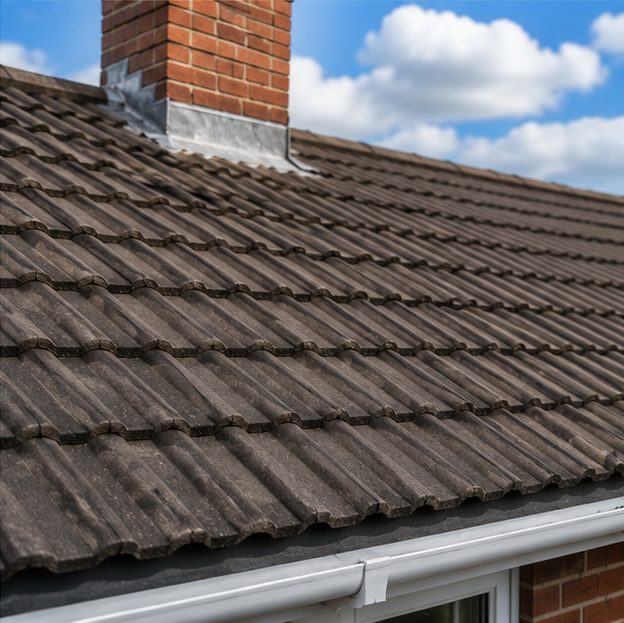
Runcorn's housing splits neatly here, and so does the job.
The new town estates and most post-war housing use interlocking concrete tiles - large, with a rolled or ribbed edge that laps over the tile beside it. Each tile covers the one below by only a small headlap. Replacing one means lifting the two or three tiles immediately around it, unhooking the broken one, and hooking the new one back into the interlock. It is quick and it is genuinely a single-tile job.
The older terraces use plain tiles - small, flat, laid in double lap so that every point on the roof has two tiles over it. Replacing a plain tile means lifting more of the courses above, and the surrounding tiles are more likely to be brittle. Still a repair, but a slower one, and one where a couple of neighbouring tiles usually get broken in the process and have to be replaced too. That is normal and it should be in the quotation rather than a surprise.
The thing that most often complicates a tile replacement is not the roof. It is finding the tile.
Concrete interlocking tiles have been made in a great many profiles since the 1950s and a large proportion of them are long out of production. The tile on a 1968 Runcorn estate house may not have been made since the 1980s, and the modern equivalent will be close but not identical - a slightly different roll, a slightly different length, a different colour once weathered.
The answers, in order of preference: salvaged tiles of the exact profile from a reclaim yard; tiles taken from a less visible slope of the same roof and the modern equivalent put in their place; or, where neither is possible, the closest current match with the mismatch acknowledged up front.
What we will not do is put four bright new tiles in the middle of a weathered front elevation and say nothing about it. If a perfect match is not available we will tell you before the work rather than after.
When a tile comes off, the batten is visible, and that is the moment the job either stays small or does not.
A sound batten takes a nail and the repair is done. A batten that is soft, split at the nail line, or has clearly been wet for a long time will not hold anything, and the fix is to cut back to sound timber and let in a new length - which means lifting more of the covering.
The underlay matters too. If the felt under the missing tile has already gone brittle or torn, putting a tile over it restores the first barrier but leaves the second one absent, and the next defect in that area will leak straight away.
Neither of those is a reason for a new roof. They are reasons a one-tile job can reasonably turn into a small-area job, and a quotation should say what happens if that is found rather than leaving it to the day.
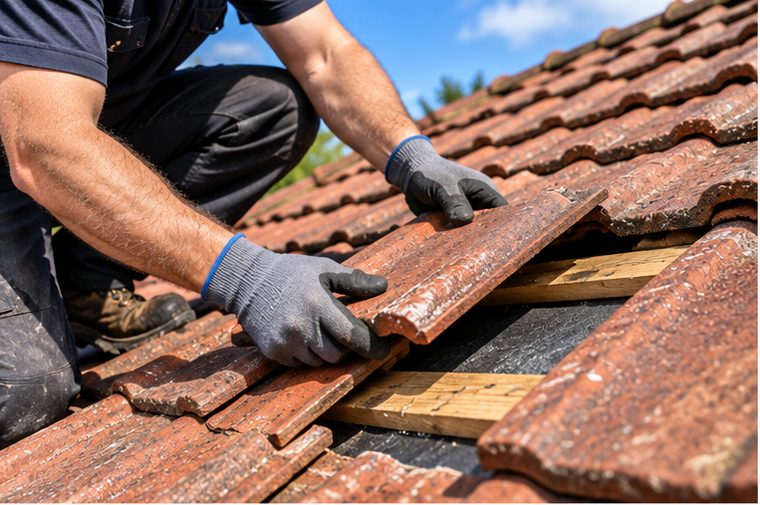
Ask what was found under the tile. If nobody lifted anything, nobody knows.
Ask whether the profile is being matched, salvaged or substituted.
Ask what happens if the surrounding tiles break during the work, because on an old plain-tiled roof some of them will.
And if a quotation jumps from a broken tile to a new roof, ask what is wrong with the rest of the covering and how they established it. There may be a good answer. There should certainly be one.
The rest of the series, on the questions people ask most.
Every town has its own page, written around what the roofs there are actually like. Start with the main roof repairs page.
“I had a leak in my vally had a number of roofers to come and take a look couldn’t find the problem Roofline’s solutions fixed the problem first time. Very happy with these guys thank you for the brilliant service”
Michael Price“Excellent work replacing ridge tiles, repointing chimney and repairing flashing. Also fixed other broken tiles. Clean and tidy job. Would definitely recommend.”
Neil“Highly recommend. Very quick and efficient. Great communication. Went above and beyond to work the weekend to complete the work that needed to be done. Very happy with the results.”
Karen JonesDescribe what is happening and roughly where you are, and we will come back to you — usually the same day. If water is coming in now, please call instead.
Prefer to talk? Call 07464 259566 · WhatsApp 0044 7464 259566 · Email Evensbuddy@yahoo.com
We cover Chester, Cheshire, the Wirral and Flintshire from Elton, just north of Chester.
2 Manley View
Elton
Chester
CH2 4QF
Almost all of our work happens at your property rather than here, so please call before travelling.
Monday – Friday — 24hrs — Emergency Call-Outs
Saturday — 8:00 – 19:00
Sunday — 8:00 – 19:00
Weekday emergency call-outs are answered around the clock. Weekend cover is 8:00 to 19:00.