★★★★★
“Excellent work from the lads at roofline solutions. I had a leak in my valley, they came out and sorted it within a day.”
Chris HollewellIn nearly every case the window is fine. What has failed is the kit that weathers it into the roof, or it is not a leak at all.
A modern roof window is a sealed unit in a frame, and the frame is not what keeps water out of the roof. The flashing kit does that: a set of preformed pieces that weather the window into the surrounding covering - an apron below, side sections, a head flashing above, and soakers or a gutter detail at the top.
When water appears around a roof window, that kit is the first and usually the last place to look. Replacing the window changes nothing if the kit is what has failed, and it is a very expensive way of finding that out.
So the first question to ask anybody quoting for a replacement unit is what they found wrong with the flashing.
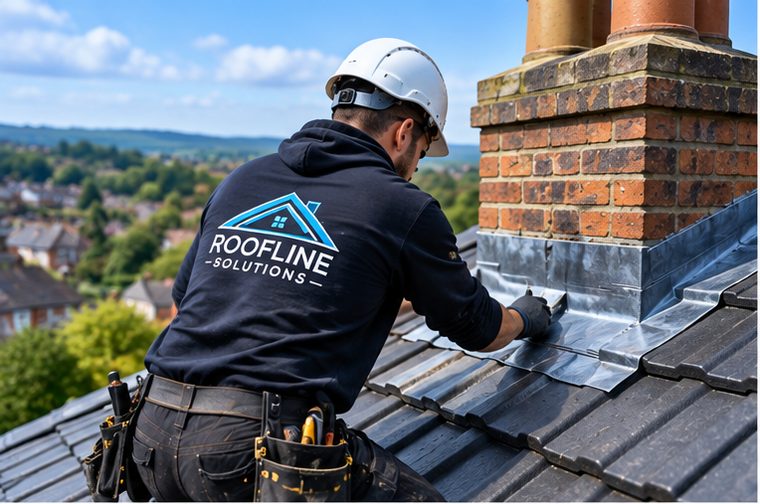
The wrong kit for the covering. Flashing kits come in versions for flat coverings such as slate and for profiled coverings such as interlocking tile, and they are not interchangeable. A flat-profile kit under a deeply profiled tile leaves gaps at every roll. That leaks from the day it was fitted, and on a house that has been re-covered since the window went in it is a common finding.
The head flashing and what is above it. Water coming down the slope has to be taken round the window. If the head detail has been compressed, bedded in mortar rather than formed, or has debris sitting behind it, it overflows into the roof. This is the commonest genuine leak.
Soakers or side sections cut short. Same failure as at any abutment: the piece that should carry water out over the covering does not reach far enough.
Sealant. A previous repair with mastic around the frame. It sheds water for a season, cracks, and then holds water against the joint.
Water on the inside of the glass, or running down the internal frame and onto the reveal, in cold weather, is condensation.
A roof window is the coldest surface in a room and it is usually in a bathroom, a kitchen, a loft conversion or a stairwell - places with high humidity and often poor ventilation. Warm moist air meets cold glass and condenses, exactly as it does on a car windscreen.
The tells are clear once you know them. It appears on cold nights rather than during rain. It is worst in the morning. It is on the glass and the inner frame rather than on the plaster around the opening. And it is worse when the window has a blind, because the blind traps a layer of still cold air against the glass.
A leak wets the plaster of the reveal and the ceiling around the window. Condensation wets the glass and the frame. That distinction saves people a great deal of money.
The fix is ventilation and moisture control - using the trickle vent if there is one, opening it after a shower, and not sealing the room up. Not roofing.
The houses here are large and much extended, with roofs that step, turn and change level, and they tend to have several roof windows rather than one.
That raises a specific trap: water appearing at a roof window that is not the source. On a complicated roof, water entering at a valley, an abutment or a saddle higher up runs down the rafters and finds the first thing that penetrates the ceiling - which is very often the window opening.
So on a roof with several levels, the rule is the same as anywhere: find the highest point staining reaches in the roof space before deciding what is wrong. If the staining starts above the window and runs down to it, the window is the exit, not the entrance.
It is also why replacing a roof window on the strength of a damp reveal is a decision worth resisting until somebody has been in the loft.
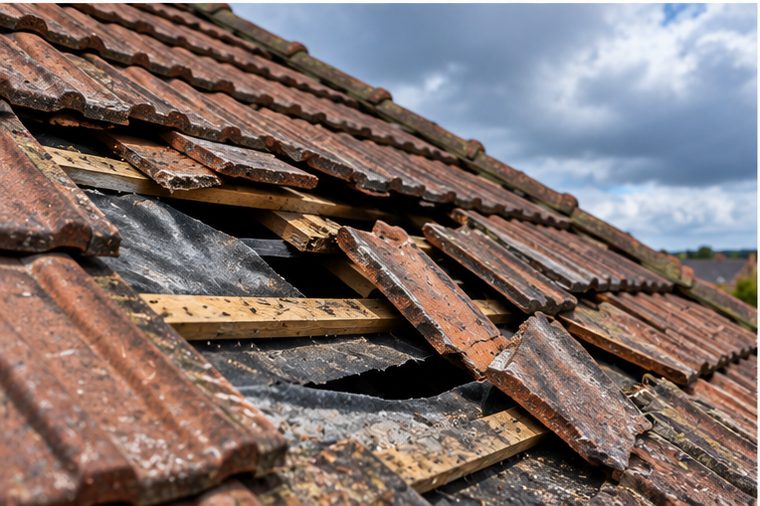
The tiles or slates around the window come off. The existing kit comes out. A kit matched to the actual covering goes in, with the head detail formed properly and the side sections lapping correctly over the covering below.
Anything that was sealed gets the sealant removed rather than added to.
And the head detail gets checked for debris, because on a roof with trees over it - and Heswall has plenty - the space above a roof window collects exactly the same leaf litter that blocks a valley.
Ask for photographs. None of this is visible from inside the room, and the difference between a kit that has been properly formed and one that has been persuaded into place is entirely in the detail.
The rest of the series, on the questions people ask most.
Every town has its own page, written around what the roofs there are actually like. Start with the main roof repairs page.
“Excellent work from the lads at roofline solutions. I had a leak in my valley, they came out and sorted it within a day.”
Chris Hollewell“I needed help removing a chimney.
Buddy discussed the options available to me, taking into account my budget, timeline and DIY ability.
We settled that his team would remove the chimney to the roofline, using scaffolding and ladders.
He gave a detailed description of the steps his team were going to take, how long it would take them, and provided a fair quote.
His team were pleasant and worked efficiently. They got the job done in the estimated time and I was happy with the end result.”
“Highly recommend. Very quick and efficient. Great communication. Went above and beyond to work the weekend to complete the work that needed to be done. Very happy with the results.”
Karen JonesDescribe what is happening and roughly where you are, and we will come back to you — usually the same day. If water is coming in now, please call instead.
Prefer to talk? Call 07464 259566 · WhatsApp 0044 7464 259566 · Email Evensbuddy@yahoo.com
We cover Chester, Cheshire, the Wirral and Flintshire from Elton, just north of Chester.
2 Manley View
Elton
Chester
CH2 4QF
Almost all of our work happens at your property rather than here, so please call before travelling.
Monday – Friday — 24hrs — Emergency Call-Outs
Saturday — 8:00 – 19:00
Sunday — 8:00 – 19:00
Weekday emergency call-outs are answered around the clock. Weekend cover is 8:00 to 19:00.