★★★★★
“Excellent work from the lads at roofline solutions. I had a leak in my valley, they came out and sorted it within a day.”
Chris HollewellSome valleys fail because they wore out. A surprising number fail because of how they were made, and those have been leaking since the day they were laid.
The tiles or slates either side of a valley are cut on the rake, and there has to be a clear channel of open lining between the two cut edges for the water to run down.
How wide that channel needs to be depends on the roof area draining into it, the pitch and the exposure. What it must not be is decorative. A valley cut so the tiles almost meet looks neat and is under-capacity from the first day.
The symptom is unmistakable once you know it: the valley copes with ordinary rain and overflows sideways in a downpour, every time, for years. Nothing is broken and nothing is worn. The roof has simply never been able to carry what lands on it.
It is the commonest built-in valley fault and it is only cured by lifting the tiles and re-cutting them.
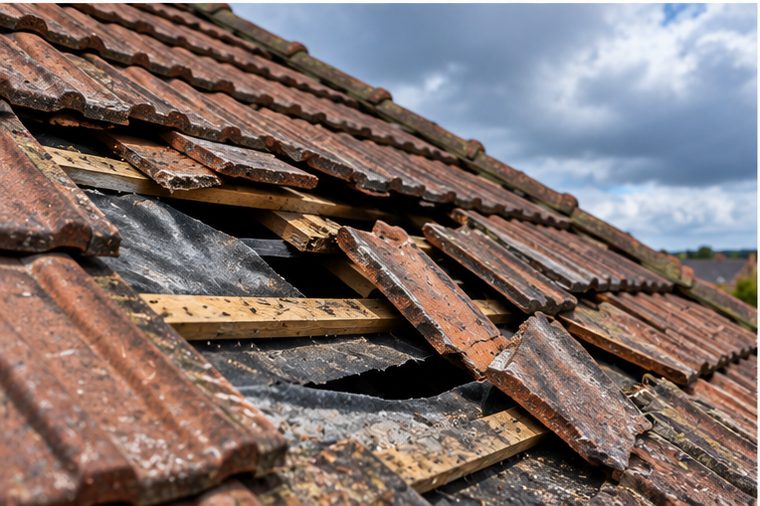
Lead expands and contracts substantially with temperature, and a valley - open to the sky, dark, and often in sun for part of the day - goes through a wide range.
A lining formed in pieces that are too long cannot accommodate that movement, so it fatigues and splits. The split runs across the channel, along a fold, and it is usually in the middle of a long run.
Guidance from the Lead Sheet Association sets maximum piece lengths for valley linings, with each piece lapped over the one below. A valley run in a single continuous length is a split waiting to happen, and repairing that split without shortening the pieces gets you the same failure again.
A valley lining does not sit on a flat board and stop. It sits on a valley board with tilting fillets - triangular battens along each side - which lift the edge of the tiles slightly and stop them lying flat into the channel.
Without them, the cut tiles sit down into the valley, obstructing the flow and holding water against the lining. The channel is narrower than it looks and the lining stays permanently wet.
Related: the lining needs adequate upstand at each side and the tiles need to lap over it far enough that wind-driven rain cannot get under. A lining that is too narrow for the covering leaves that lap marginal.
None of this is visible without lifting tiles, which is why it survives so long undiagnosed.
The commonest thing we find on a previously repaired valley: mastic run along the cut edges of the tiles, or over a split in the lining.
It sheds water for a season. Then it shrinks, cracks and, because it is bonded along one edge, holds water against the defect rather than letting it drain. The valley is worse than before anybody touched it, and the sealant has to be removed before a proper repair can be made.
Valleys work by shape and gravity - a clear channel, adequate laps and upstands, and water directed rather than blocked. Nothing you apply over a failed valley turns it back into a working one.
The houses here are large, built on a slope and extended more than once. Every extension that meets the main roof at an angle creates a valley.
Valleys formed as part of an addition are, in our experience, considerably more likely to carry the built-in faults above than the original valleys of the house. They are made on site, at the end of a job, joining new work to old, often by somebody whose main task was the extension rather than the roof.
So on a much-extended Heswall house, the valley to look at first is not the oldest one. It is the newest.
The other local factor is size. Large complicated roofs concentrate more water into each valley, so a channel that would be adequate on a semi is marginal here.
The rest of the series, on the questions people ask most.
Every town has its own page, written around what the roofs there are actually like. Start with the main roof repairs page.
“Excellent work from the lads at roofline solutions. I had a leak in my valley, they came out and sorted it within a day.”
Chris Hollewell“I needed help removing a chimney.
Buddy discussed the options available to me, taking into account my budget, timeline and DIY ability.
We settled that his team would remove the chimney to the roofline, using scaffolding and ladders.
He gave a detailed description of the steps his team were going to take, how long it would take them, and provided a fair quote.
His team were pleasant and worked efficiently. They got the job done in the estimated time and I was happy with the end result.”
“Highly recommend. Very quick and efficient. Great communication. Went above and beyond to work the weekend to complete the work that needed to be done. Very happy with the results.”
Karen JonesDescribe what is happening and roughly where you are, and we will come back to you — usually the same day. If water is coming in now, please call instead.
Prefer to talk? Call 07464 259566 · WhatsApp 0044 7464 259566 · Email Evensbuddy@yahoo.com
We cover Chester, Cheshire, the Wirral and Flintshire from Elton, just north of Chester.
2 Manley View
Elton
Chester
CH2 4QF
Almost all of our work happens at your property rather than here, so please call before travelling.
Monday – Friday — 24hrs — Emergency Call-Outs
Saturday — 8:00 – 19:00
Sunday — 8:00 – 19:00
Weekday emergency call-outs are answered around the clock. Weekend cover is 8:00 to 19:00.