★★★★★
“Excellent work from the lads at roofline solutions. I had a leak in my valley, they came out and sorted it within a day.”
Chris HollewellIndividually, yes. The complication on a Heswall roof is that the slates that fail are rarely the ordinary ones in the middle of a slope.
A whole slate in the open field of a slope is replaced individually and it is ordinary work. The broken one is removed with a slate ripper, a tool that slides under it and cuts or draws the two nails holding it, and the replacement is slid up and held with a lead or copper tingle, because the original nail positions are covered by the courses above.
That is correct practice on every slate roof in the country. It is not a shortcut.
If that were the whole story, this page would end here. On the big, much-extended houses around Heswall and Gayton it usually is not.
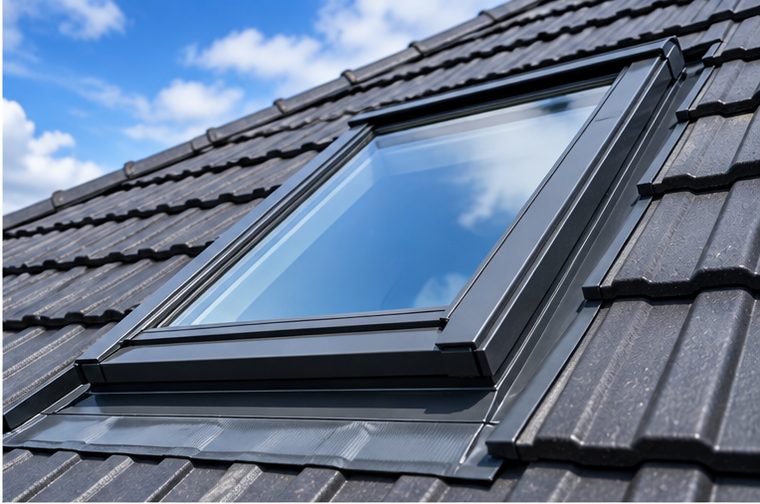
A roof with valleys, hips, dormers and abutments has a great many slates that are not full slates. They have been cut on site to fit a particular position: raked along a valley, mitred at a hip, trimmed against a wall, notched around a penetration.
Each one was cut for that spot. You cannot take a full slate out of the van and put it in, and you cannot swap one cut slate for another from elsewhere on the roof. It has to be cut again, to the same rake, with the same free channel left beside it.
That matters because cut slates are also the ones most likely to break. They are smaller, they are often held by a single nail, and they sit exactly where water concentrates.
This is the part worth taking seriously on a complicated roof.
A slate cracked in the middle of a slope has usually been stood on. A slate broken beside a valley or at an abutment has frequently broken because of what is underneath it.
Under the cut slates along an abutment are the soakers - small individual pieces of lead, one per course, turned up against the wall. If a soaker has slipped, corroded or was never there, the slate above it has no support at its edge and moves, and a slate that moves against a hard edge breaks.
The same at a valley. If the valley lining has lifted or the boards beneath have gone soft, the cut slates along it lose their bearing and start to crack.
So replacing the slate and stopping there fixes the visible half. The slate will break again, usually within a couple of years, and the homeowner concludes roofing is a racket. It is not; it is a repair that stopped at the symptom.
Lifting the cut slates either side, not just the broken one. Checking that every soaker in that run is present, sound and correctly lapped. Checking that the cover flashing over them is still in its chase and properly wedged. Renewing whatever is not, and then re-cutting and refixing the slates.
It is more work than replacing a slate and it is considerably less work than doing it three times. On a roof with several junctions it is worth having them all looked at while access is up, because the second one is nearly always in the same condition as the first.
And the thing not to accept: sealant over the junction. Mastic sheds water for a season, then shrinks, cracks and traps water behind itself, so the roof is worse than before anyone touched it. Lead junctions work by shape and gravity, and there is no product that turns a failed one back into a working one.
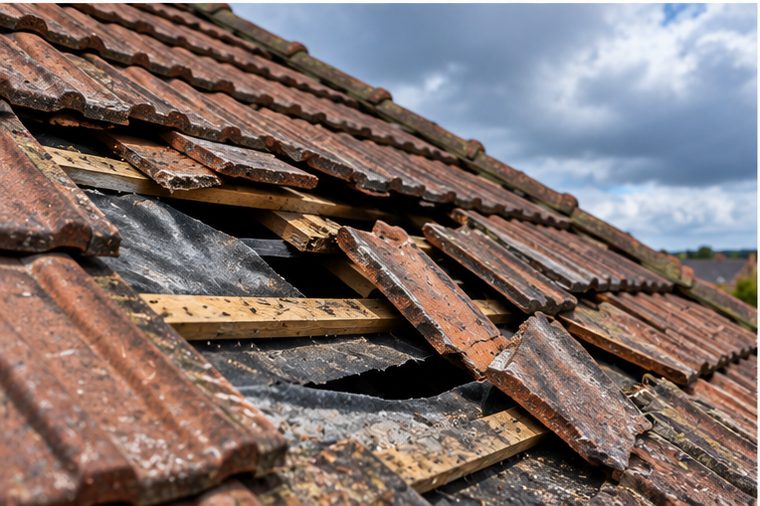
The count is the test, as on any slate roof. Slates that slip intact and for no reason are slates whose nails have corroded, and nails corrode as a population rather than one at a time.
One a year on a large roof is normal. A climbing rate is a slope reaching its end, and at that point stripping and relaying the existing slates on new battens with non-ferrous nails - buying salvage to make up the broken ones - resets the clock for considerably less than a new covering.
On a roof with a lot of junction work, doing a slope that way also lets every valley, soaker and abutment in that area be dealt with properly at the same time, which is usually where the real value is.
The rest of the series, on the questions people ask most.
Every town has its own page, written around what the roofs there are actually like. Start with the main roof repairs page.
“Excellent work from the lads at roofline solutions. I had a leak in my valley, they came out and sorted it within a day.”
Chris Hollewell“The guys did a great job in repairing our chimney. They were reliable, friendly and efficient. Buddy kept me in the loop throughout the whole process and I would not hesitate to use Roofline again!”
Hollie Furnival“I needed help removing a chimney.
Buddy discussed the options available to me, taking into account my budget, timeline and DIY ability.
We settled that his team would remove the chimney to the roofline, using scaffolding and ladders.
He gave a detailed description of the steps his team were going to take, how long it would take them, and provided a fair quote.
His team were pleasant and worked efficiently. They got the job done in the estimated time and I was happy with the end result.”
Describe what is happening and roughly where you are, and we will come back to you — usually the same day. If water is coming in now, please call instead.
Prefer to talk? Call 07464 259566 · WhatsApp 0044 7464 259566 · Email Evensbuddy@yahoo.com
We cover Chester, Cheshire, the Wirral and Flintshire from Elton, just north of Chester.
2 Manley View
Elton
Chester
CH2 4QF
Almost all of our work happens at your property rather than here, so please call before travelling.
Monday – Friday — 24hrs — Emergency Call-Outs
Saturday — 8:00 – 19:00
Sunday — 8:00 – 19:00
Weekday emergency call-outs are answered around the clock. Weekend cover is 8:00 to 19:00.