The short version
- A flat roof should be laid to a fall - it is not meant to be flat
- Ponding turns a pinhole into a leak by giving it constant pressure
- Deflection between joists is the usual cause on an older roof
- Correcting the fall is the one chance you get, at replacement
A Flat Roof Is Not Flat
Every flat roof is designed with a slope. The industry benchmark is a minimum finished fall of around 1 in 80, which in practice means designing to something steeper - commonly 1 in 40 - so that after construction tolerances and deflection the finished roof still drains.
The fall is created either by cutting the joists to slope, by adding tapered timber firrings on top of level joists, or on a warm deck by using tapered insulation.
A roof that ponds has either lost its fall or never had enough.
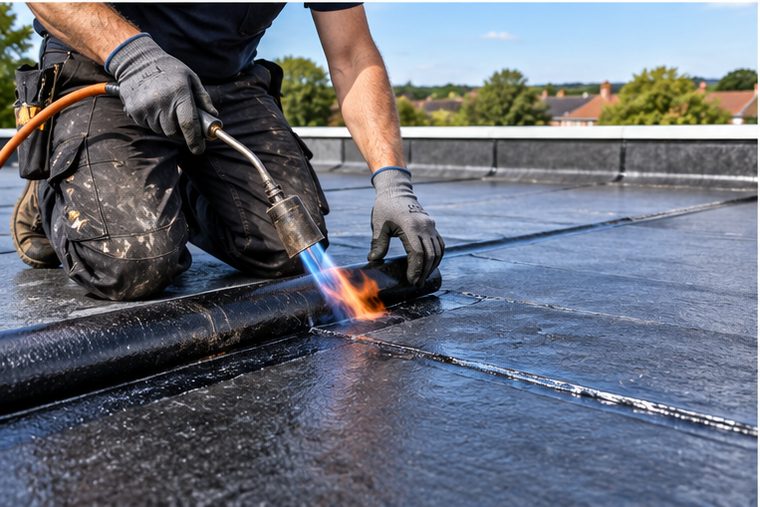
Why Water Sitting There Causes Leaks
Standing water does not create a hole. What it does is exploit every imperfection that a draining roof would tolerate.
Constant pressure. Water sitting on a pinhole, a small seam imperfection or a slightly lifted lap is pressing on it continuously rather than passing over it for ten minutes. Given weeks, it finds a way through defects that would never have leaked on a roof that drained.
The covering never dries. Bitumen and some membranes soften when permanently wet and warm, and the plasticiser that keeps a covering flexible is leached out faster.
Freeze-thaw. Standing water becomes ice, ice expands, and any small crack or open lap is levered wider each time it happens. A pond that freezes twenty times a winter is doing twenty small demolitions.
Weight. Water is heavy. A pond deflects the deck slightly, which deepens the pond, which adds weight. On a weak or ageing deck that is a slow feedback loop, and it is why ponds tend to grow rather than stay the same size.
Silt and vegetation. Ponds collect debris, and debris holds water even when the pond has evaporated. Moss and algae in a ponded area are a sign it has been there for years.
Why It Happens on Older Roofs
Deflection. Timber joists sag over decades, particularly if they were marginal for the span. The middle of a bay drops, and a roof that drained when it was built now holds water in the middle.
The firrings were never there. On some older extensions and garages the deck was simply laid on level joists with no fall at all. That was never right, and no covering will save it.
Blocked or badly placed outlets. A roof can have a perfectly good fall and still pond if the water is being led to a place it cannot leave. An outlet set slightly high, or one that has silted up, produces a pond around itself.
A recover that flattened the fall. Laying a new covering over an old one, especially with insulation boards over an existing slope, can reduce or reverse a shallow fall if it is not thought about.
The Crewe Terrace Version
On the railway terraces, the flat roofs are mostly over rear outriggers and back additions - long, narrow, often running between two properties and frequently draining into a shared or awkwardly placed gutter.
Those are the classic ponding candidates. Narrow roofs with a long run to a single outlet, joists that have deflected over a century, and an outlet position determined by where the downpipe already was rather than by where the water wants to go.
They also frequently drain into a box gutter behind a parapet, shared with the neighbouring property - so a blockage that is not on your roof at all can put a pond on it.
If you have a ponding outrigger roof, it is worth establishing where the water is supposed to go and whether that route is clear, before assuming the roof is the problem.
What Can Be Done
Not much, cheaply, on an existing roof - which is the honest answer.
Clearing the outlet and the route to it. Free, and it fixes a proportion of ponding complaints outright.
Adding an additional outlet, where the pond is somewhere the water could be let out if there were somewhere for it to go.
Living with it, on a covering that is otherwise sound. A shallow pond on a good EPDM or asphalt roof is not an emergency and those materials tolerate it reasonably well.
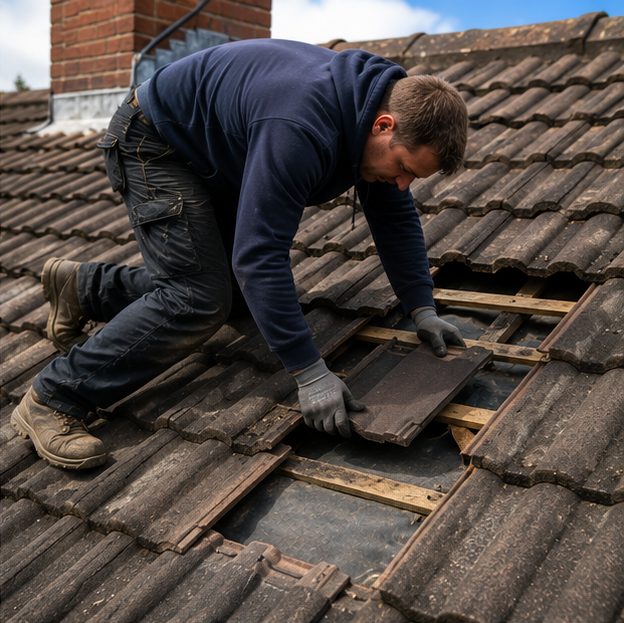
And correcting it properly at replacement, which is the real answer. When the covering comes off, firrings or tapered insulation can be added to build a proper fall. That is the one opportunity, it adds comparatively little to the job, and it is the difference between the new roof lasting its full life and repeating the old one's history.
Ask specifically whether the fall is being corrected. A quotation to recover a ponding roof that does not mention it is a quotation to rebuild the same problem.