The short version
- Storm damage concentrates at edges - that is a repair by definition
- A quote for a new roof should name what is wrong with the rest of it
- The exception: the storm exposed a covering that was already finished
- On a terrace, your section is not the whole roof
Why the Answer Is Nearly Always Yes
Wind loads a roof by suction and that suction concentrates at the ridge, the verges, the corners and the eaves. It is comparatively mild over the middle of a slope.
So storm damage, by its nature, is perimeter damage - a run of ridge, a verge, a triangle of tiles running up from the eaves. That is a defined area with a defined repair.
A gale does not wear out a covering. It finds the weakest fixings and the least protected edges. Which means the correct response is almost always to repair what went and to fix the perimeter better than it was, not to renew a roof that is otherwise doing its job.
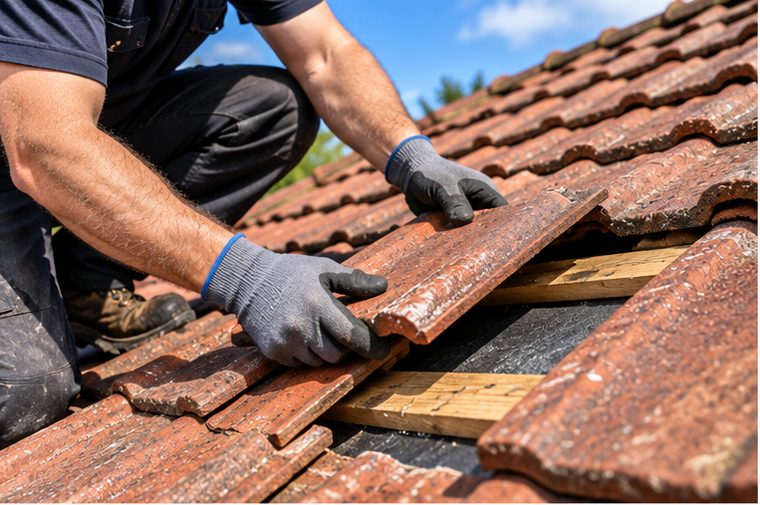
The Questions to Ask If Somebody Says Otherwise
Not to be awkward - there is a real situation where a new roof is the right answer, covered below. But it should be evidenced rather than asserted.
What is wrong with the parts that did not blow off? A specific answer sounds like: battens soft wherever a tile was lifted, nail fatigue across the elevation, tile surfaces gone and absorbing water, eleven previous repairs in five years. A non-specific answer sounds like: it is an old roof.
What did you find when you lifted a tile? This is the single best question. The condition of the battens and the fixings is visible the moment a tile comes off, and it is the actual evidence.
How many repairs has it had, and where? Failures in new places each time is a covering. Failures in the same place is a misdiagnosis.
Can I see photographs? None of this is visible from the ground, and a roofer who has been up there can show you.
The Situation Where They May Be Right
The storm found a roof that was already at the end.
The signature is scope and location. If tiles have come out of the middle of slopes rather than only at the edges, if several separate areas went in one night, or if every tile that was lifted revealed soft battens underneath, then the wind did not do that on its own. It removed a covering whose fixings had already gone.
That is a genuine and not uncommon finding on older roofs, and it deserves a straight conversation rather than a series of repairs that each buy less time than the last.
The honest way to have it is with both numbers on the table: what the repair costs and what the replacement costs, plus a realistic view of how long the repair buys. Anybody unwilling to price the repair at all is worth a second opinion.
The Crewe Complication: Your Roof Is Not Your Roof
On the railway terraces that make up so much of the town, the covering is continuous across the party walls. There are walls underneath at intervals, but the roof above is one slope.
Two consequences after a storm.
First, damage to a neighbouring section can put water into your house, and vice versa. If your ceiling is wet and your own section looks untouched, look along the terrace before assuming it is yours.
Second, "a new roof" on a mid-terrace house means recovering your section and butting it against old work at each end. That is entirely possible and we do it, but those junctions have to be detailed properly rather than simply run up against, or they become the next problem.
Where a whole run is at the same stage, neighbours co-ordinating is genuinely cheaper - the access is shared - and produces a better roof. Where it is only your section, the junction detailing is the thing to ask about.
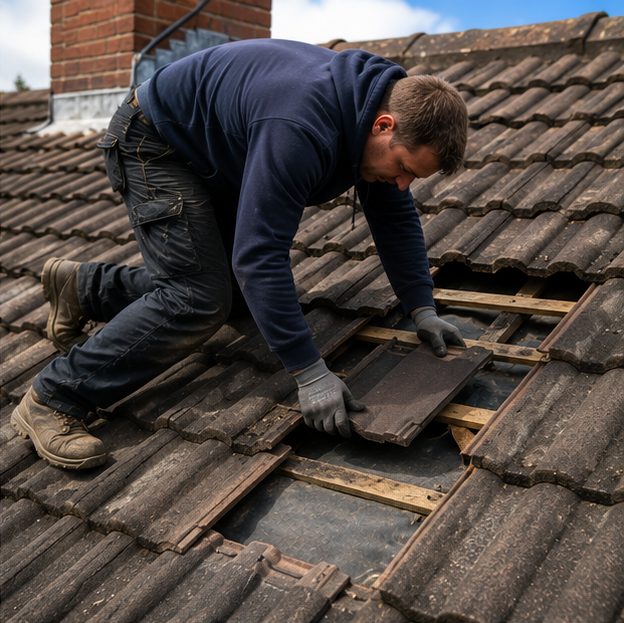
And the Doorstep Version
Worth saying plainly because it happens after every named storm: somebody knocks, says the roof is dangerous and needs replacing, and wants a decision now.
Nobody who has assessed your roof properly has done so from a passing van, and no legitimate roofer needs an answer on the doorstep. Take a name and a business address, get the claim in writing, and ring a firm you have looked up.
If the roof genuinely needs replacing, it will still need replacing next week.