The short version
- Slate fails at its nails; tile fails at its nibs, battens and surface
- A slate needs a ripper and a tingle; a tile is unhooked and rehooked
- Slate has a middle option - strip and relay the same slates
- Matching an obsolete tile profile is harder than matching slate
Why Crewe Has Both
The Victorian and Edwardian railway terraces were slated. The estates that went up from the 1930s onward, and everything since, are almost all tiled - clay early on, concrete later.
So it is entirely normal here to have a slate roof and a tiled roof in the same street, of different ages, with completely different failure patterns and completely different conversations about them.
How Each One Fails
Slate almost never wears out. Good Welsh slate outlives the people who fitted it. What fails is the iron or mild steel nail holding it, which corrodes over decades until it lets go - so slates slip intact, with no storm to blame. That is nail sickness, and because every nail on an elevation went in on the same day, it arrives as a population rather than one at a time.
Tile fails in more ways. Concrete tiles lose their coloured surface layer and begin absorbing water rather than shedding it. Clay tiles delaminate - splitting into layers - under freeze-thaw. Both hang on a nib over a batten with only some courses nailed, so they creep downward when a nib snaps or a batten softens. And mortar-bedded ridges and verges fail on both, but tiled roofs tend to be the ones with mortar verges.
The practical difference: a slate roof usually tells you it is ageing through the rate at which intact slates arrive on the ground. A tiled roof tells you through the appearance of the covering and the condition of the fixings when one is lifted.
How Each One Is Repaired
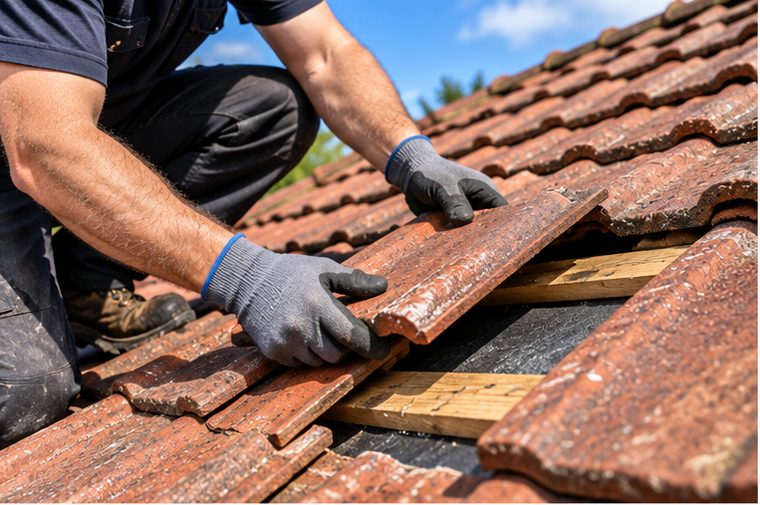
On a tiled roof, replacing one is mechanical. The tiles around it are lifted, the broken one is unhooked from the interlock or the nib, and the new one is hooked back in. Quick, and genuinely a single-tile job on an interlocking roof.
On a slate roof it is not possible to nail the replacement, because the original nail positions are covered by the two courses above. So the broken slate is drawn out with a slate ripper - a long hooked tool that cuts or pulls the nails - and the replacement is held with a lead or copper tingle folded over its bottom edge. That is correct practice, not a bodge, and it is why a repaired slate roof has small metal tabs visible if you look for them.
It also means a slate repair takes longer and needs a specific tool and a specific technique. Anybody who tells you they replaced a slate by nailing it back in has either lifted a large area or is describing something that did not happen.
Repair or Replace - the Answers Differ
This is the part worth knowing, because slate has an option tile does not.
On a tiled roof, once the covering has genuinely aged - surfaces gone, fixings tired, failures in new places each year - the answer is a new covering. The tiles themselves are at the end of their life and there is nothing to reuse.
On a slate roof the material is usually still good. So there is a middle option: strip the slope, renew the battens and underlay, and relay the existing slates with new non-ferrous nails, buying salvage to make up the broken ones. It costs considerably less than new material, keeps the appearance of the building, and resets the clock on the part that actually failed.
If you have a slate roof and somebody has quoted you for a new covering, ask about that explicitly. It is not always offered.
Matching - the Practical Nuisance
Counter-intuitively, matching slate is usually easier than matching tile. Slate is a natural material in a limited range of sizes and colours, and reclaim yards trade in it constantly.
Concrete interlocking tiles have been made in dozens of profiles since the 1950s and many are long out of production. The tile on a 1970s Crewe estate house may not have been made for forty years, and the nearest current equivalent will be visibly different once weathered. Salvage is the first answer; taking tiles from a hidden slope and putting the modern equivalent there is the second.
And One Thing They Share
On a terrace - which is most of the older stock here - the covering is continuous across the party walls, whatever it is made of. Water that gets under it runs along the battens, so a defect two houses along can appear in your bedroom regardless of whether the roof is slate or tile.
That is a Crewe problem rather than a material problem, and it is covered on the main Crewe roof repairs page.