★★★★★
“The guys did a great job in repairing our chimney. They were reliable, friendly and efficient. Buddy kept me in the loop throughout the whole process and I would not hesitate to use Roofline again!”
Hollie FurnivalA damp chimney breast is not automatically a roof problem, and one of the four usual causes needs no roofing work at all.
Damp on a chimney breast is one of the more misdiagnosed things in a house, because four quite different mechanisms produce a similar-looking stain.
1. Water coming in at the roof - failed flashing, a silted back gutter, or eroded pointing and spalled brick on the exposed part of the stack. This is the roofing one.
2. Hygroscopic salts from old soot in the flue, which make the plaster itself absorb moisture out of the room air. No water is entering the building at all.
3. Condensation inside a disused flue, usually because the chimney has been sealed at the top, the bottom, or both.
4. Ordinary condensation on a cold breast in a room with high humidity - commonest in a bedroom above a kitchen or bathroom in a converted house.
Only the first needs a roofer. Knowing which you have is worth doing before anybody quotes for scaffolding.
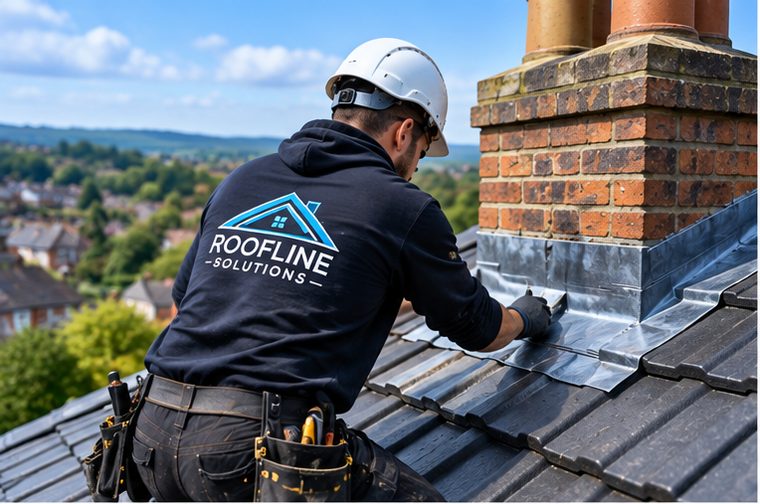
The single most useful test is what the damp tracks.
If it appears during or shortly after rain - particularly rain from one direction - and dries out in settled weather, it is water getting in. That is penetrating damp and it is the roofing one.
If it comes and goes with humidity rather than rain - worse in muggy weather, worse when the heating is off, worse in a room where washing is dried, and not obviously connected to whether it has rained - that is salts. Soot contains chlorides and nitrates that are hygroscopic, meaning they pull water vapour out of the air. Once they are in the plaster, the plaster is permanently damp-seeking.
Salt damp also has a distinctive look: a brown or yellowish stain that comes through emulsion however many coats you put on, sometimes with a fluffy white bloom, and often with the plaster blown or bubbling rather than simply stained.
And if the damp is confined to the coldest surfaces, appears as beading rather than staining, and is worst in winter in a room with poor ventilation, it is condensation on the breast rather than anything to do with the chimney at all.
This one is worth knowing because it is self-inflicted and common in converted properties.
When a fireplace is taken out and the chimney is no longer used, people block the opening at the bottom and cap the stack at the top. That leaves a tall masonry shaft, open to nothing, with cold air at one end and warm moist air leaking into it at the other.
Moisture condenses inside it, runs down, soaks into the breast and produces damp in a house with a perfectly sound roof.
The fix is ventilation at both ends: a vented cap or cowl at the top rather than a sealed one, and an air brick or vent in the blocked-off opening at the bottom. It costs very little and it solves the problem permanently.
If somebody has sealed your chimney completely and damp appeared afterwards, that sequence is close to conclusive.
A great many Birkenhead properties are let or converted, and a damp chimney breast is exactly the sort of thing that sits in the gap between parties.
If you rent, the roof and the structure are your landlord's responsibility under section 11 of the Landlord and Tenant Act 1985. Report it in writing, keep a copy, and photograph the patch with dates. If the cause turns out to be condensation and ventilation rather than water ingress, that is still worth establishing properly rather than being asserted at you.
If you own a flat in a converted house, the stack above roof level is almost always the freeholder's responsibility while the breast inside your flat is yours. Which means a chimney leak is frequently a repair one party pays for and making good that another party pays for - and it is a great deal easier to sort out with a written assessment naming the defect than with two people guessing.
We are happy to provide that separately from any work, which on a managed building is often the most useful thing we do.
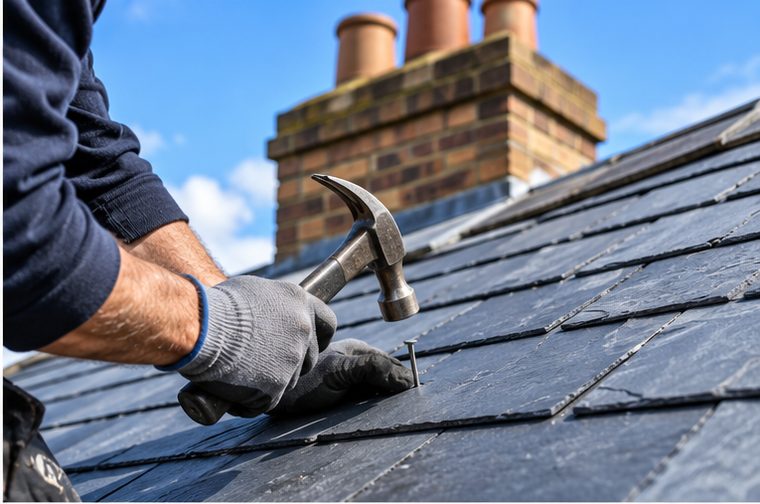
Looking at the stack, the flashing and the back gutter from the roof - not from the pavement.
Looking in the roof space at the point where the stack passes through, for staining and for where the highest damp reaches.
Asking what the damp does over time, which is the question that separates penetrating from hygroscopic.
And being told plainly if the answer is that the roof is fine. We would rather tell you the problem is a sealed flue and charge you nothing than sell you a flashing you did not need.
The rest of the series, on the questions people ask most.
Every town has its own page, written around what the roofs there are actually like. Start with the main roof repairs page.
“The guys did a great job in repairing our chimney. They were reliable, friendly and efficient. Buddy kept me in the loop throughout the whole process and I would not hesitate to use Roofline again!”
Hollie Furnival“I needed help removing a chimney.
Buddy discussed the options available to me, taking into account my budget, timeline and DIY ability.
We settled that his team would remove the chimney to the roofline, using scaffolding and ladders.
He gave a detailed description of the steps his team were going to take, how long it would take them, and provided a fair quote.
His team were pleasant and worked efficiently. They got the job done in the estimated time and I was happy with the end result.”
“The men were genuine and trustworthy. Turned up every time when they said they would, and phoned ahead. Very respectful and did an amazing job.,thank you x”
freda markhamDescribe what is happening and roughly where you are, and we will come back to you — usually the same day. If water is coming in now, please call instead.
Prefer to talk? Call 07464 259566 · WhatsApp 0044 7464 259566 · Email Evensbuddy@yahoo.com
We cover Chester, Cheshire, the Wirral and Flintshire from Elton, just north of Chester.
2 Manley View
Elton
Chester
CH2 4QF
Almost all of our work happens at your property rather than here, so please call before travelling.
Monday – Friday — 24hrs — Emergency Call-Outs
Saturday — 8:00 – 19:00
Sunday — 8:00 – 19:00
Weekday emergency call-outs are answered around the clock. Weekend cover is 8:00 to 19:00.