★★★★★
“The guys did a great job in repairing our chimney. They were reliable, friendly and efficient. Buddy kept me in the loop throughout the whole process and I would not hesitate to use Roofline again!”
Hollie FurnivalUsually yes. Here is what can actually be repaired on each type of covering, and what cannot.
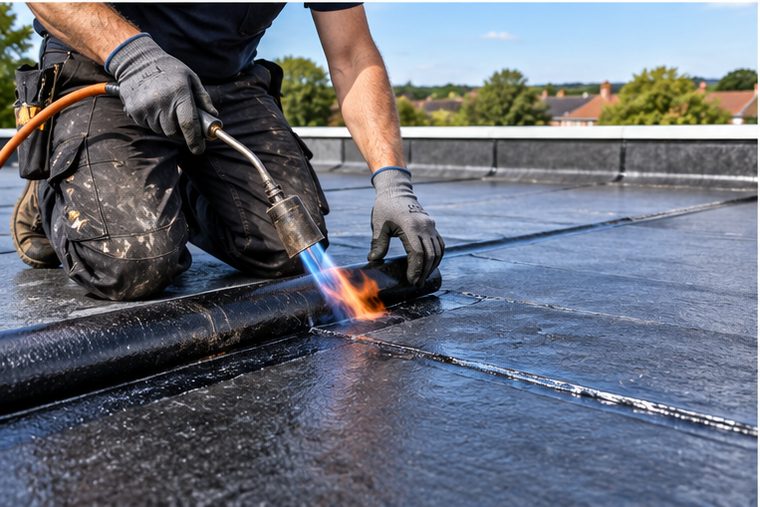
Layers of bitumen felt bonded together, usually three, and still the commonest covering on older extensions and outriggers across Birkenhead.
Repairable: a local split or tear; a lifted or failed edge detail; an upstand that has come away from a wall; a blister that has not burst; a failed joint at an outlet. All of those are patched with matching material, properly bonded and dressed, on a covering that still has flexibility in it.
Not repairable: widespread crazing where the surface has gone brittle and cracks when pressed; multiple existing patches; the top layer having weathered off across the area so the mineral finish is gone. At that stage the material has lost the plasticiser that made it flexible and it will crack next to wherever you patch it.
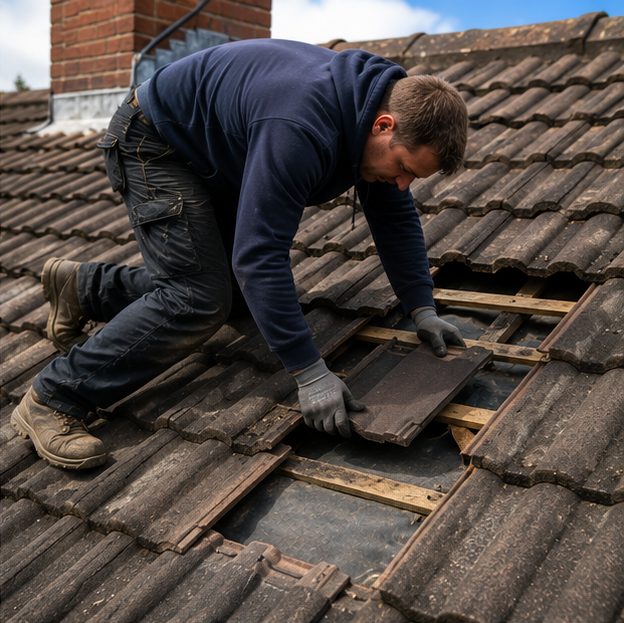
A single sheet, so there are very few joints in the field of the roof.
Repairable: punctures and tears, which patch well with the same material and the correct primer and tape. Seam failures at a lap or a detail. Failed bonding at an upstand or a corner. Because EPDM stays flexible for a long time, these repairs generally take properly.
Not repairable: a sheet that has been repeatedly punctured, or one that has gone chalky and hard over a large area. And EPDM laid over a deck that moves will keep failing at the same point, which is a deck problem rather than a covering one.
Rigid, laid in situ, and it fails where things move.
Repairable: a crack, ground back and laminated over with matching material; a damaged edge trim; delamination at an isolated point.
Not repairable in the useful sense: cracks that keep reappearing along the same line. GRP is rigid and the deck below it is not; if the deck deflects at a joint, the laminate cracks there and will do it again after any repair. That needs the deck stiffening, which is a bigger job than the roof.
Widespread crazing across the surface is age and ultraviolet exposure, and it is terminal.
Single-ply membranes are welded at their seams and are readily repairable by somebody with the right welding kit for that system - which is worth checking, because the systems are not interchangeable.
Mastic asphalt, found on some older and better-built flat roofs, is repaired by heating and reworking the material itself. It is a specialist trade and genuinely repairable, often for decades longer than people assume. Its usual failures are cracking at upstands and crazing at the surface, both of which can be dealt with.
The four places flat roofs actually leak are all details rather than covering, and all four are repairable on almost any system with life left in it.
The upstand where the roof meets a wall - carried up high enough, tucked in or capped properly.
The edge trim or drip at the perimeter.
The outlet - clearing, or renewing the detail around it.
Penetrations - a soil vent, a flue, a rooflight kerb.
If your leak is at one of those, the answer is very likely yes regardless of what the covering is made of.
On a converted house, the flat roof over a back addition is frequently a shared or freeholder responsibility even where it is only reachable from one flat - and even where only one flat suffers when it leaks.
Check the lease rather than assuming. A leaseholder instructing repairs directly on a structure that is the freeholder's to maintain can create a bill nobody else agreed to, and can complicate recovering it through the service charge.
If you rent, the roof is your landlord's responsibility under section 11 of the Landlord and Tenant Act 1985. Report it in writing and keep a copy.
What we can do in either case is come and produce a written assessment naming the covering, the defect and its location, separately from any work. On a managed building that is frequently the most useful thing anybody can hand over, because it turns an argument into a decision.
The rest of the series, on the questions people ask most.
Every town has its own page, written around what the roofs there are actually like. Start with the main roof repairs page.
“The guys did a great job in repairing our chimney. They were reliable, friendly and efficient. Buddy kept me in the loop throughout the whole process and I would not hesitate to use Roofline again!”
Hollie Furnival“The men were genuine and trustworthy. Turned up every time when they said they would, and phoned ahead. Very respectful and did an amazing job.,thank you x”
freda markham“I needed help removing a chimney.
Buddy discussed the options available to me, taking into account my budget, timeline and DIY ability.
We settled that his team would remove the chimney to the roofline, using scaffolding and ladders.
He gave a detailed description of the steps his team were going to take, how long it would take them, and provided a fair quote.
His team were pleasant and worked efficiently. They got the job done in the estimated time and I was happy with the end result.”
Describe what is happening and roughly where you are, and we will come back to you — usually the same day. If water is coming in now, please call instead.
Prefer to talk? Call 07464 259566 · WhatsApp 0044 7464 259566 · Email Evensbuddy@yahoo.com
We cover Chester, Cheshire, the Wirral and Flintshire from Elton, just north of Chester.
2 Manley View
Elton
Chester
CH2 4QF
Almost all of our work happens at your property rather than here, so please call before travelling.
Monday – Friday — 24hrs — Emergency Call-Outs
Saturday — 8:00 – 19:00
Sunday — 8:00 – 19:00
Weekday emergency call-outs are answered around the clock. Weekend cover is 8:00 to 19:00.