★★★★★
“Brilliant company. Did a really good job worked hard, looks really good up to my expected standards which are high. Can highly recommend them.”
CHESHIRE PORCELAINTiles hold each other down. That is the whole reason a roof survives a gale, and the whole reason it can fail all at once when it does fail.
The reason a tiled roof survives weather that would take a loose object off it is that it is not a collection of loose objects. Each tile hangs on a nib over a batten, is covered by the courses above and laps the ones beside it, and the whole assembly holds itself down.
Only a proportion of tiles are actually nailed. On the estate housing built across Winsford in the 1960s and 70s the usual practice was every third or fourth course, with the rest relying on the nib and the weight of what is above.
That works, and it worked for fifty years. But it means the roof is a system, and systems fail differently from components.
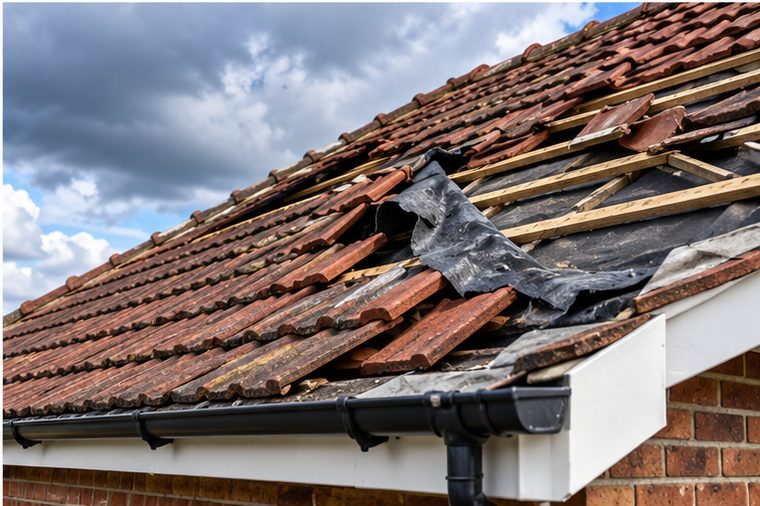
Look at how the interlock works and it becomes obvious. Every tile is held down at its head by the course above. The one course with nothing above it is the ridge, which is capped. The one course with a completely free lower edge is the eaves course, above the gutter.
If the wind gets under the eaves course and lifts it, it has now exposed the head of that tile and the tail of the one above. The next course up is easier to lift than the first one was. And the next.
That is unzipping, and it is why storm damage on a pitched roof is so often a triangular area running up from the eaves rather than a scattered handful of gaps.
It is also why the eaves course and the verge should be the best-fixed parts of any roof and, on roofs of this era, frequently are not.
The second mechanism is pressure rather than suction, and it is what turns a small failure into a large one.
If wind gets underneath a covering - through a gap where a tile has gone, at an open verge, or under a lifted eaves course - it pressurises the space between the tiles and the underlay. Now the roof is being pushed up from below at the same time as it is being sucked up from above.
That is the situation where a roof can lose a large area quickly. It is uncommon on a sound roof, because there is nowhere for the air to get in. It is much less uncommon on a roof that lost one tile in October and never had it replaced.
Which is the practical argument for dealing with a single gap before the winter: not the water, the air.
These roofs are now between fifty and sixty years old, built as complete estates in the same materials at the same time. Three things follow.
The mortar-bedded ridges and verges have generally been repointed at least once, and repointing over old bedding is shorter-lived than the original.
The nails in the courses that were nailed have had fifty years to corrode, and the battens have had fifty years to soften.
And several of the estate designs used shallower pitches, on which wind-driven rain gets further up under the covering and the underlay does more work than it would on a steeper roof.
Put those together and the roofs here are more vulnerable to a gale than their age alone suggests - and, because they were built together, they get there together.
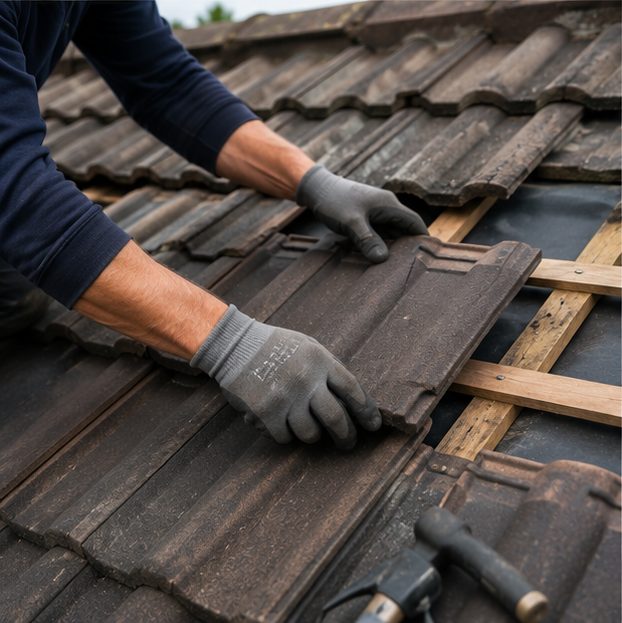
A scattered tile or two at the perimeter after a serious gale is ordinary.
A triangular area running up from the eaves is unzipping, and the question is what let the wind in at the bottom.
A whole run along a verge is a verge failure, not a tile failure.
Ridge sections gone in a line means the bedding had already let go.
And damage in the middle of a slope, away from any edge, means either an impact or fixings that have reached the end across that whole elevation.
The repair should answer the question the pattern asks. Putting the same tiles back the same way, into the same eaves detail that let the wind under, is a repair that has a date on it.
The rest of the series, on the questions people ask most.
Every town has its own page, written around what the roofs there are actually like. Start with the main roof repairs page.
“Brilliant company. Did a really good job worked hard, looks really good up to my expected standards which are high. Can highly recommend them.”
CHESHIRE PORCELAIN“Rapid response and fair pricing. Good workmanship. Pleasant staff.”
Ben Green“Excellent work replacing ridge tiles, repointing chimney and repairing flashing. Also fixed other broken tiles. Clean and tidy job. Would definitely recommend.”
NeilDescribe what is happening and roughly where you are, and we will come back to you — usually the same day. If water is coming in now, please call instead.
Prefer to talk? Call 07464 259566 · WhatsApp 0044 7464 259566 · Email Evensbuddy@yahoo.com
We cover Chester, Cheshire, the Wirral and Flintshire from Elton, just north of Chester.
2 Manley View
Elton
Chester
CH2 4QF
Almost all of our work happens at your property rather than here, so please call before travelling.
Monday – Friday — 24hrs — Emergency Call-Outs
Saturday — 8:00 – 19:00
Sunday — 8:00 – 19:00
Weekday emergency call-outs are answered around the clock. Weekend cover is 8:00 to 19:00.