★★★★★
“Excellent work replacing ridge tiles, repointing chimney and repairing flashing. Also fixed other broken tiles. Clean and tidy job. Would definitely recommend.”
NeilFive things you can establish yourself, most of them from an upstairs window. They will not give you a final answer, but they will tell you which conversation you are in.
The most reliable single signal, and the easiest. Look down at the roof from an upstairs window and count the visible repairs - patches of different colour, squares of newer material, blobs of black sealant.
One patch with a known cause is a fault that was fixed.
Three or four patches of different ages, in different places, is a covering that has been producing faults rather than having them. That pattern predicts what a proper inspection finds more reliably than anything else you can see.
And two patches on top of each other in the same place means the material around the first one could not hold it.
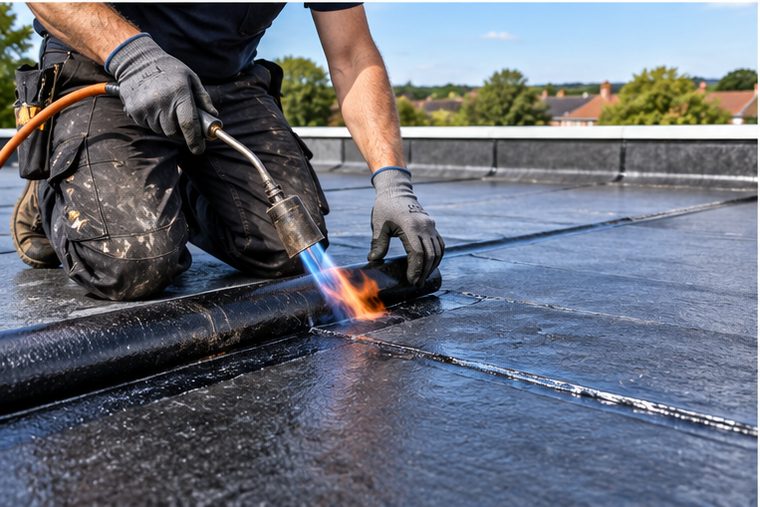
Not during rain - two days after, when everything that is going to drain has drained.
Pools still sitting there mean the roof is not shedding water. A flat roof is not flat: it should be laid to a fall so water runs to the outlet.
Ponding does not itself make a hole, but it keeps the covering permanently wet, magnifies any small defect, accelerates ageing, and in freezing weather puts ice loads where you do not want them.
More practically: a covering that spends its life under water is a poor candidate for patching, because a patch has to bond and stay bonded in the worst conditions on the roof.
A tidemark or a ring of silt showing where water sits, even when it is dry, tells you the same thing.
This distinguishes a fault from an ending, and you can usually see it from a window or with a zoomed photograph.
A split, tear or lifted edge in one place, with the rest of the surface looking even, is a fault. Repairable.
Crazing - a network of fine cracks spread across the whole surface, like old paint - is the material at the end of its flexible life. There is no useful patch for that, because it will crack next to wherever you patch it.
On felt, add the mineral finish. If the grey or green granules have weathered off and the bitumen underneath is exposed and shiny, the covering is well through its life.
From inside. Does the damp patch below the flat roof dry out between spells of rain, or does it stay damp?
A patch that appears when it rains and fades afterwards is water getting in and then stopping. That is a leak with a specific route.
A patch that stays damp regardless is more serious. It usually means water is sitting inside the roof build-up rather than passing through it - saturated insulation in a warm-deck roof, or a soaked deck. Neither dries out in place, because there is a vapour barrier below and a waterproof covering above.
That is the finding that most often turns a repair into a replacement, and it is one you can spot from your own ceiling.
On a Widnes estate house, if the garage or extension roof is original and has never been recovered, it is somewhere between fifty and seventy years old and it is probably built-up felt on a chipboard deck.
Neither of those is a scandal - they were standard - but both matter. Felt of that age has lost its flexibility, and ordinary chipboard swells and delaminates once wet and does not recover.
If it has been recovered in the last twenty years, the covering may well be EPDM or GRP and the deck may have been replaced at the same time, which changes the picture entirely.
Ask whoever quotes what the deck is made of and what it felt like underfoot. That is the question that decides the size of the job, and it has a specific answer.
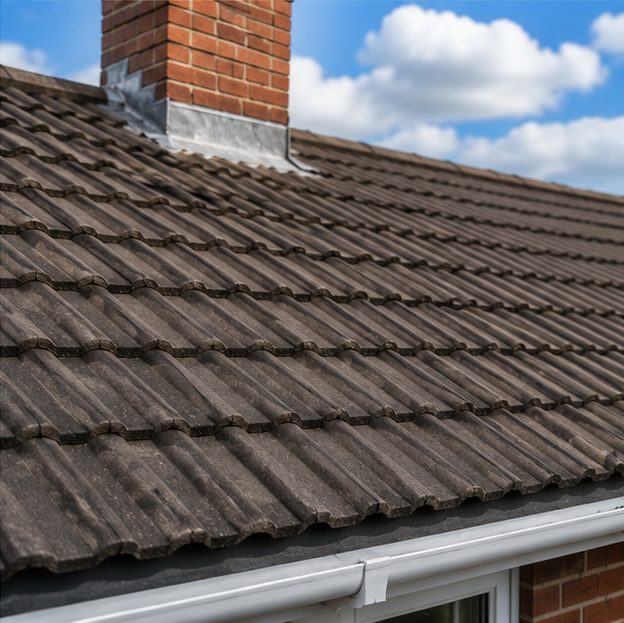
Patches few, no ponding, no crazing, ceiling dries out: repair.
Patches several, ponding, crazing across the surface, ceiling permanently damp: the conversation is about replacement, and the useful next step is somebody establishing the state of the deck and whether the insulation is wet.
Anything in between is genuinely a judgement, and it is worth having somebody look rather than deciding from a window - but you will now know what questions to ask, which is most of the battle.
And do not walk on it to check. A flat roof that has taken water is exactly the sort that gives way, and a garage roof is high enough to break a leg.
The rest of the series, on the questions people ask most.
Every town has its own page, written around what the roofs there are actually like. Start with the main roof repairs page.
“Excellent work replacing ridge tiles, repointing chimney and repairing flashing. Also fixed other broken tiles. Clean and tidy job. Would definitely recommend.”
Neil“Would highly recommend roofline solutions they arrived in time an explained to me what need to be done well spoken and polite”
Kyle Cummings“Highly recommend. Very quick and efficient. Great communication. Went above and beyond to work the weekend to complete the work that needed to be done. Very happy with the results.”
Karen JonesDescribe what is happening and roughly where you are, and we will come back to you — usually the same day. If water is coming in now, please call instead.
Prefer to talk? Call 07464 259566 · WhatsApp 0044 7464 259566 · Email Evensbuddy@yahoo.com
We cover Chester, Cheshire, the Wirral and Flintshire from Elton, just north of Chester.
2 Manley View
Elton
Chester
CH2 4QF
Almost all of our work happens at your property rather than here, so please call before travelling.
Monday – Friday — 24hrs — Emergency Call-Outs
Saturday — 8:00 – 19:00
Sunday — 8:00 – 19:00
Weekday emergency call-outs are answered around the clock. Weekend cover is 8:00 to 19:00.