★★★★★
“Excellent work replacing ridge tiles, repointing chimney and repairing flashing. Also fixed other broken tiles. Clean and tidy job. Would definitely recommend.”
NeilThere is a shelf of products aimed at this and most of them make the eventual repair more expensive. Here is what each one actually does.
Every product in this category is trying to solve the same problem in the same way: bridge a gap by sticking to both sides of it.
The trouble is what the gap is doing. Lead expands and contracts substantially with temperature - a dark flashing on a south-facing stack goes through a very wide temperature range in a single day - and masonry moves at a completely different rate. So the joint between them is opening and closing, twice a day, forever.
Anything bonded across that joint is being stretched and compressed on the same cycle. It fails at the bond line or it tears. Not because it is a bad product, but because it is being asked to do something no adhesive does for long.
A properly formed lead junction does not stick to anything. It works by shape and gravity - the lead is tucked into a chase, wedged, and lapped over what is below, so water is directed rather than blocked, and every part is free to move.
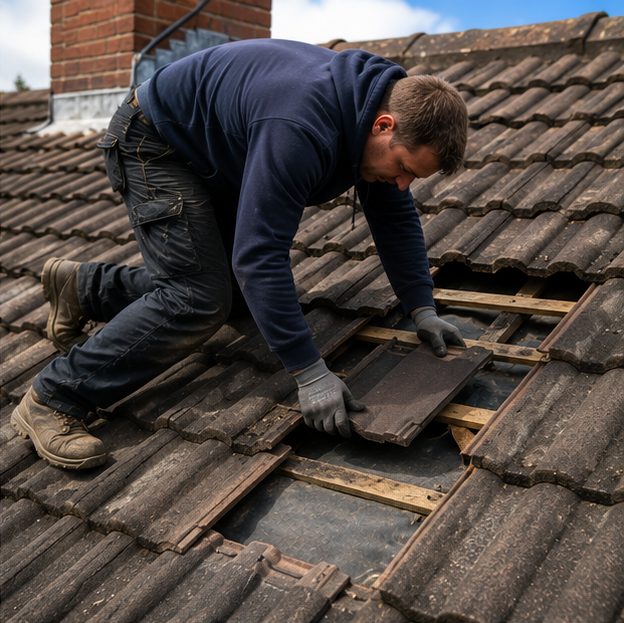
Silicone and mastic. Sheds water for a season. Then it shrinks, loses its bond at one edge and cracks. Because it is still stuck along the other edge, it now forms a small reservoir holding water against the joint. The leak comes back worse than it was, and the silicone has to be scraped off before anything proper can be done.
Self-adhesive flashing tape. Aluminium or lead-foil faced bitumen tape. It works initially and it looks convincing. Ultraviolet light degrades the facing, heat softens the bitumen so it creeps, and the edges lift. On a south-facing stack it can be curling within two summers. It also sticks extremely well to lead, which is a problem when it has to come off.
Liquid roof sealants and rubberised paints. Brushed over the junction. Same failure, same reason: they crack exactly where the movement is, which is the joint you were trying to seal.
Mortar or cement fillets. Not sold as a product but used as one, and worth naming. A triangular fillet of sand and cement in place of lead is rigid against two things that move. It always cracks. If you have one, it is not a question of whether.
A temporary make-safe. If water is coming into your house tonight and the weather is too bad for a proper repair, taping or sealing a joint to get through the next few days is sensible and we would do it ourselves.
Two conditions make it legitimate rather than a bodge. It is described to you as a make-safe, not as the repair. And the permanent work is arranged rather than left to whenever the leak reappears.
Lead work also has practical weather limits - dressing lead and raking out and pointing a chase both want reasonable conditions - so "we will make it safe now and do it properly in a fortnight" is often the honest answer rather than a delaying tactic.
A large proportion of Widnes housing went up in the same twenty-five years, with stacks that are shorter than Victorian ones and often set into the slope rather than standing free.
Two consequences. First, those stacks are lower, so the back gutter above them is shallow and silts up readily - and a silted back gutter produces a leak that no amount of sealant anywhere will fix, because nothing has failed.
Second, they are reachable-looking. A short stack on a two-storey house looks like something a person could get to off a ladder, which is exactly why so many of them have been sealed by somebody with a tube of silicone. It is also why more people are hurt doing this than any other DIY roofing task.
Do not go up. There is nothing you can achieve at a chimney from a ladder that justifies being on one.
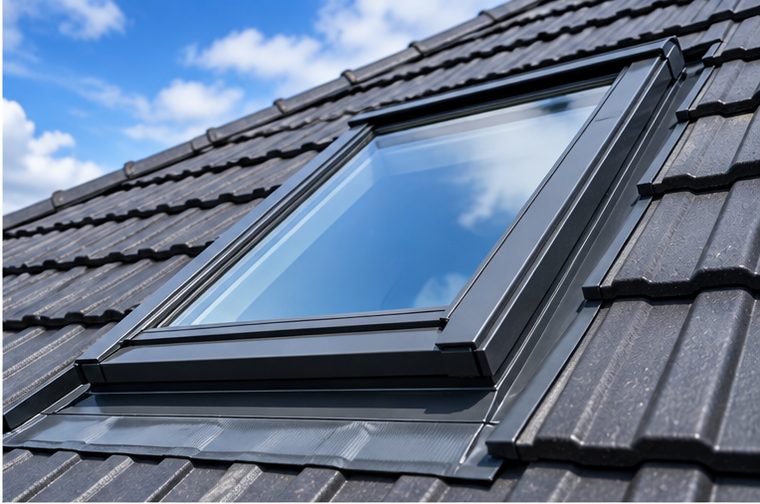
Re-dressing lifted lead back into its chase, wedging and repointing it, is a modest job. Replacing a failed piece with a correctly sized one, lapped rather than run in one length, is not a large job either.
The expensive part of any chimney work is getting safely to the chimney, and that is the same whether the repair takes an hour or a day. Which is the real argument against the tube of silicone: it does not save you the access, it just postpones it and adds a removal job to the front of it.
The rest of the series, on the questions people ask most.
Every town has its own page, written around what the roofs there are actually like. Start with the main roof repairs page.
“Excellent work replacing ridge tiles, repointing chimney and repairing flashing. Also fixed other broken tiles. Clean and tidy job. Would definitely recommend.”
Neil“Highly recommend. Very quick and efficient. Great communication. Went above and beyond to work the weekend to complete the work that needed to be done. Very happy with the results.”
Karen Jones“Would highly recommend roofline solutions they arrived in time an explained to me what need to be done well spoken and polite”
Kyle CummingsDescribe what is happening and roughly where you are, and we will come back to you — usually the same day. If water is coming in now, please call instead.
Prefer to talk? Call 07464 259566 · WhatsApp 0044 7464 259566 · Email Evensbuddy@yahoo.com
We cover Chester, Cheshire, the Wirral and Flintshire from Elton, just north of Chester.
2 Manley View
Elton
Chester
CH2 4QF
Almost all of our work happens at your property rather than here, so please call before travelling.
Monday – Friday — 24hrs — Emergency Call-Outs
Saturday — 8:00 – 19:00
Sunday — 8:00 – 19:00
Weekday emergency call-outs are answered around the clock. Weekend cover is 8:00 to 19:00.