★★★★★
“job well done good communication throughout the job very clean and tiddy when the job is finish flat roof replacement many thanks.”
Sumit BalA tile that has moved but is not broken has not been hit by anything. It has been lifted, repeatedly, by air.
The mental picture most people have is wind hitting a roof and shoving tiles off it. That is not what happens, and the difference matters for where the damage appears.
Air flowing over a roof behaves like air over a wing. It accelerates as it goes over the eaves, the verge and the ridge, and faster-moving air is at lower pressure. The result is suction from above - the roof is being pulled upward.
That suction concentrates at the edges and corners. On the same roof in the same gale, a tile at a verge or a corner carries several times the load of one in the middle of the slope. Which is exactly where West Kirby roofs lose things.
Every gale therefore lifts and drops the perimeter tiles, thousands of times a year on this coast. Each cycle works at the fixing. Nothing breaks; things loosen.
West Kirby faces the mouth of the Dee with nothing in the way, and the prevailing wind carries salt.
Salt is an electrolyte, and it accelerates the corrosion of steel and iron considerably. Nails, clips and screws that would last decades a few miles inland do not last as long here. So the pattern on this coast is a covering in visibly good condition sitting on fixings that have quietly given up.
That is the specific West Kirby version of a moving roof: nothing wrong with the tile, everything wrong with what was holding it. It is also why the weather face goes first and the sheltered face, on the same house, of the same age, often has lost nothing at all.
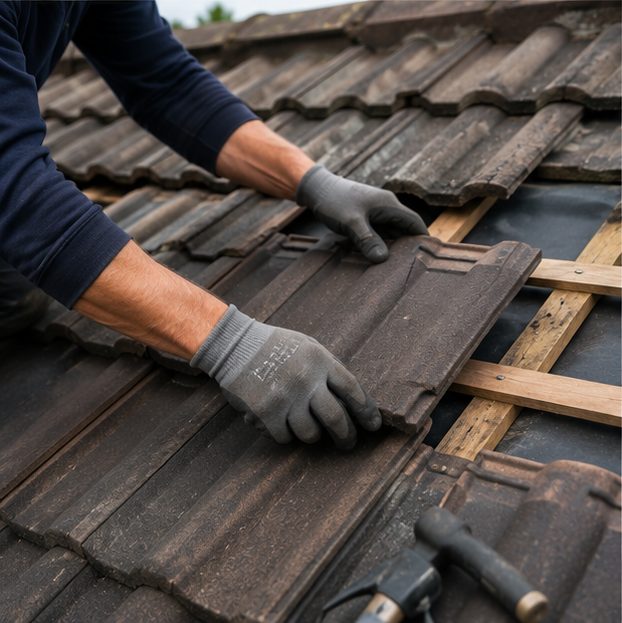
Plain and interlocking tiles hang on a nib at the head of the tile which hooks over the batten. Only a proportion of courses are nailed; the rest rely on the nib and the weight of the tiles above.
When a nail corrodes, a nib snaps or a batten softens, the tile does not fall. It slides down a few millimetres and stops, because the tile below is in its way. Then a bit more the following winter.
The visible result is a row that is no longer level with the row beside it. Roofs are made of straight lines, and a course that steps down where it should be straight is the single most useful thing to look for from the pavement. It is also the point at which a cheap job stays cheap, because the tile is still on the roof and the headlap has only just started to reduce.
Left alone, creep reduces the lap until wind-driven rain gets past it, and then the tile eventually slips clear altogether.
The other things that move here are the mortar-bedded ones. A ridge or verge bedded in mortar has a life, and on an exposed coastal roof that life is shorter. Once one ridge tile is loose, the wind has an edge to work at and the rest of the run follows faster than the first one did.
The same is true at a dry verge run, where a single unclipped unit gives the wind a way underneath the whole line.
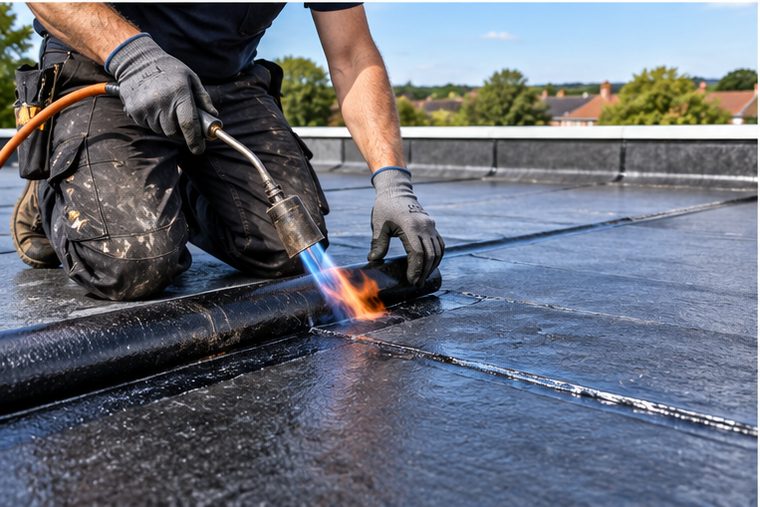
Put a tile back exactly as it was and it goes back into the conditions that moved it. On this coast a repair should reflect the exposure: more of the covering mechanically fixed, clips at the perimeter zones, and non-ferrous fixings as a matter of course rather than as an upgrade.
It is also worth dealing with the run rather than the tile. If one verge unit has gone, the rest of that verge is next, and doing the line while access is up costs considerably less than three separate visits over three winters.
The rest of the series, on the questions people ask most.
Every town has its own page, written around what the roofs there are actually like. Start with the main roof repairs page.
“job well done good communication throughout the job very clean and tiddy when the job is finish flat roof replacement many thanks.”
Sumit Bal“I had a leak in my vally had a number of roofers to come and take a look couldn’t find the problem Roofline’s solutions fixed the problem first time. Very happy with these guys thank you for the brilliant service”
Michael Price“Would highly recommend roofline solutions they arrived in time an explained to me what need to be done well spoken and polite”
Kyle CummingsDescribe what is happening and roughly where you are, and we will come back to you — usually the same day. If water is coming in now, please call instead.
Prefer to talk? Call 07464 259566 · WhatsApp 0044 7464 259566 · Email Evensbuddy@yahoo.com
We cover Chester, Cheshire, the Wirral and Flintshire from Elton, just north of Chester.
2 Manley View
Elton
Chester
CH2 4QF
Almost all of our work happens at your property rather than here, so please call before travelling.
Monday – Friday — 24hrs — Emergency Call-Outs
Saturday — 8:00 – 19:00
Sunday — 8:00 – 19:00
Weekday emergency call-outs are answered around the clock. Weekend cover is 8:00 to 19:00.