★★★★★
“job well done good communication throughout the job very clean and tiddy when the job is finish flat roof replacement many thanks.”
Sumit BalYes, and it does it by getting underneath rather than by pushing. Which is why the fix is about what holds the edges down.
The picture most people have is wind pressing on a roof. On the windward slope it does, but that is not what causes the damage.
Air flowing over a building accelerates as it passes edges, ridges and anything projecting, and accelerated air is at lower pressure. So most of a roof in a gale is experiencing suction - being pulled upward - and the suction is strongest exactly where things stick up.
A chimney is the biggest projection on the building. The air going round and over it accelerates hard, and the flashings around it sit in the most aggressive part of the wind field there is on a house.
That is why chimney flashings on a West Kirby seafront property lift while the same detail on a sheltered inland house of the same age does not.
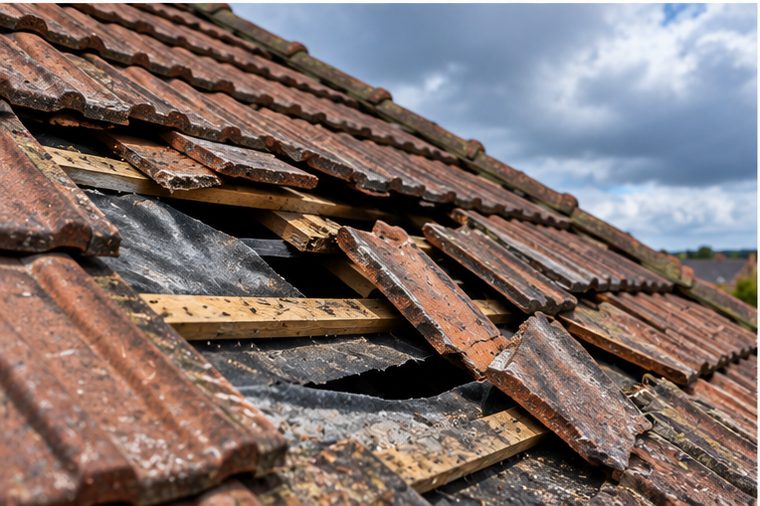
A cover flashing is held two ways. Its top edge is turned into a chase raked out of a mortar joint, wedged with lead wedges and pointed - that part is genuinely held down.
Its bottom edge, lying over the tiles or slates, is the free edge. On a sheltered roof, dressing and the weight of the lead are enough. On an exposed one they are not, and the answer is clips - strips fixed under the covering and turned over the lead to hold the free edge.
Once wind gets under that free edge it has something to work at, and the same gust that would do nothing to a clipped flashing will lift an unclipped one a little further each time until it is standing away from the roof.
A lifted flashing does not necessarily leak in ordinary rain, which is why it can sit like that for a year with nobody noticing. It leaks in the first proper westerly.
The West Kirby-specific part, and it is about the fixings rather than the lead.
Airborne salt accelerates the corrosion of steel and iron considerably. The clips holding a free edge, and any nails or screws in the arrangement, corrode faster here than a few miles inland - so a specification that is entirely adequate in Chester gives up years earlier facing the Dee.
The lead itself is unaffected. Lead is one of the most corrosion-resistant materials in ordinary construction and salt does not trouble it. It is what holds it on that goes.
Which produces the classic coastal finding: sound lead, lifted along one edge, with nothing wrong with the material at all.
Fatigue. Every gust that lifts and drops a piece of lead flexes it, and lead that is flexed repeatedly in the same place work-hardens and eventually cracks.
That combines badly with a sheet that is too long. An oversized flashing is already fighting its own thermal movement; add repeated wind flexing at the free edge and it splits along a fold considerably sooner than it would inland.
So on this coast, sheet length matters more than it does elsewhere - correctly sized pieces with lapped joints rather than one continuous run.
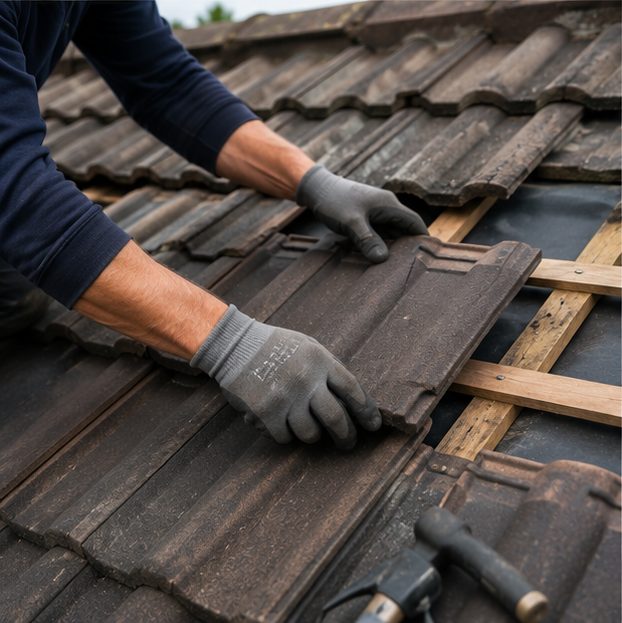
Non-ferrous fixings and clips as standard rather than as an upgrade. This is the single most important difference and it costs very little.
Clips at the free edge wherever exposure demands them, which on the west-facing side of a West Kirby property it generally does.
Correctly sized pieces with proper laps.
And the chase raked out and wedged properly rather than the lead being bedded in mastic, because a mastic-bedded top edge on an exposed stack is a flashing waiting for a gale.
Put a flashing back exactly as the one that failed and it goes back into the conditions that failed it.
The rest of the series, on the questions people ask most.
Every town has its own page, written around what the roofs there are actually like. Start with the main roof repairs page.
“job well done good communication throughout the job very clean and tiddy when the job is finish flat roof replacement many thanks.”
Sumit Bal“Excellent work from the lads at roofline solutions. I had a leak in my valley, they came out and sorted it within a day.”
Chris Hollewell“Excellent service from Buddy and the team in installing a new garage roof in a really professional manner. Was kept updated at all stages and given good advice as to our options. Would highly recommend”
Peter AspinallDescribe what is happening and roughly where you are, and we will come back to you — usually the same day. If water is coming in now, please call instead.
Prefer to talk? Call 07464 259566 · WhatsApp 0044 7464 259566 · Email Evensbuddy@yahoo.com
We cover Chester, Cheshire, the Wirral and Flintshire from Elton, just north of Chester.
2 Manley View
Elton
Chester
CH2 4QF
Almost all of our work happens at your property rather than here, so please call before travelling.
Monday – Friday — 24hrs — Emergency Call-Outs
Saturday — 8:00 – 19:00
Sunday — 8:00 – 19:00
Weekday emergency call-outs are answered around the clock. Weekend cover is 8:00 to 19:00.