★★★★★
“Would highly recommend roofline solutions they arrived in time an explained to me what need to be done well spoken and polite”
Kyle CummingsYes, easily. And the ones that lift and drop back down again are the reason a roof can be storm damaged and look completely normal.
A slate is held by two nails, and the courses above cover them. In a gust, the suction over the roof lifts the tail of the slate - the free lower edge - and flexes it upward.
If both nails hold, it drops back and nothing has happened.
If one nail has already corroded to the point of failure, that gust finishes it. The slate is now held by one nail. It drops back into position, looks exactly as it did, and is now free to pivot on that single fixing.
If both go, the slate slides down the roof and either stops on the one below or ends up in the garden - and that is the version everybody notices.
The one-nail version is the one that matters, because nobody notices it at all.

From the ground, a slate held by one nail looks identical to a slate held by two. It is in the right place, in line with its neighbours, at the right angle.
It may creep down a few millimetres over the following months, which reduces the headlap - the amount the slate above covers it by - and that is the first visible sign. A course sitting slightly low, a line that has stopped being straight.
Long before that shows, though, the roof is already less watertight than it was, because a slate that can lift in the wind lets water past it in driving rain even when it settles back down afterwards.
So the sequence is: storm in November, nothing visible, damp patch appearing in February during a wet spell with no wind. And the February weather gets the blame for damage the November gale actually did.
This is one of the four reasons a leak keeps coming back, and it is the one that is hardest to argue with a customer about.
Somebody comes out, finds and fixes a defect, and the leak returns. It looks like a failed repair. What has often happened is that the storm loosened several slates and only the one that visibly moved was dealt with - so there was a second source all along.
On the front at New Brighton, where exposure is as high as anywhere on the peninsula, that is common enough to be the first thing to suspect on a recurring leak that started after a named storm.
And the older Wallasey and Liscard terraces raise it in another form: their slate roofs are frequently nail-sick already, so a gale does not need to be exceptional to take out a population of fixings that were nearly done anyway.
Not from the ground. The two ways are the loft and the roof.
In the loft, in daylight with the lights off, a slate that has lifted often shows as a thin line of light or as a patch of fresh damp on the underside that was not there before.
On the roof, a slate held by one nail can be felt. It moves under a hand when the ones around it do not. That is a slow job across a whole elevation and it is why a proper post-storm inspection on a slate roof takes longer than people expect.
And where nothing shows either way but the leak is real, a water test - wetting one area at a time from the bottom upward with somebody watching inside - is the honest answer.
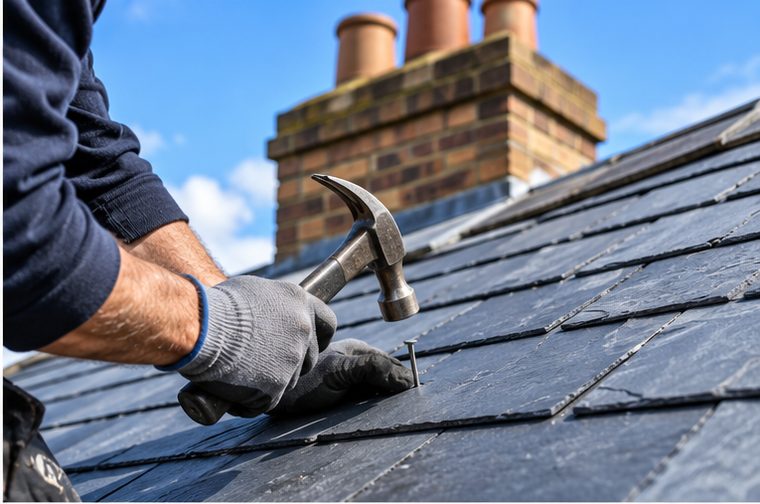
A slate held by one nail is refixed the same way as a replacement: with a lead or copper tingle folded over its bottom edge, because the original nail positions are covered by the courses above.
The more important point is scope. After a storm on an older slate roof, the sensible instruction is not "replace the slate that fell" but "check the elevation the slate fell from". If one fixing has gone, its contemporaries are close behind - and finding three loose slates while somebody is already up there costs a fraction of finding them one at a time over the next three winters.
The rest of the series, on the questions people ask most.
Every town has its own page, written around what the roofs there are actually like. Start with the main roof repairs page.
“Would highly recommend roofline solutions they arrived in time an explained to me what need to be done well spoken and polite”
Kyle Cummings“Had Roofline Solutions come and do our guttering today and done a great job. Our guttering was dangerous, after messaging over the weekend, they came Tuesday and sorted it out by Wednesday. Tidy and communicated everything to me. Thanks”
Emma Pickett“Excellent workmanship by Buddy Evans. I was impressed and amazed at how quickly the job was done. Obviously due to many years' experience. I've used several mediocre or bad roofers in the past and now I've finally found a good one.”
Czeslaw birukowskDescribe what is happening and roughly where you are, and we will come back to you — usually the same day. If water is coming in now, please call instead.
Prefer to talk? Call 07464 259566 · WhatsApp 0044 7464 259566 · Email Evensbuddy@yahoo.com
We cover Chester, Cheshire, the Wirral and Flintshire from Elton, just north of Chester.
2 Manley View
Elton
Chester
CH2 4QF
Almost all of our work happens at your property rather than here, so please call before travelling.
Monday – Friday — 24hrs — Emergency Call-Outs
Saturday — 8:00 – 19:00
Sunday — 8:00 – 19:00
Weekday emergency call-outs are answered around the clock. Weekend cover is 8:00 to 19:00.