The short version
- Almost every flat roof system needs a dry surface to bond
- Cold stops adhesives and resins curing properly
- A repair made in the wrong conditions fails in two or three years
- Make it safe now, do it properly when it will actually work
Why This Comes Up More Than It Should
Flat roofs leak in wet weather, which is when people ring. So the request is almost always to repair a wet roof, in the rain, today.
The honest answer is that a great deal can be done to stop the water and rather less can be permanently fixed, and the reason is not that anybody is being awkward. It is that the materials will not do what they are supposed to do.
What Each System Needs
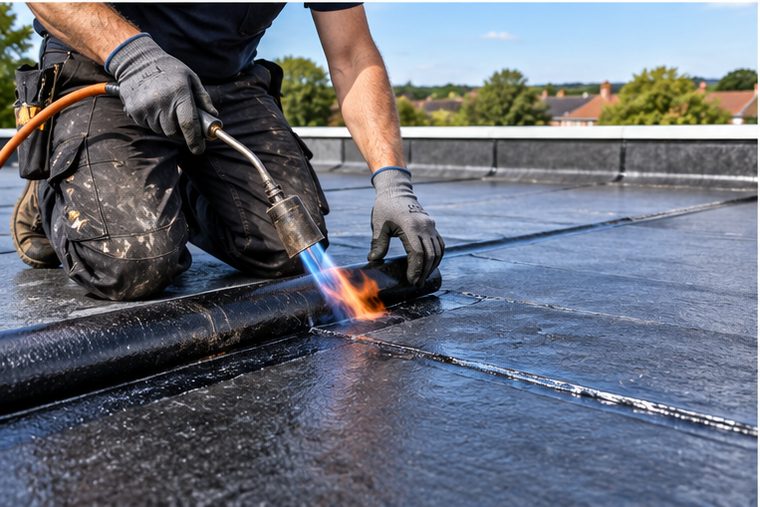
Torch-on felt. Bonded by melting bitumen with a flame. Water on the surface flashes to steam and blows the bond, so a torch-on repair to a wet substrate has voids in it from the moment it is made. It looks perfect and it is not bonded.
EPDM. Seams and patches are made with a primer and a tape. Both need a clean dry surface, and the primer needs to flash off before the tape goes on. Applied damp, the bond fails - usually in a year or two rather than immediately, which is what makes it hard to attribute.
GRP. A resin that cures chemically. It needs a dry substrate and a temperature above its minimum, and in cold it cures slowly and incompletely. A GRP repair laid in a cold snap can stay tacky for days and never reach full strength.
Liquid coatings. Same story - dry surface, minimum temperature, and usually a minimum period without rain afterwards, which in a Cheshire winter is the part that cannot be promised.
Mastic asphalt. Applied hot and the most tolerant of the group, but it still will not take to standing water.
What Can Be Done Wet
Plenty, and it is worth having.
Clearing a blocked outlet or gutter, which is frequently the entire cause and takes minutes.
Sheeting or covering the affected area, tied and weighted properly.
A properly executed temporary patch with a system designed for wet application. These exist, they work as temporary measures, and they should be described as temporary.
Getting water out of a ceiling void before it comes down.
A full assessment, so that when the weather allows, the right work happens immediately rather than after another survey visit.
The Honest Trade-Off
A repair made in unsuitable conditions does not usually fail immediately. It fails in two or three years, which is long enough that nobody connects it to the day it was done.
That is why a roofer saying "I will make this safe today and come back on a dry day to do it properly" is giving you the better outcome, even though it feels like the worse answer in the moment.
The version to be wary of is the opposite: somebody who will do a permanent repair in any weather, because that is somebody whose repairs will fail on somebody else's watch.
The Northwich Angle
One local note that changes what "properly" means here.
Where a building has moved - and Northwich has a documented history of ground movement from salt extraction, most of it long settled - a flat roof over it fails in a particular way: a split that runs in a straight line across the covering rather than a random tear.
That is a movement signature. A straight split did not get there by weathering.
It matters for this page because patching a movement split with a rigid material gets you the same split again in the same place. The repair has to accommodate movement - which usually means a flexible system and a detail that allows the two sides to move - and that is a decision made in daylight with the covering dry, not in a downpour.
So on a Northwich flat roof with a linear split, the case for waiting for suitable weather is stronger than usual.