★★★★★
“The guys did a great job in repairing our chimney. They were reliable, friendly and efficient. Buddy kept me in the loop throughout the whole process and I would not hesitate to use Roofline again!”
Hollie FurnivalFinding it in the loft is the good outcome - it means you have caught it before the ceiling. Here is what to do with that head start.
Water in the loft with no stain on the ceiling below means you are ahead of it. The insulation and the ceiling have not been through a winter of it yet, which is the difference between a roofing bill and a roofing-plus-plastering-plus-insulation bill.
So the first thing is: this is a good position to be in. What follows is how to keep it.
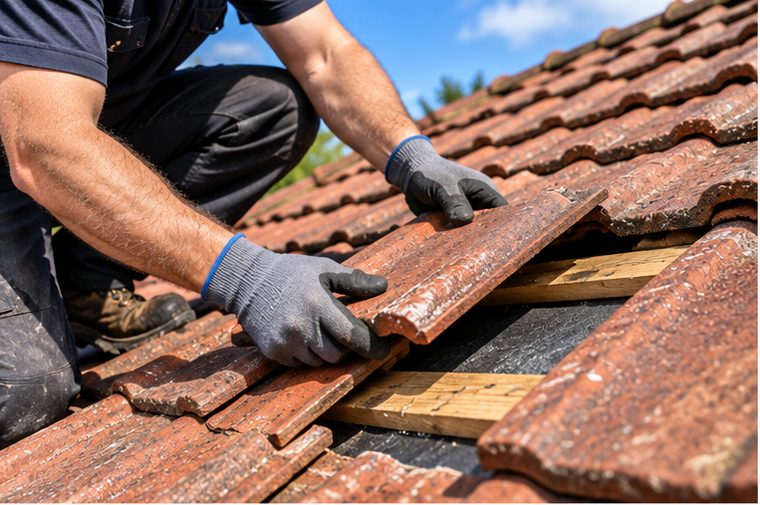
Find the highest point the damp reaches.
Water runs down and never up. So whatever is wrong is at or above that point, and everything below it is just the route the water took.
Look at the underside of the underlay, the rafters, the purlins and the wall plate at the eaves. Follow the wet upward until it stops. Note where that is relative to something identifiable - a chimney, a roof window, the ridge, a particular rafter.
That single observation eliminates most of a roof before anybody goes outside, and it is the thing a roofer will ask you about.
While you are there, note whether the damp is a run down a rafter (water travelling) or a patch on the underlay (water arriving), and whether it is spread over an area with beads on the nails - which is condensation rather than a leak.
Put a container under the drip if it is dripping, on something stable and on a joist rather than on the ceiling. Catching it in the loft is far better than letting it reach the plasterboard.
Pull the insulation clear of the wet area. Wet mineral wool compresses and never recovers, so getting it out of the way saves it - and it stops the insulation acting as a sponge that keeps the ceiling damp.
Move anything stored out of the wet area.
Look at the eaves. You should be able to see light and feel air movement where the roof meets the wall. If insulation has been pushed right out and blocked it, that matters - a roof space that cannot breathe is where damp turns into decay, and it may also be the cause if what you have is condensation.
Do not clear it all up before somebody has seen it. The wet marks, the direction of the runs and the position of the damp are the evidence. Photograph everything first.
Do not stand off the joists. Plasterboard will not carry a person and going through a ceiling is a common and serious accident.
Do not go up if the loft is unboarded, cramped, dark or you are not steady. Everything on this page is worth doing and none of it is worth falling for.
Do not seal anything. Squirting foam or sealant at the underside of a leak from inside does not stop it and makes the eventual repair harder to trace.
The wet area, wide enough to show where it is in the roof.
The highest point the damp reaches, with something identifiable in frame for scale and location.
Any daylight visible through the covering.
The eaves, showing whether the ventilation gap is clear.
And the insulation, if it is wet or compressed.
Those five photographs plus a note of the weather when it happened will tell a roofer more than an hour of description.
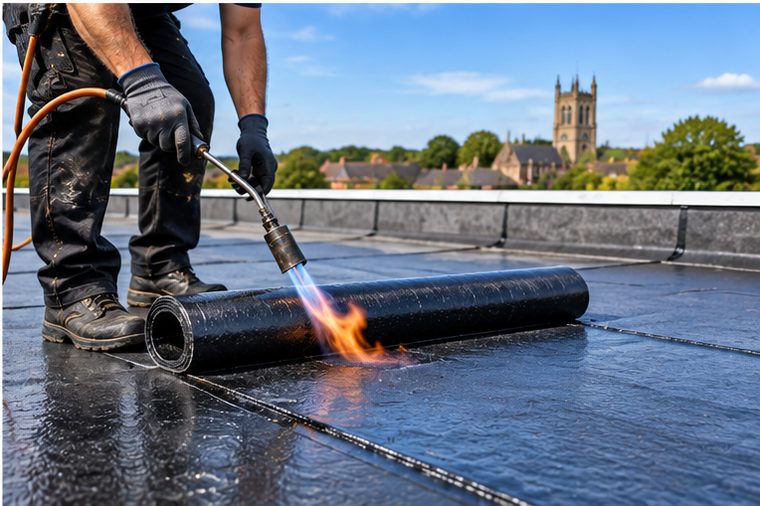
On the exposed ground east of the town, add one: which direction was the wind in?
Driving rain from one quarter will get past laps and details on that face while leaving the rest of the roof untouched, so on an exposed site the wind direction is frequently most of the diagnosis.
If the damp appears only in a westerly, say so. It tells us which elevation to inspect before anybody gets a ladder out, and on a hill property that saves a great deal of time.
And if the damp appears when it is cold and dry rather than when it is raining, that is not a leak at all - it is condensation, and the answer is ventilation.
The rest of the series, on the questions people ask most.
Every town has its own page, written around what the roofs there are actually like. Start with the main roof repairs page.
“The guys did a great job in repairing our chimney. They were reliable, friendly and efficient. Buddy kept me in the loop throughout the whole process and I would not hesitate to use Roofline again!”
Hollie Furnival“I had a leak in my vally had a number of roofers to come and take a look couldn’t find the problem Roofline’s solutions fixed the problem first time. Very happy with these guys thank you for the brilliant service”
Michael Price“Excellent workmanship by Buddy Evans. I was impressed and amazed at how quickly the job was done. Obviously due to many years' experience. I've used several mediocre or bad roofers in the past and now I've finally found a good one.”
Czeslaw birukowskDescribe what is happening and roughly where you are, and we will come back to you — usually the same day. If water is coming in now, please call instead.
Prefer to talk? Call 07464 259566 · WhatsApp 0044 7464 259566 · Email Evensbuddy@yahoo.com
We cover Chester, Cheshire, the Wirral and Flintshire from Elton, just north of Chester.
2 Manley View
Elton
Chester
CH2 4QF
Almost all of our work happens at your property rather than here, so please call before travelling.
Monday – Friday — 24hrs — Emergency Call-Outs
Saturday — 8:00 – 19:00
Sunday — 8:00 – 19:00
Weekday emergency call-outs are answered around the clock. Weekend cover is 8:00 to 19:00.