★★★★★
“The guys did a great job in repairing our chimney. They were reliable, friendly and efficient. Buddy kept me in the loop throughout the whole process and I would not hesitate to use Roofline again!”
Hollie FurnivalSometimes, genuinely. But a valley is a single hydraulic run, and repairing part of it is not the same as repairing part of a slope.
When the problem is debris. Clearing a dammed valley is as local as it gets and it is frequently the entire answer. Nothing has failed.
When the damage has an external cause. Something fell on it, something was dropped, a branch came down. A local repair to sound lining either side is correct.
When the lining is in separately lapped pieces and one has failed. A properly formed valley is made in lengths, each lapping the one below. If one length has gone and the others are sound, that length can be renewed.
When the fault is at the top or the bottom rather than the run. The detail where a valley starts at a junction, or discharges into a gutter, can be reworked without touching the middle.
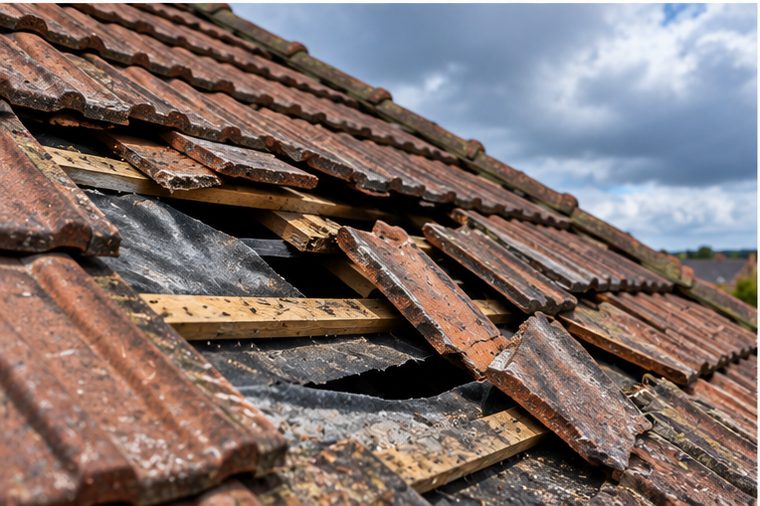
When the split is fatigue. Lead splits along a fold because the piece could not accommodate its own thermal movement - which almost always means the piece was too long. Patching that split leaves the same oversized piece still unable to move, and it will split again nearby.
When the lining has thinned. Attrition where water runs over the same line for decades affects the whole run, not one point. A patch on thin lead is a patch on a lining that is going to fail somewhere else shortly.
When the cut tiles have loosened along the run. That is the detail moving as a whole rather than a local fault.
When somebody has already patched it once. Two patches in one valley usually means the lining as a whole is at its end.
Worth stating because it is where local repairs most often go wrong.
A valley is made in lengths and each length must lap over the one below it, so water running down the channel passes over each joint rather than into it.
A patch inserted into a run has to go under the piece above it and over the piece below. Laid the other way round it forms a step facing uphill, and every drop of water in the valley runs straight into the joint.
It sounds obvious and it is done wrong regularly, usually because the patch was slipped in from above without lifting the tiles properly.
If a valley was patched and started leaking worse, that is one of the first things worth checking.
On the exposed ground east of the town and out towards the hill villages, two things push the answer towards doing the whole run.
Exposure. Driving rain arrives across a valley rather than down it, so laps and upstands are tested harder here than on a sheltered site. A lap that would be adequate in the town centre may not be on a hillside.
Uniform ageing. The whole run went in on the same day and has had the same weather since. On an exposed site that weather has been consistently harder, so when one part goes the rest is closer behind than it would be elsewhere.
And on the older stone properties around the hill villages, valleys between stone slate slopes are a specialist detail - the diminishing courses either side have to be cut and maintained, and that is not a job for a quick local patch.
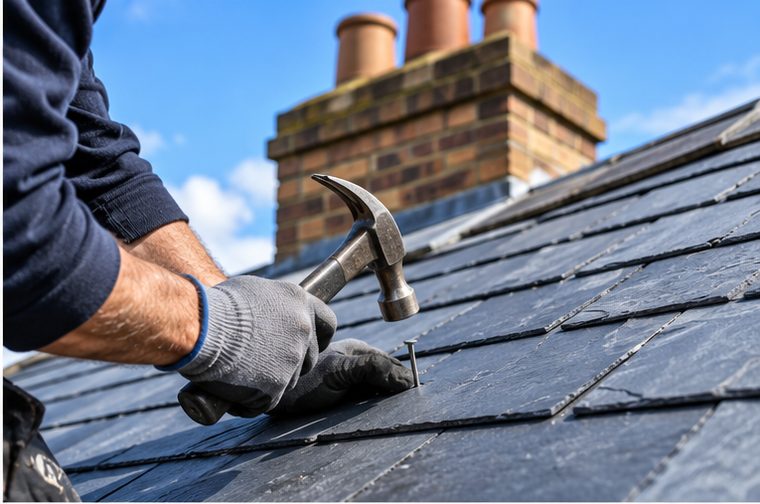
Getting safely to a valley usually means a scaffold or a tower, because a valley is in the middle of the roof rather than at an edge.
That cost is the same whether you patch a metre or reline the whole run. So the difference in price between a local repair and a full reline is much smaller than the difference in the work - which tips the arithmetic towards doing it once.
The honest recommendation on most valleys older than about thirty years is: if you are paying for the access anyway, price the full reline and compare. It is frequently closer than people expect.
The rest of the series, on the questions people ask most.
Every town has its own page, written around what the roofs there are actually like. Start with the main roof repairs page.
“The guys did a great job in repairing our chimney. They were reliable, friendly and efficient. Buddy kept me in the loop throughout the whole process and I would not hesitate to use Roofline again!”
Hollie Furnival“Excellent workmanship by Buddy Evans. I was impressed and amazed at how quickly the job was done. Obviously due to many years' experience. I've used several mediocre or bad roofers in the past and now I've finally found a good one.”
Czeslaw birukowsk“I had a leak in my vally had a number of roofers to come and take a look couldn’t find the problem Roofline’s solutions fixed the problem first time. Very happy with these guys thank you for the brilliant service”
Michael PriceDescribe what is happening and roughly where you are, and we will come back to you — usually the same day. If water is coming in now, please call instead.
Prefer to talk? Call 07464 259566 · WhatsApp 0044 7464 259566 · Email Evensbuddy@yahoo.com
We cover Chester, Cheshire, the Wirral and Flintshire from Elton, just north of Chester.
2 Manley View
Elton
Chester
CH2 4QF
Almost all of our work happens at your property rather than here, so please call before travelling.
Monday – Friday — 24hrs — Emergency Call-Outs
Saturday — 8:00 – 19:00
Sunday — 8:00 – 19:00
Weekday emergency call-outs are answered around the clock. Weekend cover is 8:00 to 19:00.