The short version
- Ridge, verge, corners and the first course above the gutter go first
- The middle of a slope is under a fraction of the load
- Once one thing goes, its neighbours are far easier to take
- Most of the damage is at the perimeter, and so is most of the prevention
Where the Load Actually Is
Wind does not press evenly on a roof. Air flowing over a building accelerates as it passes edges, ridges and corners, and accelerated air is at lower pressure - so the roof is being sucked upward, hardest exactly where it changes direction.
The consequence is that the perimeter zones of a roof carry several times the load of the middle of a slope, in the same gale, on the same building. A tile at a corner is in a different world from a tile four metres in.
Which is why the damage list is the same every time on the Hoylake and Meols seafront, and why it looks so unfair - one small area destroyed and the rest of the roof untouched.
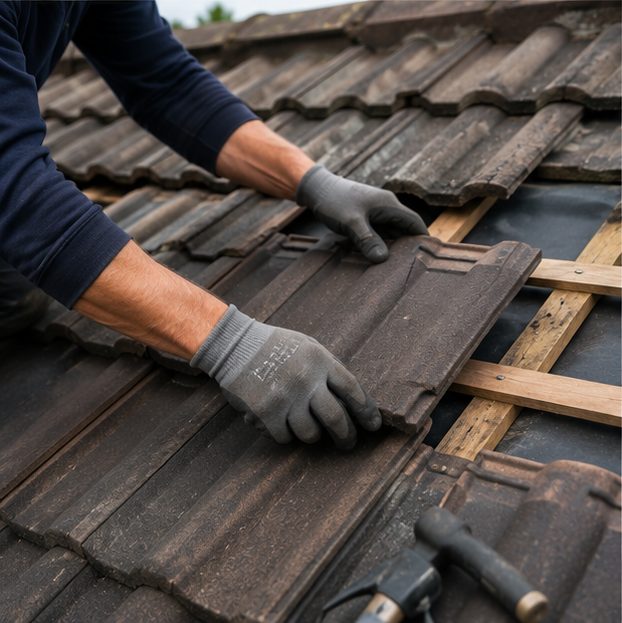
First: The Ridge and the Verges
The ridge is the highest line on the roof and the point where air separating over the building is moving fastest. Mortar-bedded ridge tiles that have been repointed once already are the classic first casualty.
The verge - the edge of the roof at a gable - is second, and often first on a house whose gable faces the prevailing wind. Once the wind gets under the first tile at a verge it has an edge to work at, and the rest of that run goes considerably faster than the first one did.
On modern housing the equivalent is a dry verge unit that was never properly clipped. One unclipped cap gives the wind a way underneath the whole line.
Second: Corners and the Eaves Course
Corners are where two perimeter zones meet, so the uplift there is the highest anywhere on the roof.
The first course of tiles above the gutter is next. It is at an edge, it has a free lower edge by definition, and on many roofs it is the course most likely to have been disturbed by ladders over the years.
On a hipped roof, add the bottom hip tile. A hip runs downhill to a corner, gravity is already pulling on it, and the hip iron that should stop it sliding has frequently rusted away.
Third: Flashings, Flat Roof Edges and Anything That Projects
A chimney is the biggest projection on a building and the air going round it accelerates hard, so its flashings sit in the most aggressive part of the wind field. Lead lifts along its free edge rather than tearing.
A flat roof edge trim is the same problem in a different material: get an air path under one corner and the wind peels the covering back.
Aerials, satellite dishes, solar panel edges and anything else bolted on adds its own local turbulence and its own load path into the roof.
Fourth: The Field of the Slope - and What It Means If That Goes
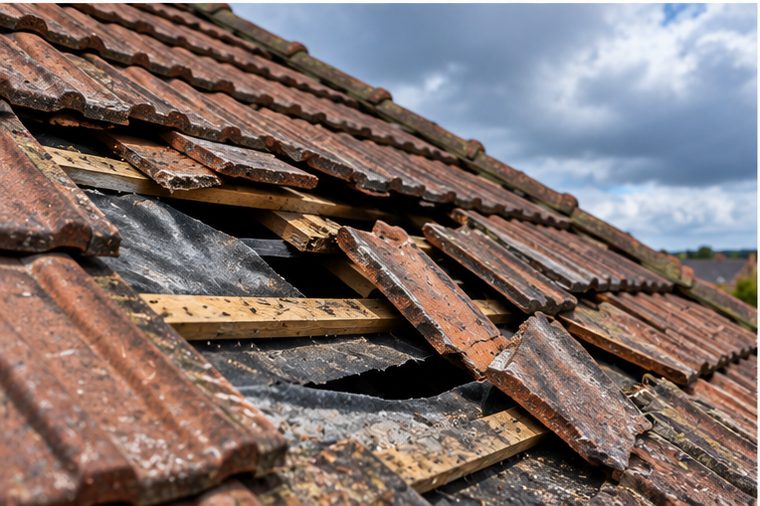
Tiles lost from the middle of a slope, away from any edge, are the least common and the most significant.
The load out there is comparatively modest, so if tiles have gone from the field of a slope, either something struck the roof or the fixings across that whole elevation are at the end.
That distinction is worth making after a storm rather than assuming the wind was exceptional. A gale that takes ridge and verge is a normal gale. A gale that takes tiles out of the middle of a slope has usually found a roof that was already going.
What Reduces It
All of the prevention is at the perimeter, which is convenient, because that is also where all the damage is.
Mechanically fixed ridges and hips rather than mortar alone. Since the 2014 revision of BS 5534, mortar on its own is no longer accepted as a fixing for ridges, hips and verges in new work - so anything on your roof relying on it predates that standard.
Clips at the verges and the eaves course, and more of the covering mechanically fixed in the perimeter zones.
Non-ferrous fixings, because on this coast salt takes out a standard specification years early.
And putting things back better than they were after a storm rather than identically, because identical is what failed.