The short version
- Lead thins where water runs over the same line for decades
- Debris arrives long before failure and accelerates everything
- Cut tiles either side loosen and reduce the clear channel
- The boards under the lining go last and cost the most
The Hardest-Working Part of the Roof
A valley is where two roof slopes meet in an internal angle, and the water from both of them converges into one narrow channel.
That means it carries several times the volume of any equivalent area of the roof, concentrated into a few hundred millimetres of width, for its entire life.
It is also invisible. You cannot see a valley from the ground on most houses, you cannot see it from the loft, and unless somebody goes up and looks along it, it is simply not inspected.
Those two facts together explain almost everything about how valleys fail.
Stage One: Debris, Years Before Anything Fails
The first thing that happens to a valley is that it collects.
Grit washes off the covering, leaves and seed come off trees, moss breaks off in lumps after a windy spell, and all of it ends up in the one channel on the roof that everything drains into.
A partly dammed valley does not leak immediately. It reduces the clear channel, so the valley copes with ordinary rain and overflows sideways in a downpour - pushing water under the tiles either side and into the roof several courses above where anybody would look.
That is a leak with no defect at all. Clear it and it stops. It is also the single most preventable roofing problem there is, and almost nobody does it.
Debris does something else too: it holds water permanently against the lining, which is what accelerates the next stage.
Stage Two: The Lining Thins and Fatigues
A lead valley erodes extremely slowly where water runs over the same line, decade after decade. It is not corrosion so much as attrition, and it concentrates in the centre of the channel where the flow is.
Lead also expands and contracts substantially with temperature. A valley lining made in pieces that are too long cannot accommodate that movement, so it fatigues and splits - and the split will be along a fold, usually across the channel rather than along it.
Debris sitting on it makes both worse: the covered part stays permanently wet, and the temperature differential between the covered and uncovered parts increases the working.
On more recent roofs the lining may be GRP or a preformed trough rather than lead. Those crack rather than thin, usually where the deck below them moves or where two lengths are joined.
Stage Three: The Tiles Either Side Loosen
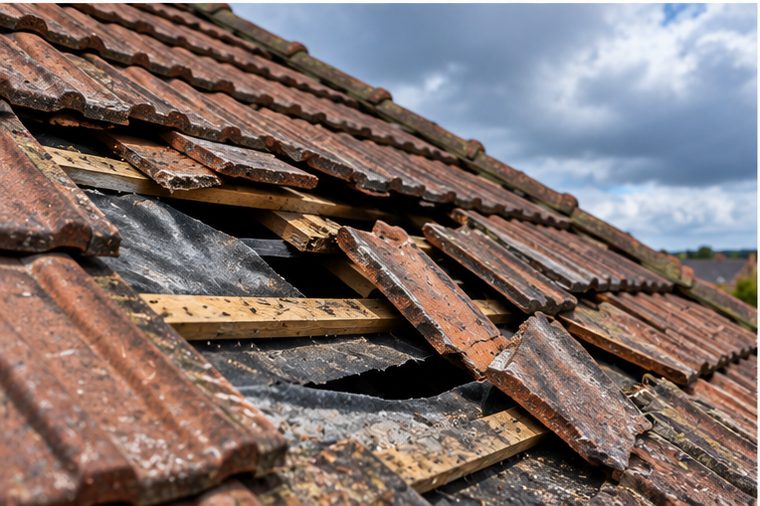
The tiles or slates along a valley are cut on the rake, so many of them are smaller than a full tile and held by a single fixing.
Over decades, those cut pieces work loose more readily than full tiles - they are lighter, less well held, and sitting where the most water passes.
When they move, two things happen. The clear channel width changes, usually reducing. And a cut tile that has dropped slightly leaves its edge unsupported, so it cracks.
A valley with several cracked cut tiles along it has usually been moving for a while, and it is a sign that the whole detail needs lifting rather than that a few tiles need replacing.
Stage Four: The Boards Underneath
A valley lining sits on boards - a valley board or sole board, with tilting fillets either side.
Once the lining has failed and water has been getting past it for a season or two, those boards take it. Timber in the wettest, least ventilated part of a roof does not last long once it is being wetted regularly.
This is the stage that changes the cost. Relining a valley on sound boards is a defined job. Relining a valley where the boards and possibly the rafter edges have decayed is carpentry plus roofing.
It is also why "the valley has been leaking for a couple of years but only a bit" is a more expensive sentence than it sounds.
The Ellesmere Port Version
Two local factors bring valleys here to that point sooner.
Exposure. The estuary gives wind-driven rain a clear run, and driving rain into a valley loads it harder than vertical rain does - the water arrives across the channel rather than down it.
And extensions. A great deal of housing here has gained a rear extension or a projecting bay at some point, and every one of those creates a new valley where the new roof meets the old. Valleys formed as part of an addition are frequently the least well detailed part of the whole building.
If your house has been extended, that junction is worth looking at specifically.