★★★★★
“job well done good communication throughout the job very clean and tiddy when the job is finish flat roof replacement many thanks.”
Sumit BalThe sequence is triage, make-safe, then diagnosis. Those are two visits more often than one, and that is not a roofer spinning out the job.
When several calls come in after the same weather - and on Deeside they do - the order is not first come, first served. It is worked out from risk.
Anything that can hurt somebody comes first. A dislodged chimney pot, a hanging section of ridge, a loose sheet above a pavement or a loading bay. That is a falling-object problem rather than a water one and it is treated as such.
Then what is underneath the water. This is the question we ask first on a commercial building and it is why we ask it. Water over a storeroom is an inconvenience. The same water over stock, a production line, a server rack or an electrical panel is a different order of problem, and the cost of what is under the roof usually dwarfs the cost of the roof.
Then the rate. A steady flow through a ceiling is more urgent than an intermittent drip, because the damage accumulates faster.
Tell us those three things when you call and we can place you accurately rather than optimistically.
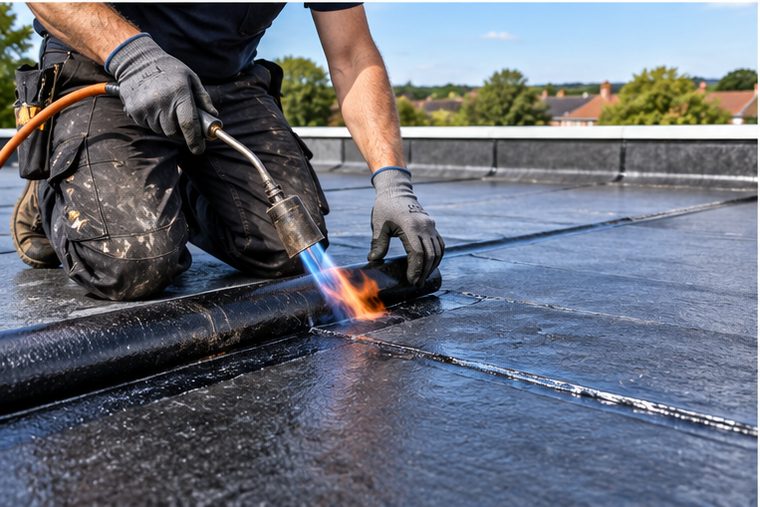
The first visit is about stopping the roof doing further damage, not about curing the fault. Depending on what has happened that might be:
Sheeting over an open area, weighted and tied rather than nailed through anything that will have to be repaired later.
Temporarily refixing or removing something that has moved. Removing is often safer than refixing in bad weather - a ridge tile taken down and put in the garden cannot fall on anybody.
Clearing a blocked outlet or gutter, which on a large flat roof is frequently the entire cause and takes minutes.
Getting water out of a ceiling void in a controlled way.
A make-safe should be described to you as a make-safe. If somebody sheets a roof and calls it the repair, that is the point to ask what the permanent work involves.
Because doing it properly needs three things that are not available at two in the morning in a gale: daylight, settled weather, and safe access.
Finding where water actually enters a roof means getting into the roof space, looking for the highest point staining reaches, and then examining the covering and everything uphill of it. On a large building it may mean a tower or a scaffold rather than a ladder.
It also frequently means establishing whether the storm caused the damage or found it - which matters for what you do next and for any insurance conversation, and which cannot be judged from a torch beam in the rain.
So the honest sequence is: make it safe now, come back and work out what failed. Two visits, and the second one is the one that stops it happening again.
On the industrial estate and the commercial units around Queensferry, Shotton and Connah's Quay there are extra practicalities that shape everything.
Access. Large flat and shallow-pitched roofs rarely take a ladder. They need a tower, a scaffold or a mobile platform, and getting one onto a working site needs space, timing and somebody who can authorise it.
Fragility. Older rooflights and some sheet materials will not carry a person and give way without warning. Falls through fragile roof surfaces are one of the most persistent causes of serious injury in construction. If a roof needs staging and boards, it needs them, and anybody offering to nip up in the dark without them is a liability to you as well as to themselves.
Authorisation. Emergency work usually has to start before anybody has approved a figure. Tell us who signs things off and we will work to that rather than stopping halfway.
Trading. Whether we can be on the roof during opening hours, and whether an area below needs closing off, are worth settling on the phone rather than on arrival.
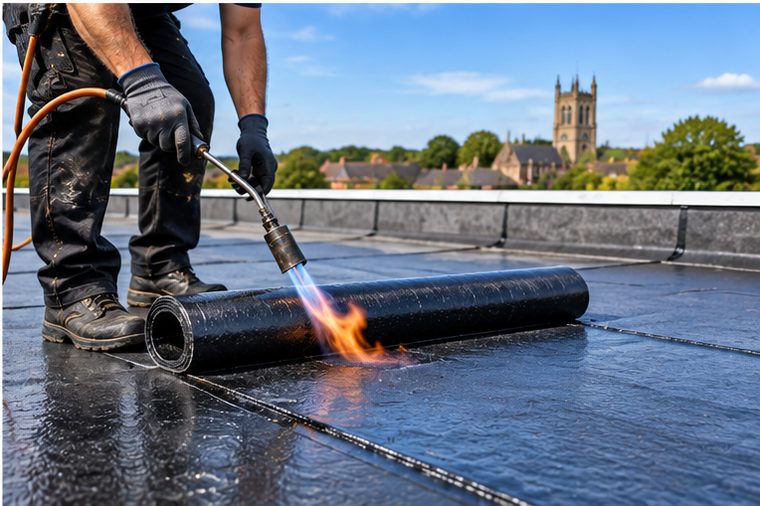
For an insurance conversation, the useful thing from us is a written assessment naming the defect and its location - not a bare invoice. That is what an insurer actually wants and it is more use than a photograph of a wet ceiling.
We are roofers rather than loss assessors and we will not tell you what your policy covers. What we can do is describe what failed, where, and whether in our view it is damage or deterioration - and let you and your insurer take it from there.
Most policies expect reasonable steps to prevent further damage, which is what the make-safe is, so that part is rarely contentious. A full permanent repair before an assessor has been is worth asking about first.
The rest of the series, on the questions people ask most.
Every town has its own page, written around what the roofs there are actually like. Start with the main roof repairs page.
“job well done good communication throughout the job very clean and tiddy when the job is finish flat roof replacement many thanks.”
Sumit Bal“Rapid response and fair pricing. Good workmanship. Pleasant staff.”
Ben Green“Very professional efficient team great communication
Would definitely recommend made the process quick and easy will definitely look to keep for any future need
Thankyou”
Describe what is happening and roughly where you are, and we will come back to you — usually the same day. If water is coming in now, please call instead.
Prefer to talk? Call 07464 259566 · WhatsApp 0044 7464 259566 · Email Evensbuddy@yahoo.com
We cover Chester, Cheshire, the Wirral and Flintshire from Elton, just north of Chester.
2 Manley View
Elton
Chester
CH2 4QF
Almost all of our work happens at your property rather than here, so please call before travelling.
Monday – Friday — 24hrs — Emergency Call-Outs
Saturday — 8:00 – 19:00
Sunday — 8:00 – 19:00
Weekday emergency call-outs are answered around the clock. Weekend cover is 8:00 to 19:00.