★★★★★
“job well done good communication throughout the job very clean and tiddy when the job is finish flat roof replacement many thanks.”
Sumit BalYes, given long enough - and the place it happens first is almost always the eaves, where the roof sits on the wall.
Roof timber gets wet from time to time and always has. Rain finds its way past a covering occasionally, condensation forms on cold nights, and none of that causes decay, because the timber dries again.
Decay needs sustained moisture. Wood-destroying fungi need timber above roughly twenty per cent moisture content and they need it to stay there - weeks and months rather than days. Below that they cannot get established at all.
So the question is not whether water got in. It is whether the timber ever gets a chance to dry out afterwards.
A roof space that breathes will dry a wetted rafter between wettings and nothing happens. A roof space that does not will hold that moisture, and the same leak produces decay.
The commonest reason a loft stops breathing is insulation pushed too far out over the wall plate at the eaves, blocking the gap that air is supposed to move through. It happens constantly when insulation is topped up, and it is invisible unless somebody goes and looks.
That is also why the eaves are where decay starts. It is the coldest part of the roof, the least ventilated once the gap is blocked, and structurally the most important, because it is where the rafter feet sit on the wall plate and transfer the roof load into the wall.
Tile goes. Underlay exposed and eventually fails over that area. Water reaches the battens and the rafter tops.
One season: damp timber, wet insulation, possibly a ceiling stain. Battens softening where the water lands. No structural issue.
Two to three seasons: battens that will no longer hold a fixing, so the tiles around the original gap start slipping too. Surface decay on rafter tops. Still repairable as roofing rather than as carpentry, but the job has grown.
Longer, with poor ventilation: decay into the rafter itself and into the wall plate. That is structural work - cutting out and splicing rafter feet, or renewing a length of plate - and it is a different trade bill from a tile.
The point is not that a missing tile brings a roof down. It is that the repair moves from roofing to carpentry somewhere between year one and year three, and nobody notices the crossing.
Between Queensferry, Shotton, Connah's Quay and the industrial park there is a great deal of commercial and light industrial property, and the same principle applies with different components.
On a profiled sheet roof the equivalent of a missing tile is a lost or loosened sheet, a failed lap or a corroded fixing. Water then reaches the purlins and, on older buildings, the steelwork - where the problem is corrosion rather than rot, and it is just as progressive.
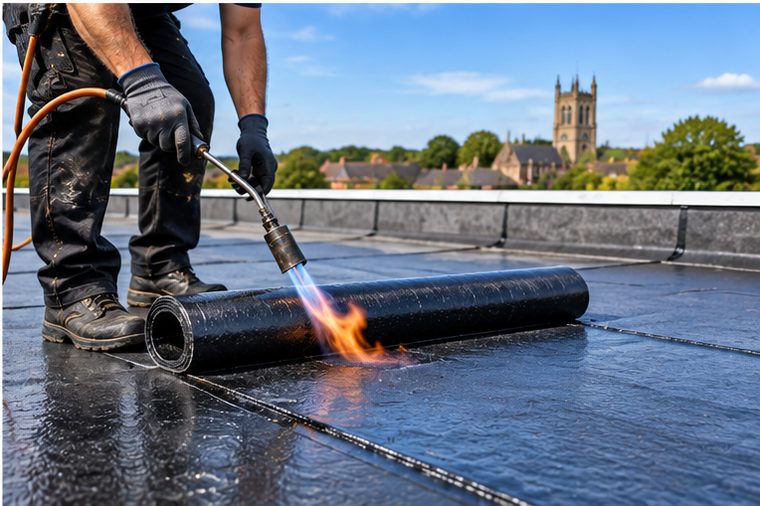
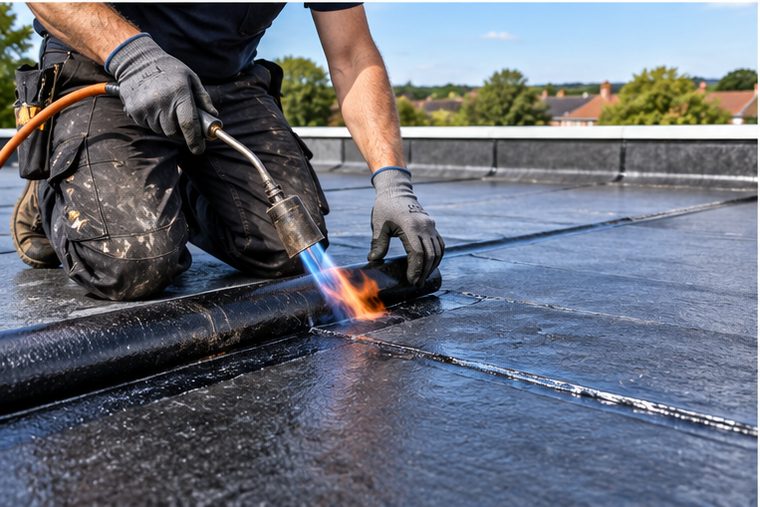
On a large flat roof it reaches the deck and the insulation. Wet insulation in a warm-deck build-up does not dry, and a saturated deck will not take a new covering later, which is how a small leak turns into a full replacement rather than an overlay.
And the urgency on a commercial building is set by what is beneath it. A leak over a storeroom is an inconvenience; over stock, machinery or an electrical panel it needs a make-safe in hours. Tell us what is under it when you call.
On any repair after a gap has been open for a while, ask what the battens were like and whether the rafter tops were sound. That is a question with a specific answer, and it is the difference between a repair and a repair that will not hold.
Ask whether the eaves ventilation is clear while somebody is up there, because it costs nothing to check and it is what decides whether the next wetting matters.
And if timber has genuinely decayed, ask for it to be described rather than just priced. Surface decay on a rafter top is a very different finding from a soft wall plate.
The rest of the series, on the questions people ask most.
Every town has its own page, written around what the roofs there are actually like. Start with the main roof repairs page.
“job well done good communication throughout the job very clean and tiddy when the job is finish flat roof replacement many thanks.”
Sumit Bal“Very professional efficient team great communication
Would definitely recommend made the process quick and easy will definitely look to keep for any future need
Thankyou”
“Rapid response and fair pricing. Good workmanship. Pleasant staff.”
Ben GreenDescribe what is happening and roughly where you are, and we will come back to you — usually the same day. If water is coming in now, please call instead.
Prefer to talk? Call 07464 259566 · WhatsApp 0044 7464 259566 · Email Evensbuddy@yahoo.com
We cover Chester, Cheshire, the Wirral and Flintshire from Elton, just north of Chester.
2 Manley View
Elton
Chester
CH2 4QF
Almost all of our work happens at your property rather than here, so please call before travelling.
Monday – Friday — 24hrs — Emergency Call-Outs
Saturday — 8:00 – 19:00
Sunday — 8:00 – 19:00
Weekday emergency call-outs are answered around the clock. Weekend cover is 8:00 to 19:00.