★★★★★
“The men were genuine and trustworthy. Turned up every time when they said they would, and phoned ahead. Very respectful and did an amazing job.,thank you x”
freda markham
A Crewe terrace has no drive, so the scaffold, the mortar and every barrow of rubble go in and out down a shared back entry. Pointing, heads, lead, pots and rebuilds, planned round that.
Crewe is a railway town and it is laid out like one. The grid of streets west and north of the station — Mill Street, West Street, Earle Street, Edleston Road and on out through Coppenhall and Hightown — went up as rows of two-up two-downs for people working the works: front doors straight onto the pavement, a small paved yard at the back, and an entry running the length of the block between two facing rows of yard walls.
The stacks follow the plan exactly. They are identical to one another, they stand on the party lines at or very near the ridge, and they were built as part of a terrace rather than as part of a house. What governs every job on one of them, though, is not the stack. It is the plot. There is no drive, no side passage and nowhere on the property to stand a wagon, and the only routes to the back of the house are the entry or the hall.
Roofline Solutions handles the outside of those stacks: raking out and repointing, cutting off and re-forming heads, part rebuilds, lead aprons, soakers, stepped flashings, back gutters and ridge saddles, pots, cowls and bird guards, and taking a stack down to roof level. Flue lining, sweeping and anything to do with an appliance are not roofing and go to a HETAS or Gas Safe registered installer and a chimney sweep. The rest of what we do is on the main chimney repairs page.
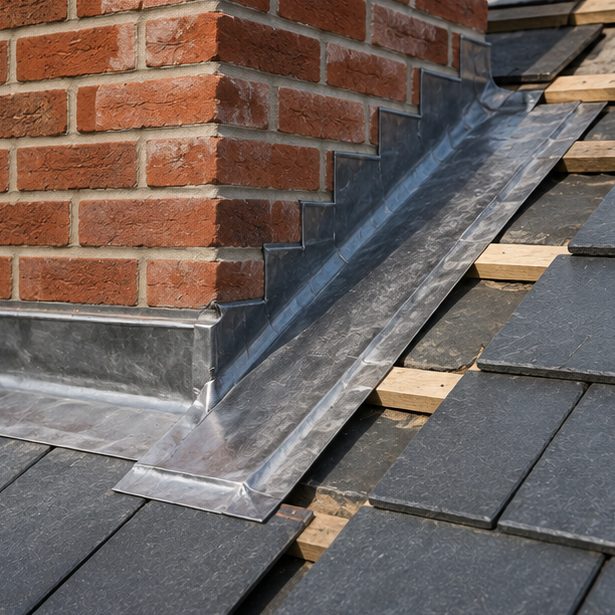
Images above are for illustration purposes only.
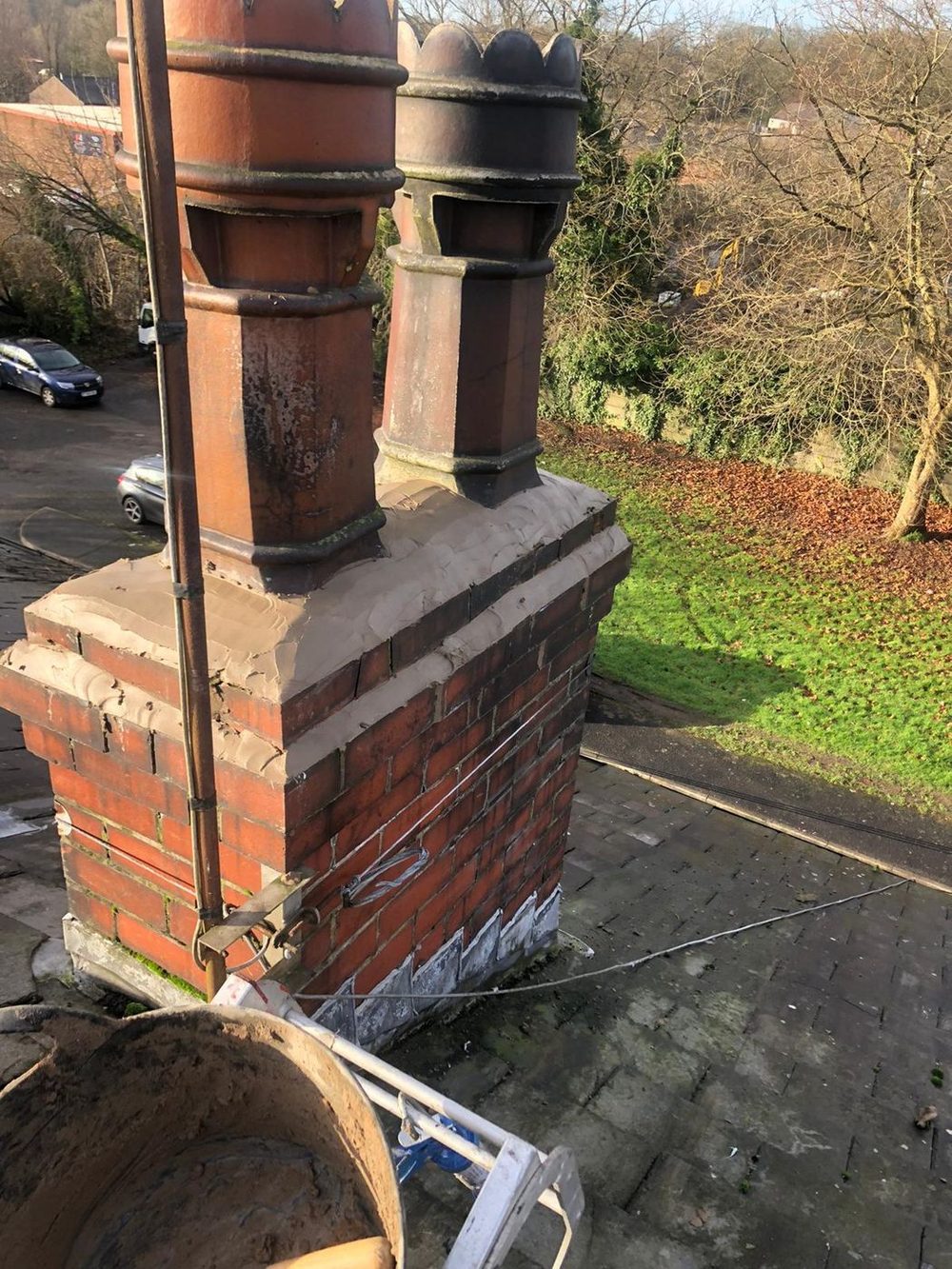
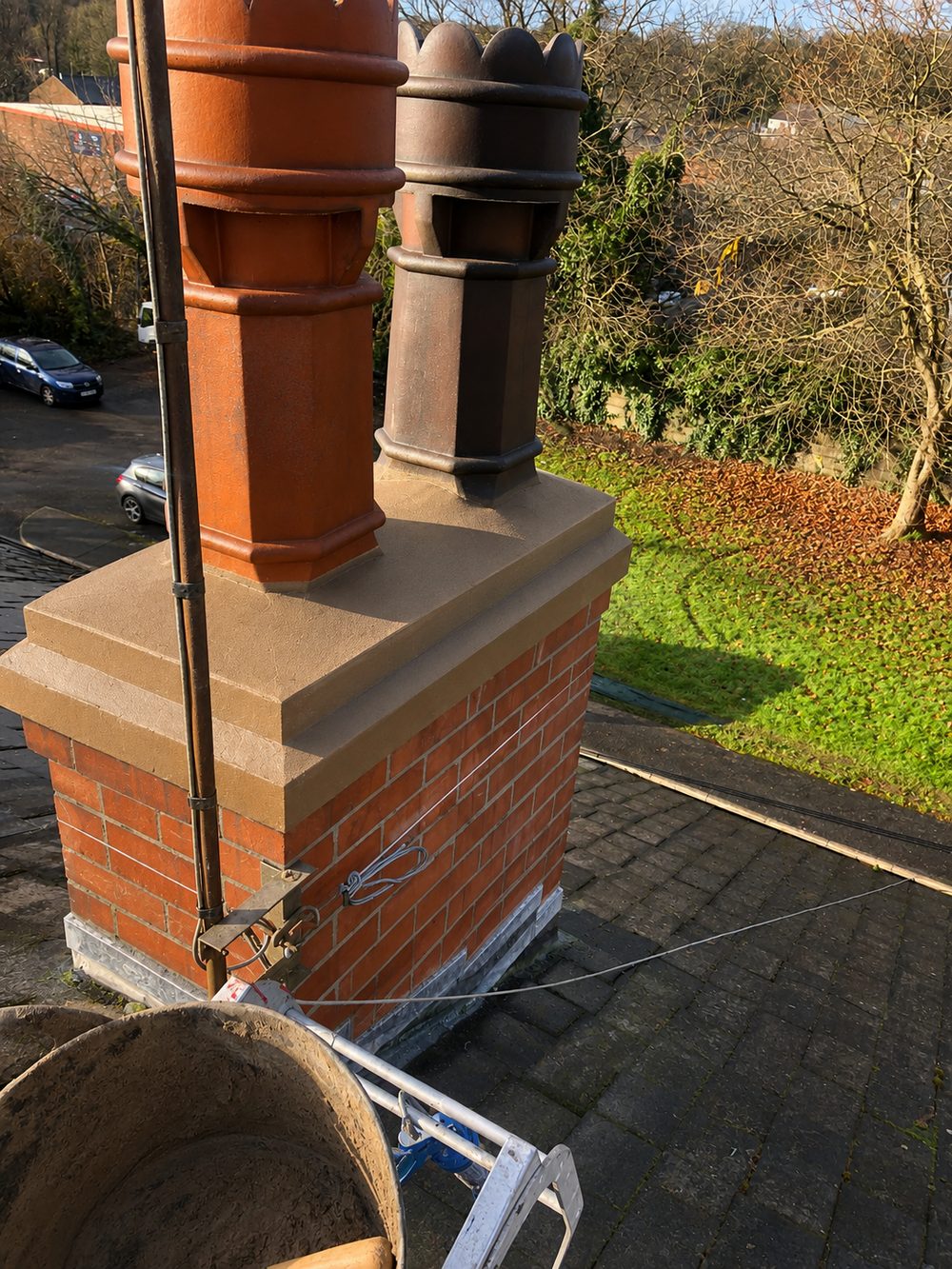
Photographs of our own chimney work. There are more on the main chimney repairs page and in the gallery.
The first thing to understand about the entry is who it belongs to. It is typically a couple of metres wide, in many cases unadopted, and it is a shared right of way for every house on both sides of the block — a service route for forty families, not a private drive. On some streets residents have put gates on both ends and the key is held house by house. In practice it is half occupied by wheelie bins, a meter box, somebody’s shed and, quite often, a rear extension built out across a yard. It cannot be blocked, it has to stay walkable for the neighbours, and it must be clear on bin day. Everything else follows from that.
What it does to a scaffold is specific. Tube comes in lengths up to about six and a half metres, boards in spans to suit. An entry two metres across, with a right-angle turn through a yard gate that may be no more than eight hundred millimetres wide, will not take a full-length tube round the corner however it is handled. So the material for a terrace scaffold is specified in shorter lengths before it is loaded onto the wagon, and the wagon itself stands on the street while the lot is carried the length of the entry by hand. Where that is genuinely impossible, the alternatives are a licensed platform over the footway at the front, or tube and boards through the house.
Then there is getting the waste out. Taking the head off a terrace stack produces a real weight of broken brick and old mortar, and none of it can simply be dropped, because underneath the scaffold is a small yard, very often a glass roof over a rear addition, and an entry with other people walking down it. It comes down in barrows and bags, and then it has to leave the block, either into a skip on the street, which needs a permit and has to be lit and marked, or bagged up the entry to a van. It is simply the part of a terrace chimney job that is worked out before a date is offered.
A terrace yard is a small hard surface sitting directly beneath the roof, and as a collector it beats a lawn every time. Learn what turns up on the flags. Sandy crumbs and thin curved flakes with a red face are brickwork letting go. Grey lumps with one smooth sloping face are pieces of flaunching off the head. Sharp, hard, ruddy fragments with a curve to them are pot. The gully in the corner of the yard is the other collector, and one that silts up with grit every few months says the head is washing into the gutter a little at a time.
The entry is also, oddly, the best view of your own chimney you will get from the ground. From your front door you are too close and the terrace is in the way; thirty metres down the entry you are in line with the rear slopes of the whole row. Take binoculars and check four things: whether the mortar around the base of the pots has broken up or gone, whether the head has lost its shape, whether the roof junction is lead or a grey fillet, and whether the ridge tiles either side of the stack are sitting down or have lifted. Indoors, watch the bedroom chimney breast and the ceiling at the top of the stairs.
Where the entry will not serve, the front of the house has to, and a terrace frontage has no set-back at all — the wall is on the pavement, so the standards stand in the public highway from the first lift and the platform is over the footway for its full height. That means a licence from Cheshire East Council, the parking bay underneath suspended, and the structure built so people can still get past: either a clear walkway kept to one side or a proper boarded gantry through it, because that pavement is the only route for the rest of the row.
The roof itself is the other half of the problem. A mid-terrace stack sits astride the party line at the ridge, which is the highest point of the building, and it has to be reached from a base in a yard that may be four metres square — a tall, narrow scaffold, which needs properly designed tying into the front and rear elevations. The covering is usually original Welsh slate on original battens with century-old nails, so it is brittle and not walked on; the stack is worked from the platform, and any slate broken in the course of the job is replaced.
Because the stack straddles the ridge, the lead set on a terrace is not the one most people picture. There is frequently no back gutter at all: instead the ridge runs into the brickwork from both directions and the junction is weathered with a lead saddle, dressed over the ridge line and turned into the courses, with soakers and a stepped cover flashing running away down each slope and a small apron on each face. That saddle is the piece that gets skimped, and the usual substitutes are a wedge of mortar or a lump of mastic where the ridge tile meets the brick, both of which crack within a season or two. On a slate roof the soakers are invisible once the slates are back down, so nobody can tell from the yard whether they are there at all.
Handling on a terrace shapes the leadwork as much as the detailing does. A roll of lead is heavy and unwieldy and has to go up a tight scaffold by hand, so pieces are cut and set out on the ground and taken up in order. Old pots come down one at a time on a line for the same reason: below the platform is a yard and an entry with people in it. The pots on these rows are usually plain cans, and a bird guard has to be sized to the rim that is actually up there rather than bought by the box.
Repointing, flaunching, stack rebuilds and removals, lead aprons, soakers, stepped flashings and back gutters, pots, cowls and bird guards — and the roof around the stack when it needs attention at the same time.
“The men were genuine and trustworthy. Turned up every time when they said they would, and phoned ahead. Very respectful and did an amazing job.,thank you x”
freda markham“Very professional efficient team great communication
Would definitely recommend made the process quick and easy will definitely look to keep for any future need
Thankyou”
“A great team that really looked after us and have continued to support us. I wouldn’t hesitate to use roofline again or recommend them to family and friends. Buddy takes pride in his work and customer service.”
Samantha MerrickWritten for homeowners working out which part of a chimney has failed, before anyone comes out.
Every town below has its own page, written around the stacks that are actually on the roofs there.
Describe what you can see and roughly where you are, and we will come back to you — usually the same day. If water is coming in now, please call instead.
Prefer to talk? Call 07464 259566 · WhatsApp 0044 7464 259566 · Email Evensbuddy@yahoo.com
We cover Crewe from our base at Elton, just north of Chester.
2 Manley View
Elton
Chester
CH2 4QF
Almost all of our work happens at your property rather than here, so please call before travelling.
Monday – Friday — 24hrs — Emergency Call-Outs
Saturday — 8:00 – 19:00
Sunday — 8:00 – 19:00
Weekday emergency call-outs are answered around the clock. Weekend cover is 8:00 to 19:00.